On March 30, 1939, test pilot Hans Dieterle pushed the Heinkel He 100 V8 past 746 kilometres per hour over a measured course near Rostock — setting an absolute world speed record for piston-engine aircraft. The Heinkel was faster than every fighter in the world. It was faster than the Messerschmitt Bf 109, faster than the Spitfire, faster than anything the Americans or Japanese were building. And the Luftwaffe did not want it.
The story of the He 100 is one of aviation’s great tragedies: a fighter that won every performance test, broke world records, and was killed not by engineering failure but by bureaucratic politics and industrial jealousy. It remains one of the most tantalising “what ifs” of the Second World War.
Quick Facts
Manufacturer: Heinkel Flugzeugwerke
First flight: January 22, 1938
World speed record: 746.6 km/h (463.9 mph) — March 30, 1939
Engine: Daimler-Benz DB 601 (1,175 hp)
Cooling system: Revolutionary evaporative surface cooling (no external radiator)
Built: ~25 aircraft (12 He 100D pre-production fighters)
Fate: Rejected by the Luftwaffe; used for factory defence and propaganda
Ernst Heinkel’s Obsession With Speed
Ernst Heinkel was a man possessed by velocity. His company had built the world’s first jet-powered aircraft (the He 178) and the first rocket-powered aircraft (the He 176). The He 100 was his masterpiece in conventional fighter design — an aircraft engineered from the ground up to be the fastest possible piston-engine fighter.
The Heinkel He 100 V8 — one of the fastest piston-engine fighters of the late 1930s, rejected by the Luftwaffe for political reasons. Wikimedia Commons
The key innovation was the cooling system. Conventional liquid-cooled fighters used external radiators — bulky scoops that created drag and added weight. Heinkel’s engineers replaced the radiator entirely with an evaporative surface cooling system. Engine coolant was circulated through a network of passages built into the wing skin itself, where the heat was dissipated directly into the airstream. The result was an airframe with no drag-inducing radiator bulge — just clean, smooth wing surfaces that sliced through the air with minimal resistance.
The performance numbers proved the concept. The He 100D — the intended production variant — reached speeds over 670 km/h in level flight at altitude, roughly 50 km/h faster than the contemporary Bf 109E. Its climb rate was competitive, its roll rate was excellent, and its handling was described as responsive and predictable.
Why the Luftwaffe Said No
The rejection of the He 100 was not about the aircraft. It was about power.
By 1938, the Luftwaffe’s procurement apparatus was tightly controlled by Ernst Udet, the head of the Technical Office, and his allies within the ministry. Messerschmitt had already secured the Bf 109 as the standard German single-engine fighter, and Udet saw no reason to disrupt production lines, retrain pilots, and reorganise logistics for a competing design — no matter how fast it was.
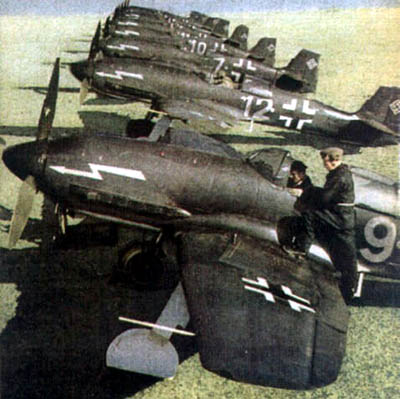
A colourised image of the He 100D — the production variant that was faster than the Bf 109 but never entered Luftwaffe service. Wikimedia Commons
There were technical objections too, though historians debate whether they were genuine or manufactured to justify a political decision. The evaporative cooling system was fragile — a single bullet hole in the wing surface could drain the coolant and kill the engine. In combat, where battle damage is inevitable, this was a legitimate vulnerability. The Bf 109’s conventional radiator could absorb minor hits and keep functioning. The He 100’s cooling system could not.
But speed is its own form of survivability. An aircraft that is 50 km/h faster than everything else can choose when to fight and when to run. The He 100’s supporters argued that its speed advantage more than compensated for the cooling vulnerability. The debate was never resolved on merit — it was settled by institutional inertia and the fact that Messerschmitt had better political connections.
Propaganda, Not Combat
Unable to sell the He 100 to his own air force, Heinkel offered it for export. Japan and the Soviet Union both acquired examples for evaluation. The Japanese were impressed enough to study the design, and the aircraft that Heinkel sold to the Soviets was tested extensively at the Nil VVS research institute in 1940.
The twelve He 100D pre-production fighters that remained in Germany were never deployed to a combat unit. Instead, the Luftwaffe repainted them in multiple fictitious unit markings and paraded them before journalists and foreign diplomats, creating the impression that the “He 113” (a deliberately misleading designation) was in widespread squadron service. The propaganda campaign was remarkably successful — Allied intelligence spent months hunting for He 113 units that did not exist.
The surviving aircraft ended up as factory defence fighters, guarding Heinkel’s own plants against Allied bombing raids. It was an inglorious end for a world-record holder — the fastest fighter of its generation, reduced to a glorified security guard because the men who ran the Luftwaffe preferred politics to performance.
Sources: Heinkel He 100 historical records, aviation archives, William Green’s “Warplanes of the Third Reich”
Three months after Israeli fighter jets struck targets deep inside Iran, Jerusalem is doubling down on airpower. On May 3, Israel's Ministerial Committee on Procurement approved the purchase of two full squadrons — 25 F-35I Adir stealth fighters and 25 F-15IA strike...
Quick FactsNationalityPakistani 🇵🇰Aerial Victories9 (5 in under 60 seconds — world record sortie)Aircraft FlownF-86 SabreWars1965 Indo-Pakistani WarBorn / Died6 Jul 1935 – 18 Mar 2013 (age 77)UnitNo. 11 Squadron PAF "Arrows" Mohammad Mahmood Alam 1965 — via Wikimedia...
In 1936, American Airlines president C.R. Smith made an audacious request to Donald Douglas: build an airliner that could carry passengers across America in 16 hours and make money doing it. The result was the Douglas DC-3 — an aircraft so well-designed that it...





 English
0 Comments