
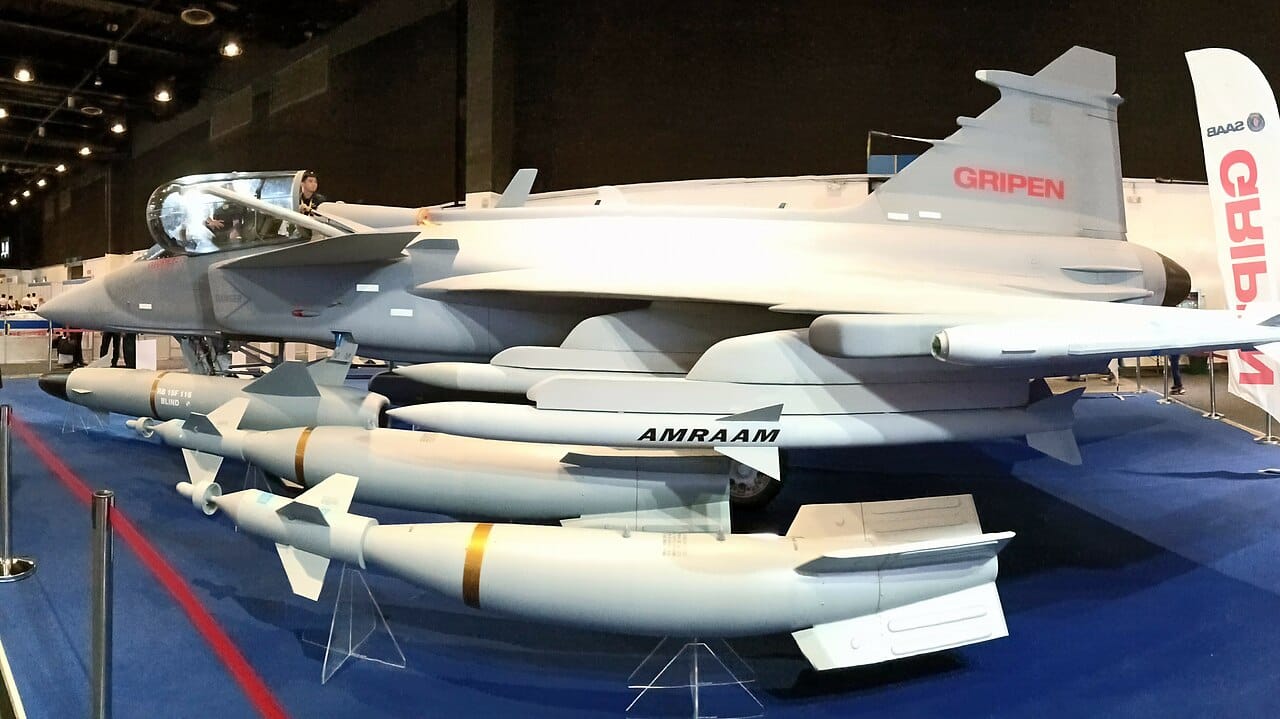
First Time Since 1937
Saab has been building fighter jets in Sweden since the company was founded 89 years ago. Until now, every single one rolled off a Swedish production line. “This is the first time since 1937, when Saab was founded, that a fighter aircraft is manufactured outside Sweden,” said Micael Johansson, Saab’s President and CEO. “It symbolises the strength of a partnership built on trust, long-term vision, and true cooperation.” The rollout was not a quiet industrial event. President Lula da Silva attended alongside Defense Minister José Múcio Monteiro Filho and Swedish Ambassador Karin Wallensten. The Brazilian Air Force’s commander, Lieutenant Brigadier Marcelo Kanitz Damasceno, called the milestone “the real expression of a ‘Supersonic Brazil.’” The aircraft took roughly two years and ten months to build from the start of structural production. Its aerostructures were manufactured at Saab’s facility in São Bernardo do Campo before final assembly at Embraer’s Gavião Peixoto plant.A Club With Very Few Members
Building a modern fighter jet — even under license — requires an industrial ecosystem that most countries simply do not have. Precision metalwork, avionics integration, flight control software, engine handling, weapons systems testing. The list is long and unforgiving. The nations capable of producing 4th-generation-or-better fighters domestically can be counted on two hands: the United States, Russia, France, China, Sweden, India, South Korea, and now Brazil. Turkey’s TF Kaan is approaching that threshold. Japan collaborates on the GCAP program. Everyone else buys off the shelf. Brazil’s route is different from South Korea’s KF-21, which is a fully indigenous design. The F-39E is a Swedish aircraft built under a comprehensive technology transfer agreement. But the distinction matters less than the result: Brazilian engineers, Brazilian workers, Brazilian factories producing a supersonic combat jet that can exceed Mach 2 and perform air-to-air combat, ground attack, reconnaissance, and air defense missions. Francisco Gomes Neto, Embraer’s CEO, was blunt about where this leads: “Our Gavião Peixoto plant is fully prepared to manufacture new Gripens for other countries.”"Victory smiles upon those who anticipate the changes in the character of war."
— Giulio Douhet, The Command of the Air
The Export Angle
That last quote is not just corporate optimism. Colombia signed a $3.6 billion deal for 17 Gripens — 15 E-models and 2 F trainers — with deliveries running from 2026 to 2032. Colombian President Gustavo Petro framed the acquisition as a “strategic alliance with Brazil,” focused on combating drug traffickers and protecting the Amazon region. If those jets are assembled in Gavião Peixoto rather than Linköping, Brazil becomes not just a fighter operator but a fighter exporter — a status that reshapes the regional balance of aerospace power in South America. The program has already created over 12,000 jobs in Brazil, with roughly 350 Brazilian engineers trained in Sweden during the technology transfer phase. Eleven of the 36 contracted Gripens (28 single-seat F-39E and 8 two-seat F-39F) have been delivered to date. The remaining aircraft will increasingly come from Brazilian hands. Since February 2026, Brazilian Gripens have been flying Quick Reaction Alert missions from Anápolis Air Force Base, protecting the airspace over Brasília. Sweden’s fighter. Brazil’s wings. Sources: Saab, Embraer, Aviation Week, The Defense Post, AeroTimeRelated Questions
What is the Saab Gripen E?
The Saab Gripen E is a modern Swedish multirole fighter, designated F-39E in Brazilian service. The first Brazilian-assembled example, serial FAB 4109, rolled out of Embraer's Gavião Peixoto plant in March, making Brazil the first Latin American country to assemble a modern supersonic combat aircraft.
Where are Gripen fighters built?
Gripen fighters were built exclusively in Sweden from Saab's founding in 1937 until Brazil began assembling them locally. Aerostructures for Brazil's jets are made at Saab's São Bernardo do Campo facility, with final assembly at Embraer's Gavião Peixoto plant — the first Saab fighter manufactured outside Sweden.
Which countries can build their own fighter jets?
Only a handful of nations can domestically produce fourth-generation-or-better fighters, including the United States, Russia, France, China and Sweden. Building a modern jet demands precision metalwork, avionics integration, flight-control software and weapons testing. Brazil joined this group through its Gripen assembly program.
How long does it take to build a fighter jet?
Brazil's first locally assembled Gripen E took roughly two years and ten months from the start of structural production to rollout. Even building a jet under license demands a long, complex industrial process spanning aerostructures, systems integration and final assembly.
Why is Brazil building its own fighter jets?
Local assembly builds Brazil's aerospace industry, transfers technology and reduces dependence on foreign production. The partnership with Saab and Embraer is part of a wider push, including talks to swap aircraft with India, that positions Brazil as a serious aviation manufacturer.
0 Comments