
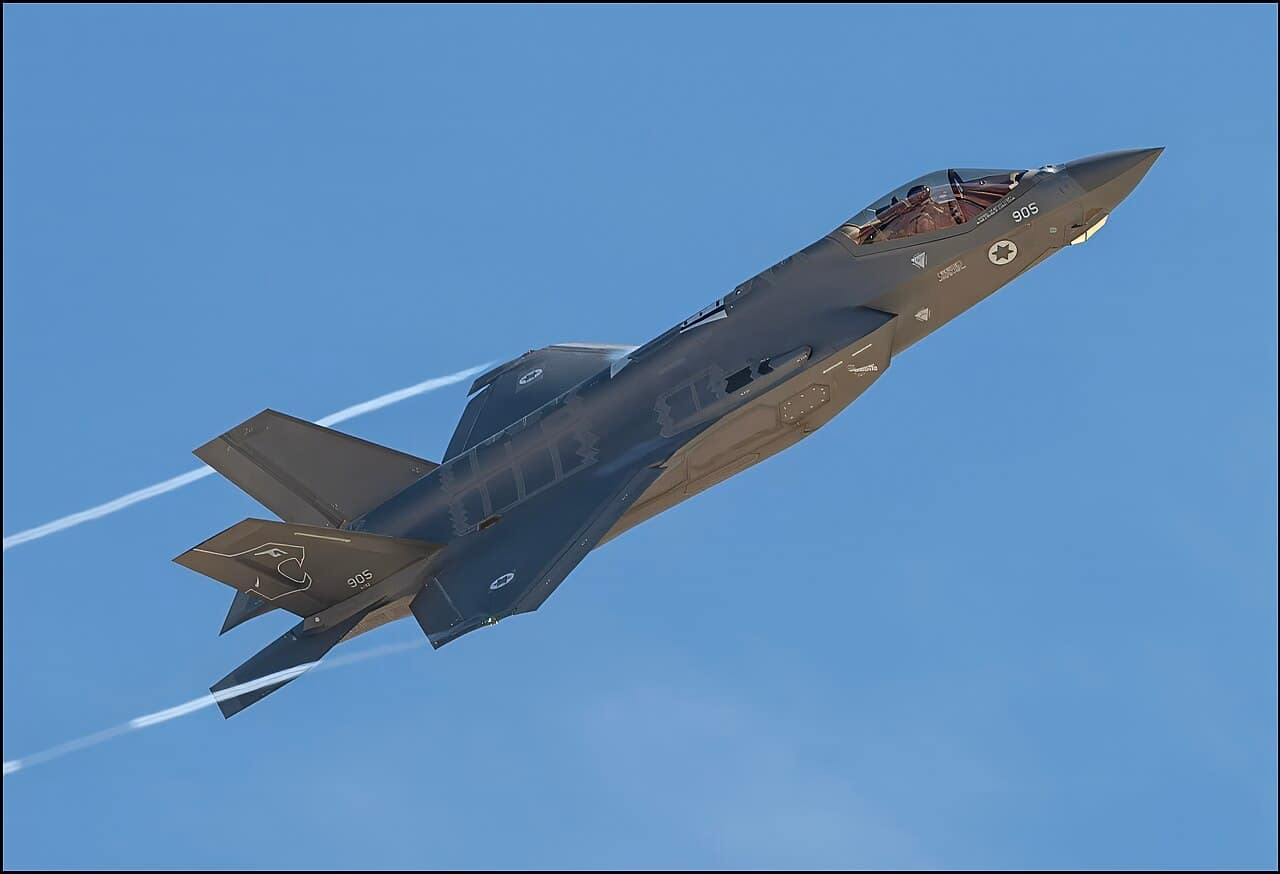
For the better part of a quarter-century, Lockheed Martin has held a hard line on one engineering principle of the F-35 Lightning II: no external fuel tanks. The aircraft was designed to be stealthy, and stealth means an unbroken radar cross-section. The moment you hang a fat fuel tank under a wing, the radar cross-section breaks, the stealth coating thermal envelope changes, and the design assumption falls apart. Customers who wanted more range than the internal 18,000-pound fuel load could provide were told, politely and firmly, to buy more aerial tankers.
This week, Israel told Lockheed it was no longer asking. On 14 May 2026 the Israeli Ministry of Defense signed a contract with Cyclone Aviation Products — an Elbit Systems subsidiary at Karmiel — to develop external fuel tanks for the F-35I “Adir.” Israel will design and produce them itself, in-country, and use them on its own jets. After flying the longest combat operations in F-35 history against Iran, Israel has decided that the stealth penalty is worth the range gain. And nobody in Washington said no.
| Aircraft | Lockheed Martin F-35I “Adir” (Israeli Air Force variant) |
| Modification | External drop tanks (size and capacity undisclosed) |
| Developer | Cyclone Aviation Products (Elbit Systems subsidiary), Karmiel |
| Contract value | “More than tens of millions of US dollars” — Israel MoD |
| First flight target | Estimated late 2027 |
| Operational benefit | Reduced dependency on KC-46/KC-135 tankers for long-range strikes |
The Iran war proved the range problem
Israeli F-35Is reportedly flew sorties of more than 2,400 km from their bases at Nevatim and Tel Nof to targets across Iran during the spring 2026 Israeli–American air campaign — sorties that required multiple aerial refuellings from Israeli Air Force Boeing 707-based tankers, KC-46As, and US Air Force KC-135s. The aircraft handled the missions. The tanker fleet, far more thinly stretched, became the binding constraint.
External fuel tanks would change that calculus. A pair of 600-gallon (≈ 2,270 litre) drop tanks roughly doubles the F-35’s combat radius, at the cost of some manoeuvrability, some stealth, and several knots of top speed. The tanks would be carried inbound, jettisoned before entering contested airspace, and the aircraft would complete the strike penetration in clean configuration. The result: longer reach with stealth preserved over the target.
Why Lockheed used to say no
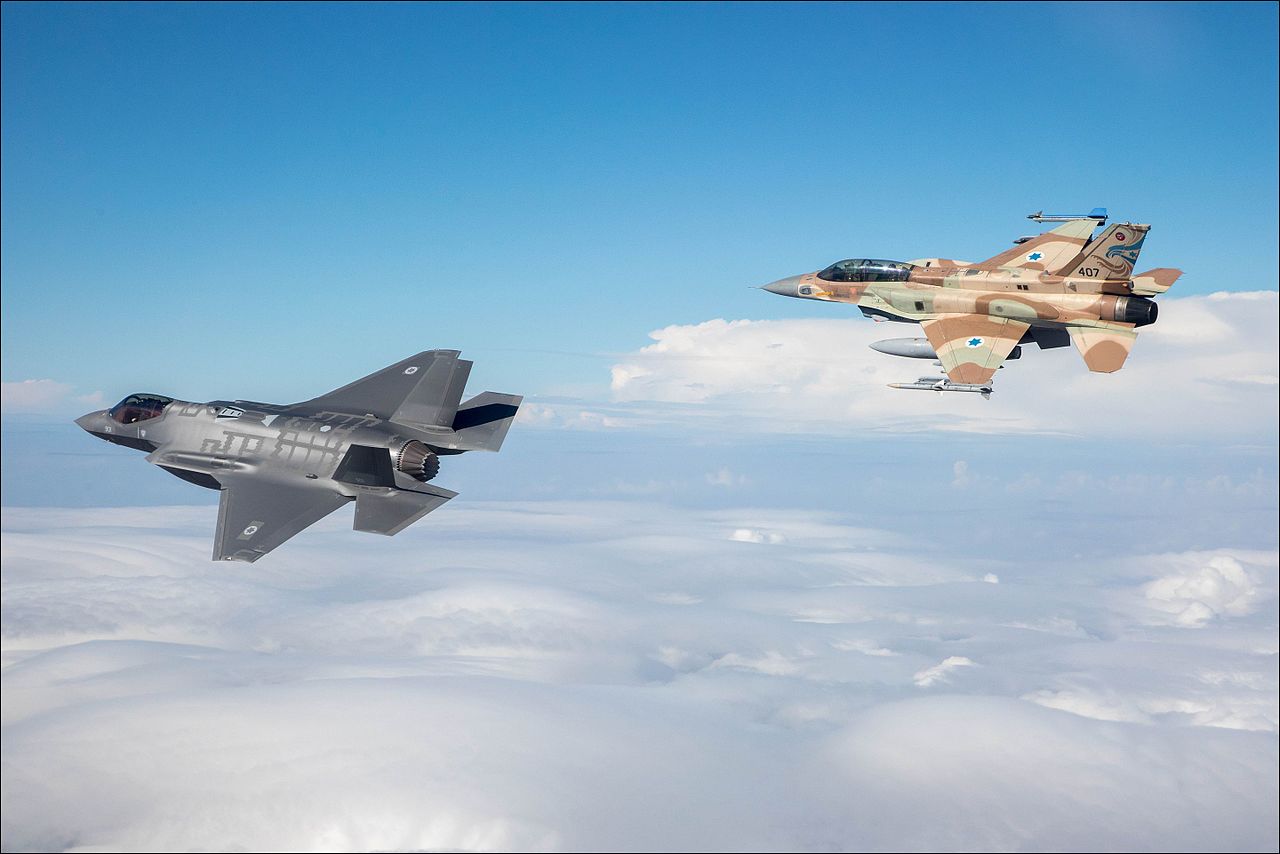
The F-35 was designed with internal fuel tanks because the Joint Strike Fighter requirements document of the late 1990s explicitly prohibited external stores in the penetrating-strike role. The whole point of the aircraft is to push deep into a hostile integrated air defence system, drop two GBU-31s out of its internal weapons bays, and exit the way it came — without ever lighting up a hostile radar. Hanging external tanks under that aircraft, even for the inbound leg, complicates every part of the design.
Lockheed Martin offered conformal fuel tanks (CFTs) as an alternative — fitted flush to the upper fuselage in the way Boeing did for the F-15E — but the engineering challenges of integrating CFTs while preserving the upper-surface radar treatment proved harder than expected, and the programme was repeatedly deferred. Israel, fresh from a war that exposed exactly the limitation the CFT was meant to fix, decided it could not wait another decade.

A pattern of Israeli F-35 modifications
The F-35I “Adir” is the only F-35 variant Lockheed allows a foreign customer to modify with sovereign equipment. Israel has already replaced parts of the electronic warfare suite, integrated its own Rafael Spice precision-guided munitions, fitted Israeli command-and-control systems, and now will add external fuel tanks. Each of these modifications has been agreed individually with the US government — the only allied operator extended this latitude.
The export implications are subtle but significant. Once Israel demonstrates an external-tank F-35 that meets stealth and combat performance targets, other long-distance operators (Japan, Australia, possibly the UK for F-35B operations from the Queen Elizabeth class) may begin to ask Washington for the same. Lockheed Martin’s long-standing answer — buy more tankers — is becoming harder to defend.
Sources: The War Zone, The Aviationist, Israeli Ministry of Defense.
 English
0 Comments