
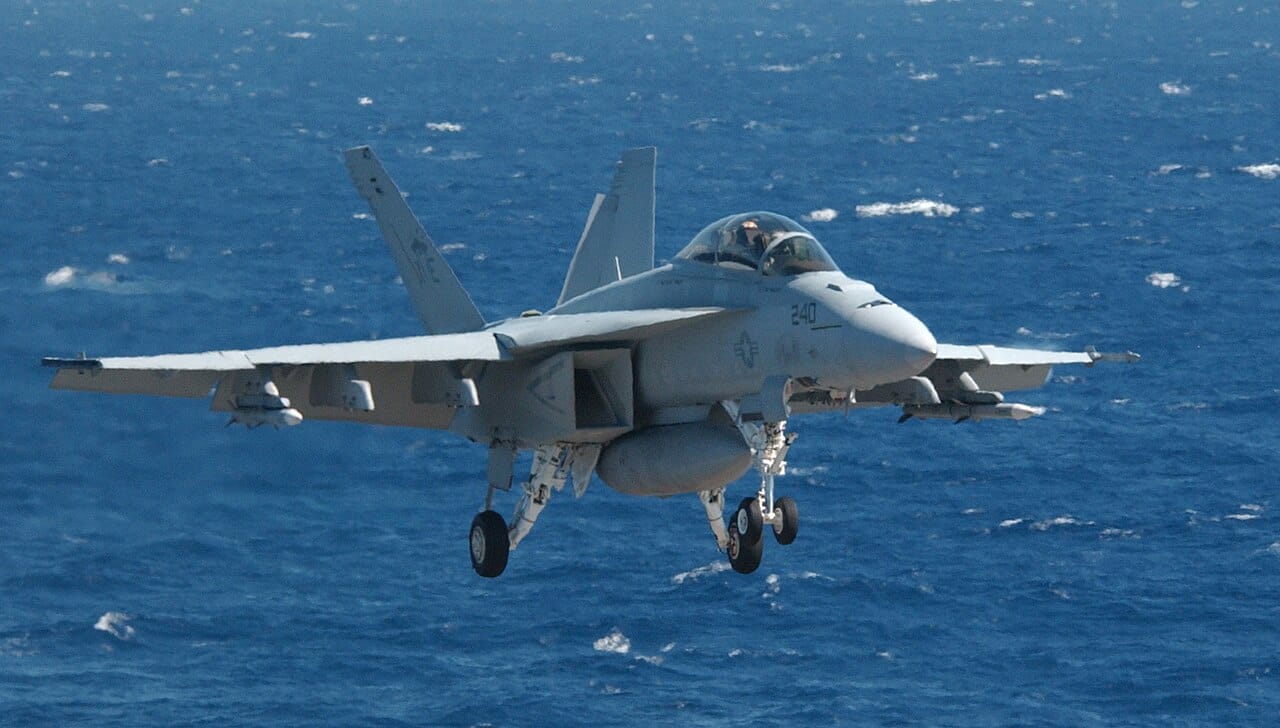
For more than five years, the AIM-260 Joint Advanced Tactical Missile has been one of the most carefully guarded weapons programmes inside the United States Department of Defense. There were no public photographs. No leaks. No images on any test range. The Pentagon would confirm the missile existed, that it would replace the AIM-120 AMRAAM, and that its range was “considerably greater.” Beyond that, the JATM was an outline on a budget line.
On 15 May 2026 that ended. A single photograph surfaced of a U.S. Navy F/A-18F Super Hornet from VX-9 — the Navy’s Air Test and Evaluation Squadron at China Lake — carrying what is unmistakably the JATM. The missile is now real. And it has been deployable on a Navy fighter long enough for someone to have photographed it on the ramp.
| Weapon | AIM-260A Joint Advanced Tactical Missile (JATM) |
| Manufacturer | Lockheed Martin Missiles and Fire Control |
| Replaces | AIM-120 AMRAAM (in service since 1991) |
| Carrier in first photo | F/A-18F Super Hornet, VX-9 “Vampires”, China Lake |
| Stated range | Classified — believed to exceed 200 km |
| Why it exists | Counter to China’s PL-15 (≈ 200 km) and Russia’s R-37M (≈ 300 km) |
Why the JATM exists
The AIM-120 AMRAAM was first fielded in 1991, in the heady atmosphere of the Soviet collapse and the F-15’s 100-0 air-to-air record. For a quarter-century it was the dominant beyond-visual-range missile in the world. It had a longer reach than the Russian R-77, it had a better seeker, it had an active radar terminal phase, and Western pilots could shoot first. That advantage is now gone.
China’s PL-15 — first publicly displayed in 2016, now in operational use on the J-10C, J-16 and J-20 — is credited with a range of approximately 200 kilometres against a non-manoeuvring target. Russia’s R-37M Vympel offers an even longer 300 kilometre range from the MiG-31BM and Su-35. By contrast, the latest AIM-120D-3 AMRAAM is rated at around 160 kilometres maximum. For the first time since the late 1970s, U.S. fighters are flying with shorter-ranged air-to-air weapons than their nearest peer competitors.

What we know about the missile itself
From the photograph and from previous public Pentagon statements, the AIM-260 appears to occupy roughly the same dimensional envelope as the AIM-120. That is deliberate: the missile must fit the existing internal weapons bays of the F-22 Raptor and F-35 Lightning II without requiring structural modifications. The seeker is believed to be a new active electronically scanned array (AESA) head with a wider field of view, mated to a dual-pulse rocket motor that allows the missile to coast at altitude and re-light its second stage for the terminal engagement — a sharply different energy profile from a conventional single-pulse motor.
Pentagon officials have publicly stated the missile entered initial operating capability with the U.S. Air Force in 2024 and that initial test shots from F-22s were completed in 2022. The new photograph confirms that the U.S. Navy has now integrated the missile onto the F/A-18F. Hand-in-hand with the longer-range AIM-174B — an air-launched derivative of the SM-6 — the Super Hornet now has two distinct long-reach options.
Why the photograph matters
A single image of a missile sitting on a pylon does not, on its face, reveal much. But VX-9 is not the development squadron — that is China Lake’s test cadre at NAWS, which is where developmental missile carriage trials happen years before service entry. VX-9 is the Operational Test and Evaluation squadron, the unit that confirms a weapon system is ready for fleet release. The photograph therefore indicates the AIM-260 has moved past developmental test and into operational evaluation on the F/A-18F. That is the last gate before broad fleet deployment.
The implications run from Taipei to Tehran. A U.S. Navy carrier group that can put AIM-260s on its Super Hornets is a different beast than one carrying only AIM-120s. Chinese PL-15-armed fighters can no longer assume they can engage from outside Western missile range. That balance was the cornerstone of Chinese counter-carrier doctrine for the last decade. It has just been quietly inverted.
Sources: The War Zone, The Aviationist, Aviation Week.



 English
0 Comments