
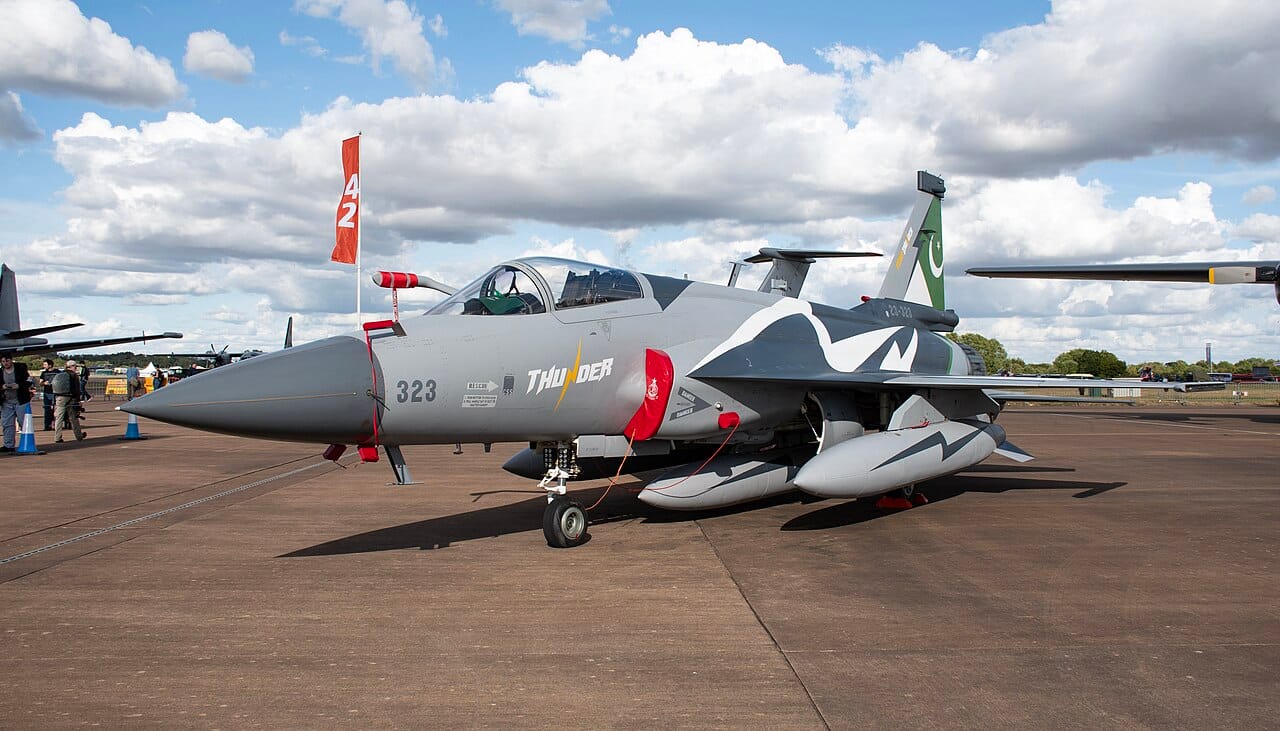
In May 2026, an unmarked Pakistan Air Force C-130J landed in Dhaka and unloaded a single very heavy crate. Inside was a fully operational combat simulator for the JF-17 Thunder Block III — the latest variant of Pakistan’s Chinese-built lightweight fighter. The simulator was delivered by a delegation led by Air Vice Marshal Aurangzeb Ahmed, the PAF Deputy Chief of Air Staff for Operations. It is the first piece of Pakistani military aviation hardware to enter Bangladesh since 1971.
That date matters. In 1971, Pakistan lost a brutal civil war to its eastern wing, which became Bangladesh. The two countries have spent more than half a century in cold mutual distrust. Now Bangladeshi pilots are about to train in the cockpit of a Pakistani fighter — and almost every defence analyst in South Asia reads it the same way. Bangladesh is buying 48 JF-17s.
| Aircraft | PAC/CAC JF-17 Thunder Block III |
| Joint manufacturer | Pakistan Aeronautical Complex + Chengdu Aircraft Industry Group |
| Transfer | Combat-grade simulator (not training-only), delivered to Bangladesh Air Force, May 2026 |
| Expected order | ≈ 48 JF-17 Block III aircraft |
| Strategic implication | First major Pakistan-Bangladesh defence deal since 1971 |
| Bangladeshi pilot training | First batch sent to Pakistan in early 2026 — first since independence |
Why this is not just a simulator
Combat-grade simulators are not introductory training devices. They model the actual avionics, weapons computer, radar, and electronic warfare suite of the operational aircraft, and they cost millions per unit. Air forces buy them in parallel with the fighters themselves, because they cut the time required to convert pilots onto a new type from years to months. Pakistan does not give them away to friends. The fact that Bangladesh has received a Block III simulator strongly implies a Block III fighter contract has either been signed or is in advanced negotiation.
The Block III is the most capable JF-17 yet. It introduces an active electronically scanned array (AESA) radar — the KLJ-7A — alongside an integrated electronic warfare system, helmet-mounted display, and full compatibility with the long-range PL-15 air-to-air missile. The Pakistan Air Force has used the type operationally and credits it with at least three confirmed kills against Indian Air Force aircraft during the May 2025 air engagement, including a Rafale.

What changed in Dhaka
Bangladesh has historically been a careful tightrope-walker between India, China, and the Muslim Middle East. Its existing fighter fleet — F-7BG and F-7BGI variants of the Chinese-built J-7 — is obsolescent and increasingly hard to keep flying. New Delhi expected Dhaka would replace them with European or Western light fighters. Instead, under the post-Hasina government in Bangladesh, Dhaka has pivoted decisively toward Beijing and Islamabad.
The JF-17 Block III is, by some distance, the cheapest 4.5-generation fighter available to a country with Bangladesh’s defence budget. At roughly $35–40 million per airframe — versus more than $80 million for a Rafale or $100 million for an F-15 — it is the only aircraft Dhaka can actually buy in meaningful numbers. The simulator delivery confirms what the prices implied. The deal is happening.


India’s problem
For New Delhi, the JF-17 entering Bangladesh service rearranges the strategic furniture. India has historically planned its eastern air defence on the assumption that the Bangladesh Air Force is a near-non-factor. A Block III fleet of 48 aircraft equipped with AESA radar and PL-15 missiles, operating in coordination with Pakistani training pipelines, fundamentally changes that assumption.
The Indian Air Force has responded with new MiG-29UPG and Su-30MKI deployments to its eastern airbases, and is accelerating the introduction of the Tejas Mk1A into the eastern command. But the simple geometry of fighter aviation — fewer airfields, longer distances, and now two competent adversaries instead of one — has shifted against India for the first time since 1971.
Sources: Defence Security Asia, Al Jazeera, Flight Global, The Week, Times of Islamabad.
 English
0 Comments