
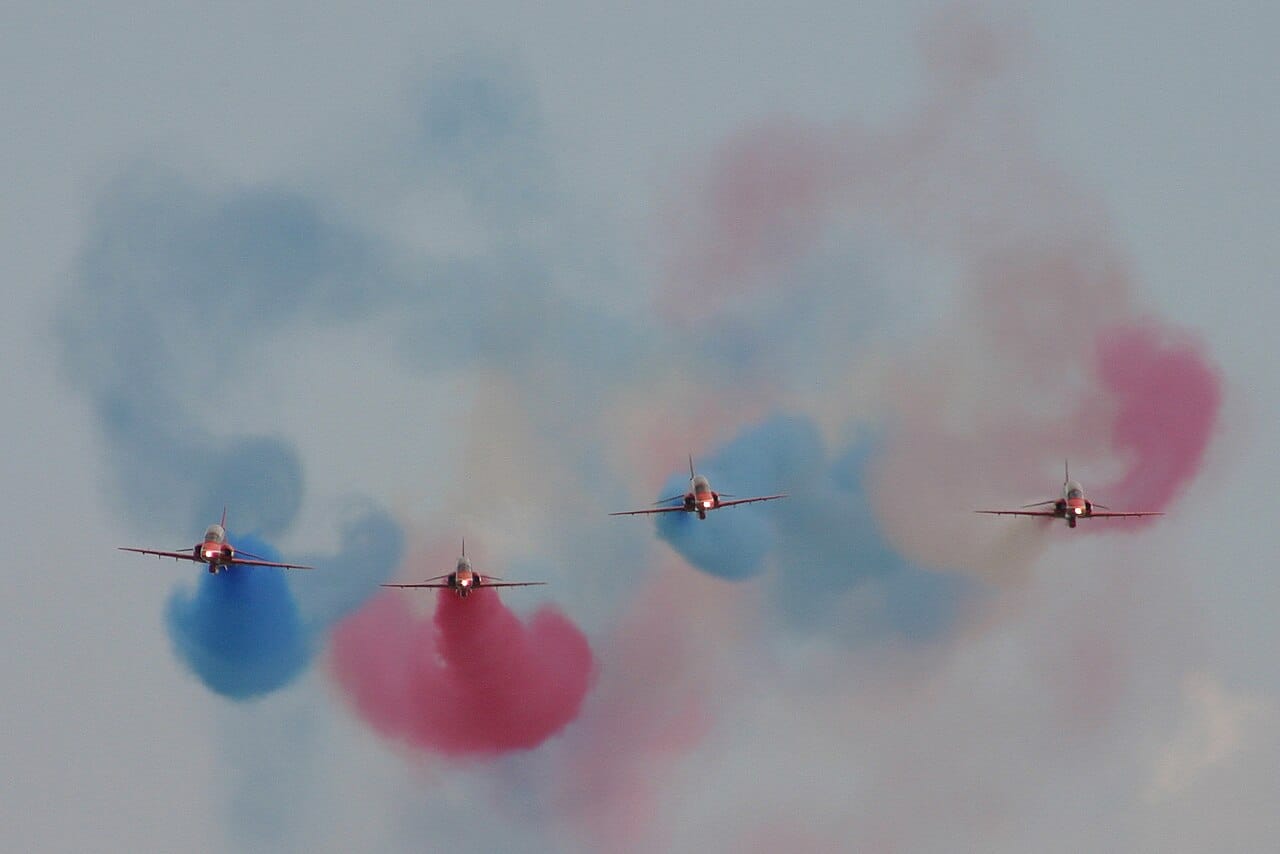
The dream of an all-British advanced jet trainer is over. On Friday 15 May, two administrators from Buchler Phillips walked into Aeralis Limited and began dismantling the company. Around 30 staff lost their jobs. With them went six years of carefully assembled blueprints, supplier networks, and political capital — and, more importantly, what was supposed to be the next jet flown by the Red Arrows.
The cause of death is straightforward and depressingly modern: a frozen procurement timetable in Whitehall, and a Qatari investor who pulled the plug when the Iran war broke out. Sixty-two years after the last all-British military jet trainer left the drawing board, Britain has run out of money for jet design. The RAF will now buy somebody else’s aircraft.
| Company | Aeralis Limited (Bristol, England) |
| Programme | Modular Common Core jet trainer for the RAF (Red Arrows replacement) |
| Status | In administration as of 15 May 2026 |
| Lead investor (former) | Barzan Holdings (Qatar Ministry of Defence) |
| Killer cause | UK Defence Investment Plan delays + funding withdrawn during Iran war |
| Staff lost | ≈ 30 |
| Result | RAF Hawk T1 replacement now expected to be a foreign design |
The aircraft that never was
Aeralis was a singular bet. Rather than design a single jet, the company proposed a modular common core fuselage that could be configured as a basic trainer with a fixed undercarriage and a small turboprop, or as an advanced jet trainer with a single turbofan, or as a twin-engined lead-in fighter trainer. Wing, tail, engine and avionics modules would attach to a common centre fuselage — a Lego concept for a fast jet. The company had no aircraft flying yet; everything existed only as a digital twin.
The economics were elegant on paper. The Royal Air Force could buy the entire family from a single supplier, cycling pilots from screening through to wings standard on broadly the same airframe. The Red Arrows could be re-equipped with a faster, cleaner-sheet aircraft. And the British industrial base would have its first sovereign-designed military jet since the late 1970s.

Why it failed: politics, not engineering
Aeralis was undone by a combination of two factors completely outside its control. The first was the long-running delay to the UK Defence Investment Plan, which kept pushing decisions on the Hawk T1 replacement programme into the next fiscal year — and then the next. Without a Ministry of Defence commitment, no Tier-1 partner would sign up to build the airframe at industrial scale, and no bank would lend against a future contract that did not yet exist.
The second was geopolitical. Aeralis’s biggest shareholder was Barzan Holdings — the procurement arm of Qatar’s Ministry of Defence — which had quietly built its stake to just under 25 per cent. When the United States and Israel attacked Iran in the spring of 2026 and Qatar found itself sharing airspace with strike packages, Barzan abruptly froze its UK aerospace investments and refused further capital calls. The Aeralis cash runway ran out within weeks.


What the RAF buys next
The most likely Hawk T1 replacement is now the M-346 family from Italy’s Leonardo — already in service with several NATO air forces, already used to train RAF aircrew through the International Flight Training School in Italy, and proven in the lead-in fighter trainer role. The Boeing-Saab T-7A Red Hawk is the American alternative, but its troubled development and US-controlled certification timetable make it an awkward fit for the British training pipeline.
For Britain, the consequence is symbolic as well as industrial. Since the Folland Gnat first flew the Red Arrows colours in 1965, the RAF aerobatic team has been a calling card for British military aerospace. From 2026, that aircraft will be designed elsewhere. With Tempest still a decade away and the Hawk T1 nearing the end of its airframe-fatigue life, the gap between British military jet generations is now wider than at any point since the Second World War.
Sources: The Aviationist, UK Defence Journal, GB News, defence-blog.com.


 English
0 Comments