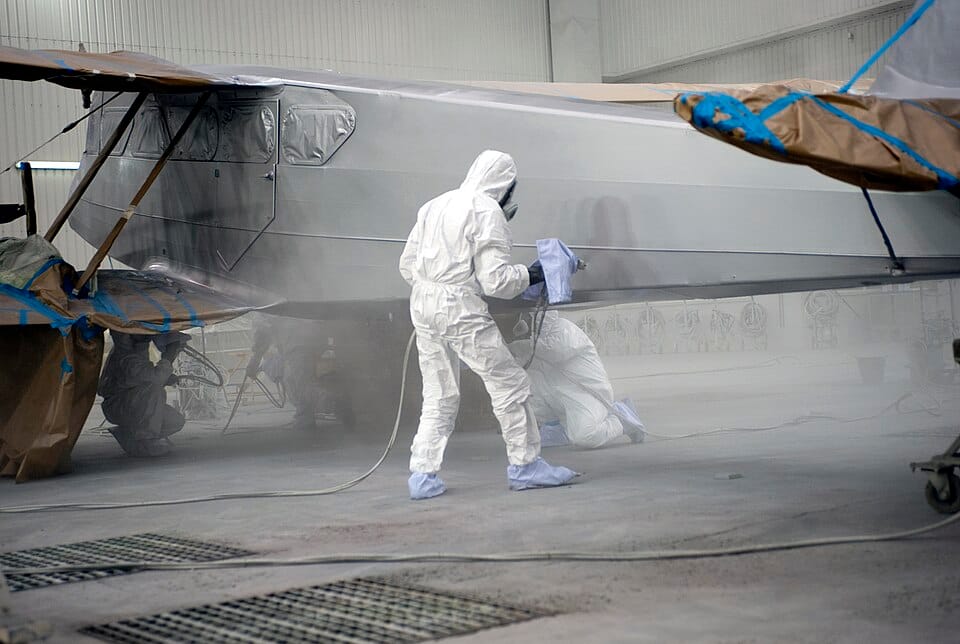
A fresh coat of paint on a Boeing 747 weighs approximately 250 kilograms. On an Airbus A380, it can reach 500 kilograms — roughly the weight of a grand piano. Every kilogram an aircraft carries costs fuel. Every kilogram of fuel costs money. And yet the overwhelming majority of the world’s airlines paint their aircraft in elaborate, multi-colour liveries. The engineering behind that decision is more complex than it looks.
Some airlines, famously, have done the maths and decided not to paint at all. American Airlines flew polished bare-metal 727s, 757s, and MD-80s for decades — saving meaningful fuel by skipping most of the paint. But most airlines accept the weight penalty. The reasons involve corrosion, marketing, heat management, and the surprising economics of bare aluminium.
Painted area (747): several thousand m² — the wings alone cover more than 500 m²
Repaint cycle: Every 5-7 years
Cost to repaint a widebody: $150,000-$300,000
Fuel cost of paint weight (747): ~$40,000/year at typical fuel prices
Why Planes Are Repainted So Often — Art Insider
Warum trotzdem lackiert wird
Paint protects. An unpainted aluminium fuselage corrodes faster than a painted one, especially in humid, salt-laden environments. Airlines operating in tropical or coastal climates — Singapore Airlines, Emirates, Qantas — would face significantly higher maintenance costs without the corrosion barrier that paint provides. The primer coat alone (typically an epoxy chromate) seals the metal from moisture and prevents oxidation.
Modern composite aircraft like the 787 and A350 add another consideration. Carbon fibre reinforced polymer does not corrode like aluminium, but it is vulnerable to UV degradation. A reflective white topcoat blocks ultraviolet radiation that would otherwise weaken the resin matrix over time. For composite airframes, paint is not cosmetic — it is structural protection.
By switching its 737-800s to a lighter paint specification — 62 lb less per jet — American projected savings of nearly 300,000 gallons of fuel a year.
Die Physik der Farbe Weiss
There is a reason most airliners are predominantly white. A white-painted fuselage reflects solar radiation, keeping the cabin and cargo hold cooler on the ground in hot climates. A dark-painted aircraft absorbs more heat, which increases cooling load on the environmental control system and can affect the temperature-sensitive avionics in the forward equipment bay.
There are exceptions. Air New Zealand has flown an all-black 787 (the “All Blacks” livery). It required additional cooling considerations and more frequent surface inspections. But for most operators, the white base coat is a thermal management tool, not just a style choice.
Why Planes Are Painted White — Captain Joe
Die Kalkulation: Lackieren oder nicht?
American Airlines’ bare-metal fleet was iconic but expensive to maintain. Unpainted aluminium requires constant polishing to prevent corrosion and maintain a presentable appearance. The labour cost of polishing a 737 every few weeks often exceeded the fuel savings from the lower weight. When American finally adopted a painted livery in 2013, the switch was partly driven by the transition to composite-bodied aircraft (the 787) that had to be painted regardless.
The maths works out differently for every airline, depending on route network, climate, fleet composition, and fuel prices. But the industry consensus is clear: the 250 kilograms of paint on a 747 costs less in fuel than the corrosion it prevents would cost in maintenance. Paint wins — and it has won for decades.
Carrying an extra kilogram costs an airliner roughly 3% of that weight in fuel per flight hour — over a year of typical utilisation, every kilo of paint burns on the order of 100 kg of fuel.
Sources: Boeing, Airbus, IATA, Simple Flying, AeroTime
Before AWACS, air warfare was a knife fight in a dark room. Pilots relied on their own radar, ground controllers with limited visibility, and radio calls that were often confused, late, or wrong. After AWACS, one side had the lights on and the other did not. The...
On May 1, 1960, CIA pilot Francis Gary Powers took off from Peshawar, Pakistan in a Lockheed U-2 spy plane. His mission: fly across the entire Soviet Union at 70,000 feet, photographing military installations, and land in Bodø, Norway. He never made it. A Soviet S-75...
When the Sukhoi Su-47 Berkut rolled out in 1997, it looked like nothing else in the sky. Its wings swept forward instead of back — an aerodynamic concept that promised extraordinary agility, superior low-speed handling, and enhanced controllability at high angles of...

 English
0 Comments