Allegiant Just Swallowed Sun Country — $1.5 Billion, 195 Aircraft

by | May 19, 2026 | Aviation World, News | 0 comments

The American budget-airline map just lost an entry. On 13 May 2026, Allegiant Travel Company closed its $1.5 billion acquisition of Sun Country Airlines, creating what both companies are calling the leading leisure-focused U.S. airline. Combined fleet: 195 aircraft. Combined route map: 175 cities, more than 650 nonstop routes. Combined annual passengers: roughly 22 million.

The merger has been brewing publicly since late 2025 and quietly for at least two years before that. Both airlines occupy almost the same commercial niche — flying leisure travellers from secondary U.S. cities to beach and mountain destinations, on schedules built around weekends and school holidays, with ancillary-fee business models that look more like Spirit than like Delta. The combination produces the kind of network density neither carrier could build on its own.

Quick Facts
Deal closed13 May 2026
Transaction value~$1.5 billion
Structure$4.10 cash + 0.1557 Allegiant shares per Sun Country share
Combined fleet195 aircraft
Combined network175 cities, 650+ nonstop routes
Combined passengers22 million per year
Brand strategyBoth brands preserved — for now
Single operating certificate~2 years to consolidate
PositionLargest leisure-focused U.S. airline

Two Airlines, One Bet

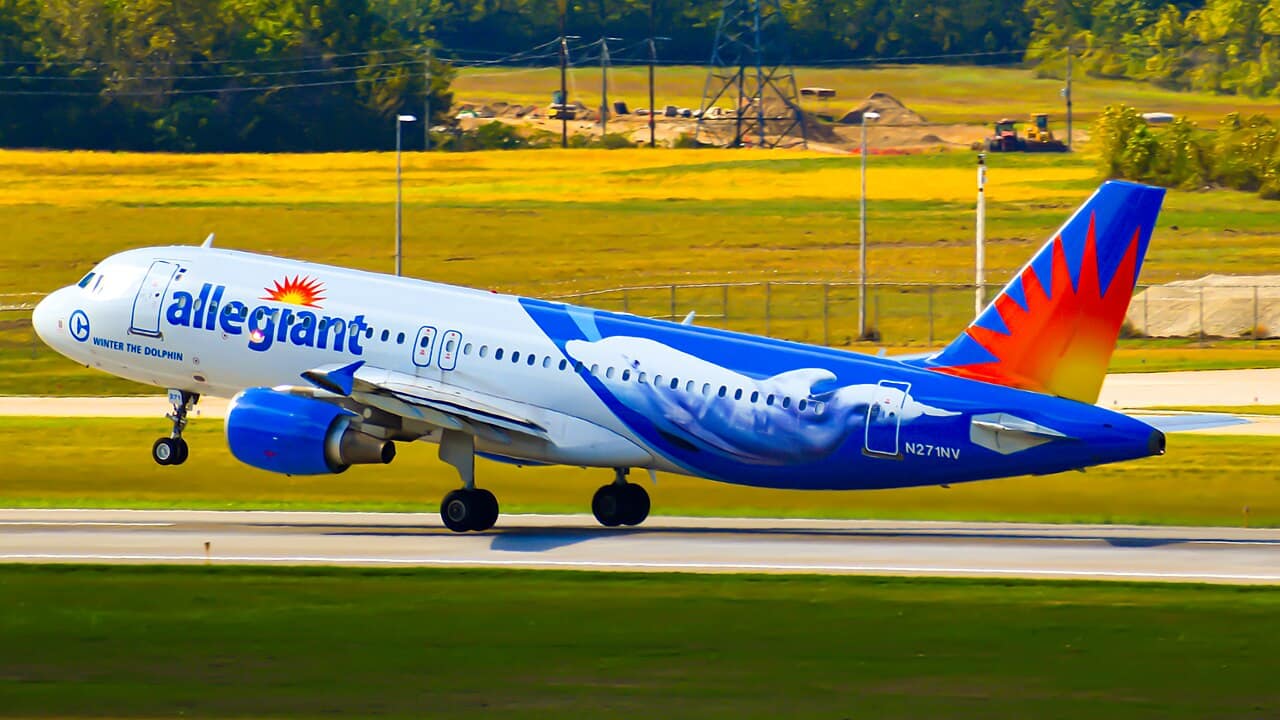
Allegiant’s business model is famously contrarian. The Las Vegas-based carrier flies older Airbus A320 family aircraft (still some MD-80s in storage, though no longer in scheduled service), uses small secondary airports, sells trips bundled with hotels and car rentals, and charges for everything else — seat selection, carry-on, water, the ability to buy the ticket through anyone other than allegiantair.com. It works because Allegiant flies twice a week or three times a week on most routes, focusing on flows like Cedar Rapids–Punta Gorda, Stewart–St. Pete Beach, Bellingham–Las Vegas. Routes the big carriers ignore.

Allegiant Air Airbus A320 in Winter the Dolphin livery
An Allegiant Air Airbus A320-200 wearing the "Winter the Dolphin" livery at Indianapolis. Allegiant's Las Vegas-based business model is built on small cities, leisure travellers, and ancillary fees. (Wikimedia Commons)

Sun Country runs a parallel operation from a different geography. Headquartered in Minneapolis–St. Paul, the airline started life in 1983 as a charter and inclusive-tour carrier flying Minnesotans to warm-weather destinations. Apollo Global Management bought it in 2018, took it public in 2021, and modernised the business around three pillars: scheduled leisure flying (the Allegiant-like piece), Amazon Air freight operations (Sun Country flies a small but lucrative fleet of 737-800 freighters for Amazon Prime Air), and ad-hoc charter work for sports teams and casino junkets.

Why Allegiant Wanted It

The cleanest version of Allegiant’s strategic case: Sun Country gives the merged airline a Minneapolis hub, a credible Northern-tier presence, an existing freight business with predictable Amazon revenue, and a fleet of Boeing 737-800s and -700s that complement Allegiant’s all-Airbus operation. The freight business is the strategically valuable piece. Amazon’s $250 million-a-year Prime Air contract with Sun Country was extended through 2030 in early 2025. That revenue stream now flows to Allegiant. No legacy or ULCC competitor in the U.S. has an equivalent freight pillar.

Sun Country Airlines Boeing 737-700
A Sun Country Airlines Boeing 737-700 in the airline's Minneapolis hangar. Sun Country brings a Minneapolis hub and Amazon Prime Air freight contract into the merger. (Wikimedia Commons)

The Sun Country and Allegiant route maps barely overlap. Roughly 95% of routes operated by either airline are unique. That makes for a merger with very little antitrust risk and very real network-expansion upside. The Department of Justice did not require divestitures; the merger went through standard review and closed on schedule.

Why Sun Country Sold

Sun Country’s shareholders — primarily Apollo and a tail of institutional investors — got a 30% premium to the airline’s pre-deal trading price. The cash component ($4.10 per share) was paid up front, with the rest converted into Allegiant equity. For Apollo, which had owned the airline since 2018, the deal was a clean exit at a moment when private-equity airline ownership was getting harder politically and economically.

Maury Gallagher
“Sun Country and Allegiant have always been two halves of the same idea. We fly leisure travellers from cities the major carriers do not serve. Putting the two together creates the largest leisure-focused airline in the United States — and the most profitable one if we run it right.”
Maury Gallagher — Executive Chairman, Allegiant Travel Company

From a passenger perspective, Sun Country's product had been quietly improving for several years — better seating, more cabin storage, a frequent-flyer scheme actually worth using. Allegiant's product has historically been more austere. Industry watchers expect Allegiant's product to gradually shift toward Sun Country's middle-of-the-road approach, but with Allegiant's ancillary-fee model attached. The combined airline will look more like a leisure-focused Spirit than a leisure-focused Delta.

The Two-Brand Question

The two airlines will continue to operate under their existing brands for the foreseeable future. The merger does not produce immediate changes to reservations, flight schedules, or travel plans. Customers booked on Allegiant remain on Allegiant. Customers booked on Sun Country remain on Sun Country. Both websites continue to function as before.
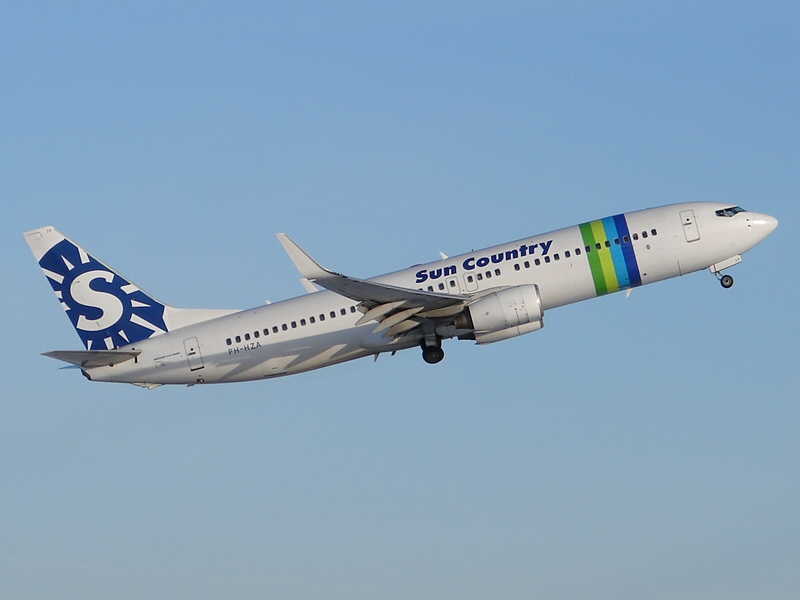
Sun Country Boeing 737-800
A Sun Country Boeing 737-800 at La Crosse Regional Airport. The airline started as a 1983 charter carrier and modernised into a three-pillar leisure / freight / ad-hoc business. (Wikimedia Commons)

The full integration — combining flight operations, dispatch, maintenance, and a single FAA operating certificate — typically takes around two years. The merged airline will eventually have to pick a single brand, single fleet plan, and single labour-relations strategy. The labour piece is the harder one: Allegiant pilots are paid less than Sun Country pilots, and Sun Country flight attendants are unionised while Allegiant's are not. Both gaps will have to close.

The U.S. Budget-Airline Landscape Shifts

The merger reshapes the lower end of the U.S. domestic market. Spirit Airlines, which exited bankruptcy in early 2026, now faces a much larger ULCC-style competitor with a freight pillar Spirit lacks. Frontier, which has been pursuing its own consolidation strategy with Spirit, now competes against a combined Allegiant–Sun Country footprint substantially larger than either of the candidates Frontier was eyeing. The legacy carriers — Delta, American, United — are largely untouched by the deal because the markets it affects sit underneath their core networks.

For passengers, the practical effect over the next two years will be mostly invisible. Routes will be added, schedules will be tweaked, but the customer-facing brands stay put. By 2028, however, when the FAA finally issues a single operating certificate, one of the two names will start to fade out. Whether Allegiant ultimately keeps Sun Country's livery as a leisure sub-brand or absorbs it into a single Allegiant identity is a marketing decision still pending. By then, the merger's strategic logic — or lack of it — will be visible in the financial numbers.

Sources: The Points Guy (Sean Cudahy, 13 May 2026); CBS Minnesota; Star Tribune; Allegiant Travel Company press release; Matador Network; Travel and Tour World; TipRanks; Nomad Lawyer.

Related Posts

0 Comments

Submit a Comment

Your email address will not be published. Required fields are marked *

en_USEnglish