
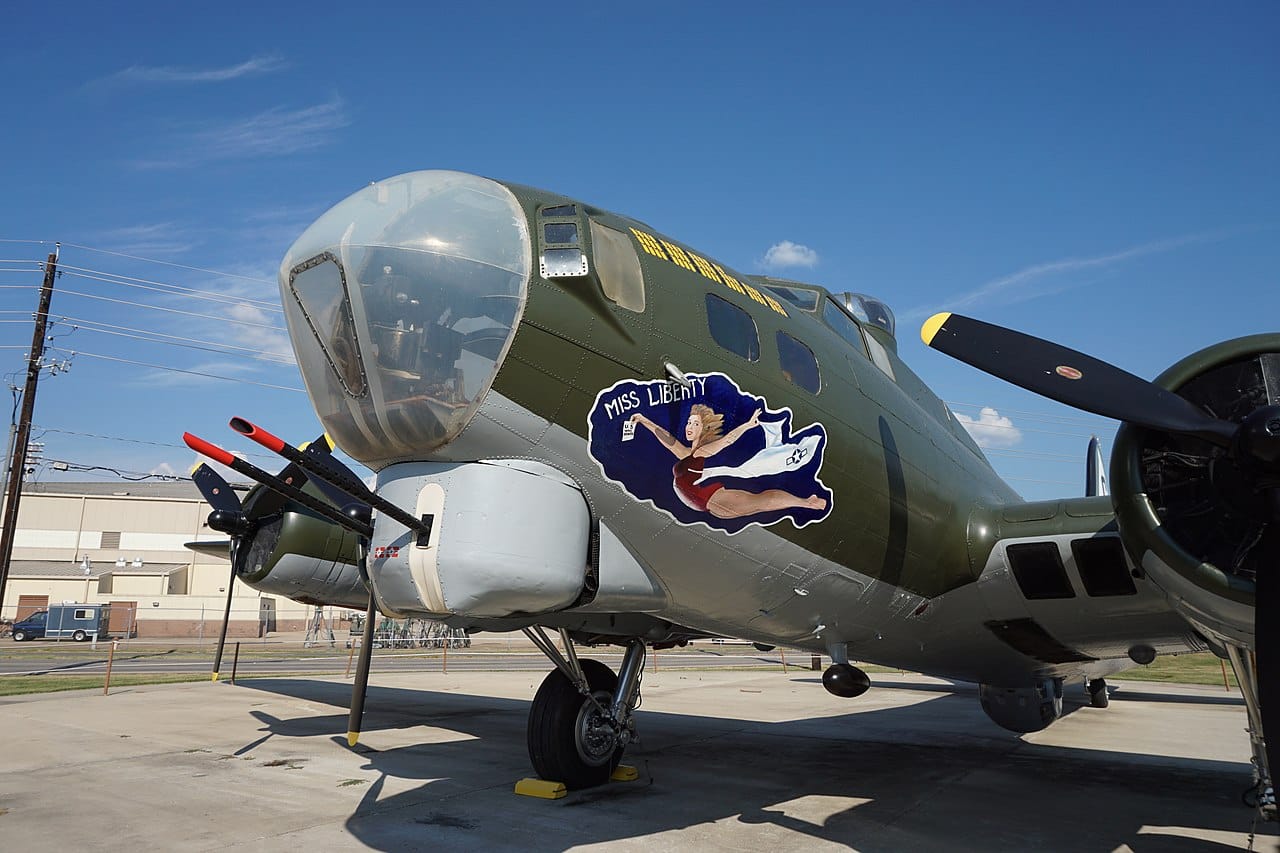
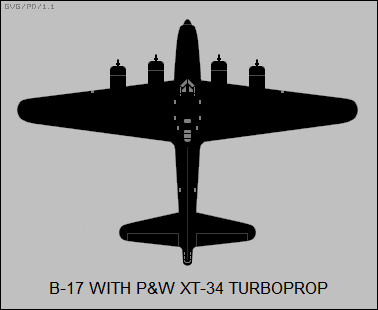
You know what a B-17 looks like. Four radial engines. The towering tail fin. Glass nose. Heavy-bomber Americana, stamped onto a thousand black-and-white photographs of the daylight raids over Germany. Now picture one with a fifth engine bolted to its nose — a giant turboprop, or sometimes a roaring jet, mounted where the Plexiglas bombardier station used to be.
That happened. Curtiss-Wright Corporation flew exactly this aircraft for nineteen years, from 1947 to 1966, out of a small airport in Caldwell, New Jersey, testing every new piston, turboprop, and jet engine the company built. The bomber was officially designated EB-17G, later JB-17G, but most of the people who flew it just called it "the testbed."
A B-17 Flying Fortress with a fifth engine bolted onto its nose. Via @worldwaraviationgroup on Instagram
Quick Facts
Aircraft: Boeing B-17G Flying Fortress (modified by Curtiss-Wright)
Operator: Curtiss-Wright Corporation, Caldwell-Wright Airport, New Jersey
Operational period: 1947-1966
Modification: Fifth engine mounted in nose position, replacing bombardier glass
Engines tested: Wright R-3350, Wright J65, Wright TJ-32, Wright XT35, others
Purpose: In-flight testing of new piston, turboprop, and jet powerplants
Crew: 4-6 (pilot, co-pilot, flight engineer, test engineer, observer)
Why a B-17?
By 1947 the B-17 was obsolete. The Air Force was retiring them by the hundred and selling them as surplus to anyone with a hangar and a dollar. Curtiss-Wright bought one, took it to its New Jersey factory, and asked: what if we used this as a flying engine test stand?
The B-17 had three things going for it. It was huge — long enough to mount a substantial engine on the nose without overloading the centre of gravity. It was already built to handle the asymmetric thrust of four wing-mounted engines, so a fifth engine in front did not destabilise it. And it was cheap. The whole airframe cost less than a single new engine to acquire.
A Fifth Engine, A New Job
Curtiss-Wright's engineers stripped out the bombardier station, the chin turret, and most of the forward fuselage equipment. In its place they bolted a structural test mount sized for almost any contemporary engine. The aircraft's four original radial engines stayed in place, providing reliable propulsion at all times. The fifth engine — the one being tested — could be started, run at full power, instrumented, and shut down in flight without ever putting the aircraft itself at risk.
This mattered. Before the testbed, every new aircraft engine had to fly on a prototype aircraft, and prototype aircraft crashed. The B-17 testbed gave Curtiss-Wright a flying laboratory where engineers could log thousands of hours on a new engine before it ever entered a production aircraft.
Engines That Flew on the Testbed
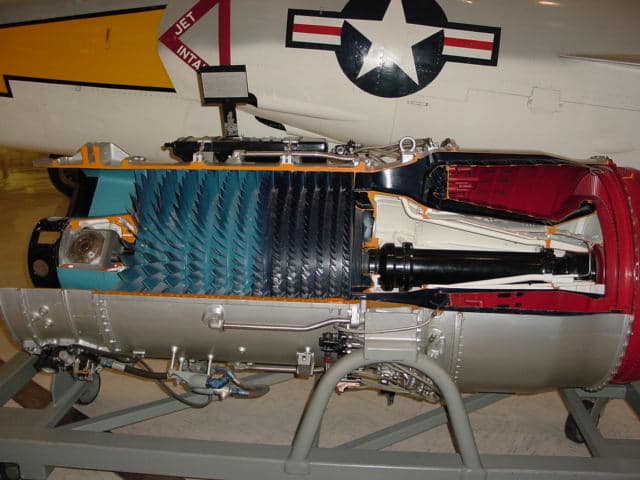
The Wright J65 turbojet — used in the F-84F Thunderstreak, the A-4 Skyhawk, the B-57 Canberra, and the F-11 Tiger — was qualified on the B-17 testbed before it ever flew on a production fighter. The Wright XT35 turboprop, intended for the giant Convair B-36 Peacemaker successor, ran on the B-17 for hundreds of hours during early Cold War testing. Half a dozen smaller piston experiments — radial engines, opposed-cylinder concepts, even a turbo-compound prototype — all logged their first flying hours on the testbed.
The aircraft was, in effect, a flying spec sheet. Anything Curtiss-Wright wanted to sell to the Pentagon had to first prove itself bolted to the nose of a 25-year-old World War II bomber.
A Quiet Retirement
By 1966, jet engines had reached the point where ground-based test cells could simulate flight conditions accurately enough that an actual flying testbed was no longer necessary. The B-17 was sold off, converted into a firefighting air tanker, and eventually lost in a crash while firebombing in North Carolina in 1980. Curtiss-Wright lost most of its engine business to Pratt & Whitney and General Electric within a decade. The company that carried the Wright brothers’ name and had built engines for many of the bombers of World War II faded from the aviation industry by the mid-1970s.
The B-17 testbed itself was not preserved. There are around 45 surviving B-17s in the world today, most painted in their wartime livery and only a handful still flying at airshows in their original four-engine configuration. None has the fifth engine. None is on the engineering record as the strangest-looking Flying Fortress ever to operate. Which is a shame — because for nearly two decades, this one aircraft had a more interesting flying career than almost any other B-17 alive.
Sources: Curtiss-Wright Corporation archives, Smithsonian National Air and Space Museum, "B-17 Flying Fortress: The Symbol of Second World War American Air Power" (Holmes), Caldwell-Wright Airport historical records.
Related Questions
Why did a B-17 have a fifth engine on its nose?
Curtiss-Wright bolted a fifth engine to a B-17’s nose to use the bomber as a flying engine test stand. From 1947 to 1966, the company mounted experimental piston, turboprop, and jet engines where the bombardier’s glass nose had been, testing each new powerplant in real flight conditions out of Caldwell, New Jersey.
What was the B-17 engine testbed designated?
The modified aircraft was officially designated EB-17G, and later JB-17G, though the crews who flew it simply called it "the testbed." Operated by Curtiss-Wright, it carried a fifth engine in its nose for nearly two decades - a quiet research role far removed from B-17 combat missions like the Schweinfurt raid.
Why was a B-17 chosen as an engine testbed?
The B-17 was ideal because it was big, cheap, and docile. By 1947 the bomber was obsolete and sold as surplus. Its long airframe could carry a substantial nose-mounted engine without upsetting the centre of gravity, and its four existing engines kept it flying safely even if the experimental test engine failed.
Which engines were tested on the B-17 testbed?
Curtiss-Wright tested a range of its powerplants on the B-17’s nose mount, including the Wright R-3350 piston engine, the Wright J65 turbojet, the Wright TJ-32, and the Wright XT35 turboprop. The arrangement let engineers evaluate new piston, turboprop, and jet engines in genuine flight conditions.
How long did the B-17 engine testbed operate?
The Curtiss-Wright B-17 testbed flew for nineteen years, from 1947 to 1966, out of Caldwell-Wright Airport in New Jersey. It carried a crew of four to six, including pilots and test engineers, evaluating successive generations of engines during a period of rapid change captured in the broader history of aviation.
0 Comments