
Quick Facts
- $4.5 billion congressional funding to expand B-21 production capacity by 25%
- Northrop Grumman investing an additional $2.5 billion of its own money
- Defense Secretary Hegseth says the Air Force needs “a lot more” than 100 Raiders
- Mitchell Institute calls for 200 B-21s to counter China
- First operational B-21 scheduled for Ellsworth Air Force Base in 2027
- Final assembly at Northrop Grumman’s Palmdale, California facility
- The B-21 is the most fuel-efficient bomber ever built, per Northrop Grumman
The Production Machine at Palmdale
Final assembly of the B-21 Raider takes place at Northrop Grumman’s sprawling facility in Palmdale, California, at the edge of the Mojave Desert. The campus, which previously built the B-2 Spirit, has been extensively modernized with digital engineering tools, advanced manufacturing infrastructure, and what Northrop describes as more than $5 billion in technology investments. The $4.5 billion in congressional funding, approved through the fiscal year 2025 reconciliation package, is split between roughly $2.4 billion for research and development and $2.1 billion for procurement. The money will support facility expansion, workforce growth, and supply chain acceleration across Northrop Grumman’s nationwide network of B-21 subcontractors and suppliers. Northrop’s own $2.5 billion investment signals something beyond compliance with a government contract. It suggests the company is betting that the final fleet size will significantly exceed 100 aircraft and that production will continue for decades. Companies do not sink that kind of capital into manufacturing infrastructure for a limited run.
The 200-Bomber Argument
The Mitchell Institute’s case for 200 B-21s rests on a series of operational calculations centered on a potential conflict with China. The institute argues that in a Taiwan Strait scenario, the United States would need to sustain long-range precision strike sorties across thousands of miles of Pacific Ocean, day after day, while absorbing losses from Chinese air defenses that are among the most sophisticated in the world. At 100 aircraft, the B-21 fleet would be stretched dangerously thin by attrition, maintenance cycles, and the need to maintain a nuclear deterrent role simultaneously. At 200, the Air Force would have enough Raiders to sustain a conventional campaign while keeping the nuclear mission intact. Admiral Richard Correll has publicly suggested that 145 B-21s would be more appropriate as a middle ground. The Air Force’s official position remains a minimum of 100 aircraft as the program of record, but senior leaders have openly acknowledged that the number is under review. Gen. David H. Tabor told lawmakers that the service is actively determining what the revised program of record should become, with an updated target expected in the FY2028 budget request due in spring 2027.Why the B-21 Is Central to the China Strategy
The strategic logic behind the B-21 is rooted in the unique demands of great power competition in the Pacific. Unlike fighters, which depend on forward bases that are increasingly vulnerable to Chinese ballistic missile attack, the B-21 can operate from bases deep in the American heartland or from dispersed locations across the Pacific and strike targets thousands of miles away. The Raider’s sixth-generation stealth technology gives it the ability to penetrate the most advanced integrated air defense systems. Its radar cross section is reportedly minuscule. Its extreme fuel efficiency, described by Northrop Grumman as the best of any bomber ever built, reduces dependence on the tanker fleet, a critical vulnerability in a Pacific conflict where aerial refueling aircraft would themselves be targets. The B-21 is also designed to carry both conventional and nuclear weapons, providing a dual-capable strike platform that can shift between roles depending on the mission. This flexibility is a core requirement as the Air Force seeks to maintain its nuclear triad while simultaneously preparing for conventional great power conflict.The Road to Ellsworth and Beyond
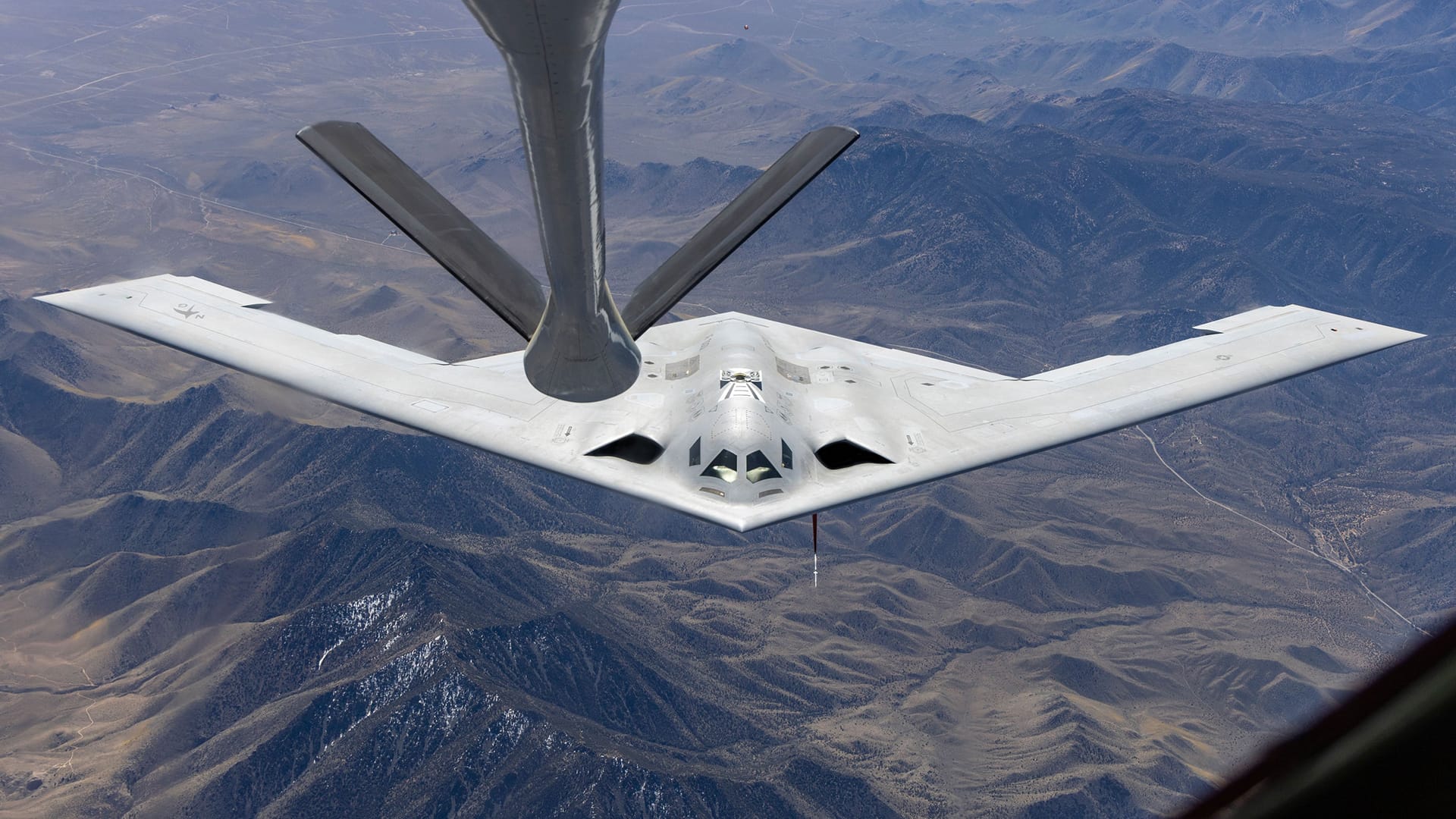
The first operational B-21 Raider is scheduled to arrive at Ellsworth Air Force Base in South Dakota in 2027, marking the beginning of the service’s transition from concept to combat capability. Ellsworth will serve as the primary Raider base, with additional basing decisions expected as the fleet grows. Flight testing at Edwards Air Force Base in California has progressed steadily. The second pre-production aircraft completed its maiden flight and joined the test fleet in late 2025. In early 2026, the first aerial refueling trials were conducted, with the B-21 successfully operating behind a KC-135 tanker, a critical milestone for an aircraft whose operational utility depends on its ability to self-deploy across intercontinental distances. The acceleration of production, combined with Northrop’s massive capital investment and the Pentagon’s increasingly explicit desire for a fleet well beyond 100 aircraft, suggests that the B-21 program is entering a new phase. The question is no longer whether the Raider will be built in large numbers. It is how large those numbers will ultimately be, and whether the production line at Palmdale can deliver them fast enough to match the pace of the threat.Sources: The Defense Post, Air & Space Forces Magazine, Army Recognition, EDR Magazine, 19FortyFive, Defence Industry EU, Military Times

 English
0 Comments