Before the Global Positioning System existed — before the first satellite was even launched into the constellation — fighter jets were already screaming across continents at supersonic speed and arriving remarkably close to their targets. They did it using a technology so elegant and so deceptively simple that it borders on magic: the inertial navigation system.
No radio signals. No ground stations. No satellites. Just spinning gyroscopes, precision accelerometers, and the laws of Newtonian physics.
Quick Facts
Technology: Inertial Navigation System (INS)
Developed: 1950s–1960s for military aviation
How it works: Gyroscopes maintain a fixed reference frame; accelerometers measure movement from a known starting position
Key advantage: Completely autonomous — cannot be jammed, spoofed, or detected
Key limitation: Position error accumulates over time (drift)
The Elegant Physics of Dead Reckoning
An inertial navigation system works on a principle that Isaac Newton would have understood immediately. If you know exactly where you start, and you measure every acceleration you experience in every direction from that moment onwards, you can calculate where you are at any point in time by integrating those accelerations twice — once to get velocity, again to get position.
The engineering challenge was building instruments precise enough to make this work at supersonic speed over transcontinental distances. The gyroscopes had to maintain their orientation in space despite the aircraft manoeuvring violently around them. The accelerometers had to detect the tiniest changes in motion while filtering out vibration, turbulence, and the rotation of the Earth itself.
The Stabilised Platform
The heart of a 1960s inertial navigation system was the stabilised platform — a mechanical gimbal assembly that kept three precision accelerometers perfectly aligned with the local north-east-down reference frame, regardless of how the aircraft pitched, rolled, or yawed. Spinning gyroscopes on the platform detected any rotation and commanded torque motors on the gimbals to correct it, keeping the platform rock-steady in space.
This was mechanical engineering at its absolute limit. The gyroscopes spun at tens of thousands of RPM on air bearings that had to be virtually frictionless. The gimbals had to move with zero backlash. Thermal expansion had to be compensated to fractions of a micron. A single speck of dust on a bearing surface could introduce enough drift to put a bomber miles off target after a few hours of flight.
Unjammable, Undetectable, Indispensable
The greatest advantage of INS was — and remains — its complete independence from external signals. Unlike radio navigation, radar, or GPS, an inertial navigation system emits nothing and receives nothing. It cannot be jammed, spoofed, or detected by an enemy. For military aircraft operating in contested airspace, this made INS indispensable.
The SR-71 Blackbird relied on an astro-inertial navigation system that combined INS with a star tracker, automatically correcting drift by fixing on celestial bodies even during daylight at extreme altitude. Intercontinental ballistic missiles used INS to guide their warheads to targets thousands of kilometres away with accuracies measured in hundreds of metres — all without any external input after launch.
Today, GPS has largely replaced INS as the primary navigation source, but every modern fighter jet, airliner, and submarine still carries an inertial system as backup. In an age of GPS jamming and spoofing, the old technology that predates satellites by decades remains the last line of navigational defence.
The genius of inertial navigation systems explained
How inertial navigation changed air, sea, and space travelSources: Technology Originals (Instagram), MIT Instrumentation Laboratory, Smithsonian National Air and Space Museum
Every fighter pilot trains for it. Most pray they'll never experience it. The moment a jet engine — the machine that keeps you flying at 500 knots and 30,000 feet — stops working. Whether it's a compressor stall that sounds like a cannon going off behind your seat, a...
Luca Parmitano has lived two lives that most people only dream about. In the first, he was a fighter pilot — flying AMX Ghibli attack jets for the Italian Air Force, deployed to Afghanistan, trained to fly low and fast into hostile territory. In the second, he became...
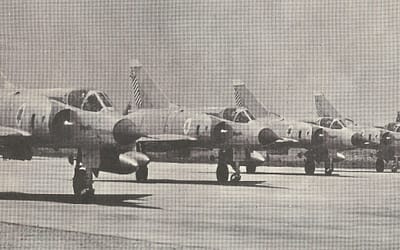
Before the Rafale, before the Mirage 2000, before the Mirage F1 — there was the Mirage III. Dassault's first supersonic fighter was a revelation when it entered service in 1961: a sleek, tailless delta that could break Mach 2, carry a nuclear bomb, and outfight...



 English
0 Comments