
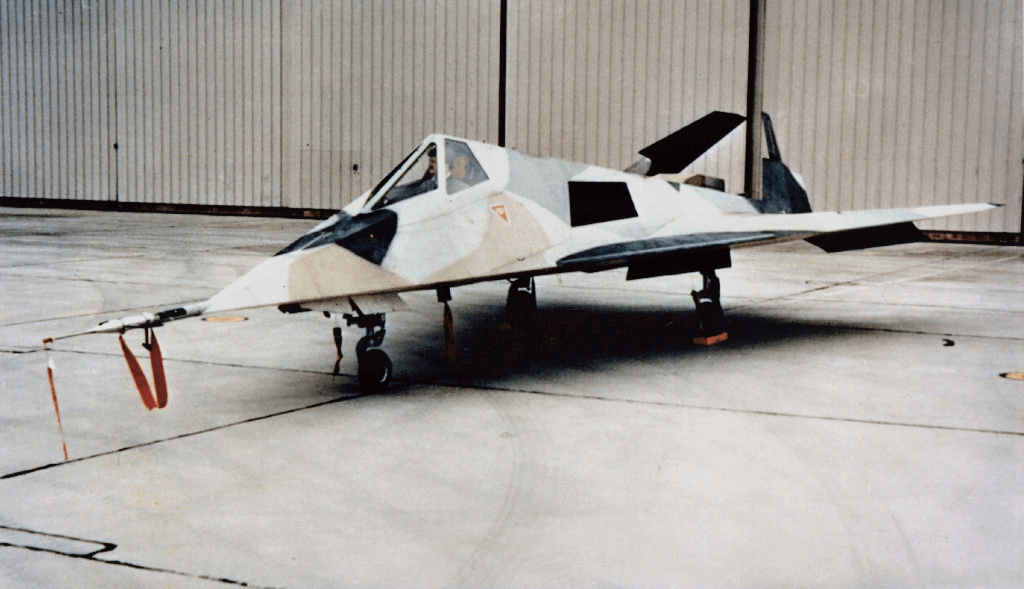
The history books tell us that stealth was born in 1977, when Lockheed’s “Have Blue” demonstrator first flew at Groom Lake and proved that an aircraft could be designed to disappear from radar. The history books are wrong by fifteen years. The first serious American stealth aircraft was built in 1962 by Boeing, in Wichita, under a US Army contract. It was called the Model 853-21 “Quiet Bird,” and almost nobody has ever heard of it.
Quick Facts
Aircraft: Boeing Model 853-21 “Quiet Bird”
Customer: US Army reconnaissance aircraft study
Built: Half-scale model only — 1962 at Boeing Wichita
Length: 33 feet (10 metres)
Wingspan: 33.65 feet (10.3 metres)
Predates: Have Blue (1977) by 15 years — F-117 (1983) by 21 years
The Brief: Survive Soviet Radar
In the early 1960s, the US Army had a problem. They wanted a small, single-pilot reconnaissance aircraft that could fly over Warsaw Pact territory to spot armoured columns. The trouble was that East Germany was wallpapered with Soviet early-warning radars, and a conventional aircraft — no matter how small — would be detected immediately.
Boeing Wichita responded with an unconventional answer. Rather than try to outrun or outmanoeuvre Soviet radars, they would simply not show up on them. The Quiet Bird was an aircraft designed, from the wing root outward, to have the smallest possible radar cross-section.
That objective drove everything. The fuselage was faceted — covered in flat panels angled to scatter radar energy away from the source. The single engine was a low-bypass turbofan chosen for its small thermal signature. The wing was small and reduced surface area. Internal structure used composites and radar-absorbent material.
“With this aircraft, we changed the rules on how to design and build an aircraft, and what we’ve learned is enabling us to provide our customers with affordable, high-performing products.”
— Jim Albaugh, President and CEO of Boeing Integrated Defense Systems, at the 2002 unveiling of Boeing’s later Bird of Prey stealth demonstrator
A Half-Scale Model That Worked
Boeing built a half-scale model and tested it through 1962 and 1963 on a ground-based radar range. The results were exceptional: tests showed a dramatically lower radar cross-section than a conventional aircraft of the same size. By the standards of the day, this was remarkable.
But the project also had problems. The aerodynamics of the faceted shape were marginal. The internal volume was tight. The projected cruise speed was slower than the Army wanted. And — most fatally — the senior generals making the decision did not yet understand what a stealth aircraft could be used for. The Army cancelled the project before any full-scale prototype could be built.
Boeing put the Quiet Bird model in storage. It would sit there for nearly fifty years.
“This project stressed affordability as much as performance and quality. The entire programme cost $67 million — less than a single B-2 bomber.”
— George Muellner, Senior VP of Boeing Air Force Systems, on the 2002 Bird of Prey programme — not the Quiet Bird
The Lineage Almost Nobody Saw
The Quiet Bird’s place in stealth history is now better understood than it was. Boeing itself admits that little is known about the programme — most of its records were reportedly destroyed in the 1970s. The basic premises — faceted geometry, controlled emissions, careful management of every detectable signature — were the same. The Quiet Bird simply lacked the computing power to optimise the geometry, the materials science to absorb radar at scale, and the political support to break through.
Have Blue had all three. Have Blue gets the credit. But fifteen years earlier, in a Wichita workshop, a half-scale aircraft was already proving the concept. The history books should have told us.
Sources: Boeing historical releases (2015), Sandboxx News, Boeing Images archive.
 English
0 Comments