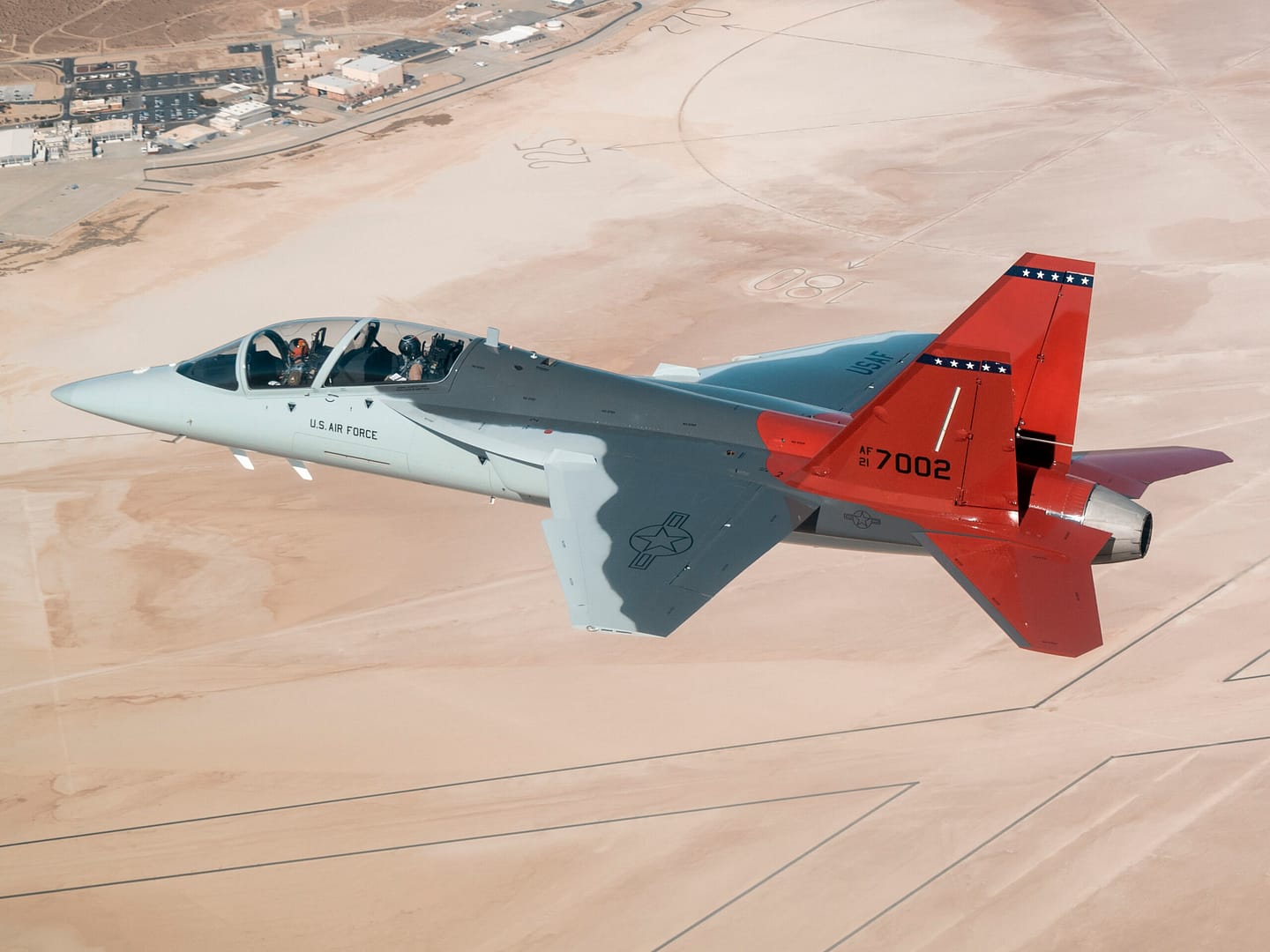
Boeing just looked at the Navy’s trainer competition, looked at the T-7A Red Hawk, and said: nah.
On June 12, the company announced it would not bid the T-7A for the Navy’s Undergraduate Jet Training System programme — the competition to replace the aging T-45C Goshawk with 216 new trainer jets. Boeing’s official explanation was politely clinical: “After careful evaluation, we have determined the T-7A does not meet the U.S. Navy’s Undergraduate Jet Training System requirements.”
Translation: the jet that Boeing is still struggling to deliver to the Air Force cannot be adapted for Navy use without a development effort so expensive and time-consuming that it would defeat the purpose of bidding.
Quick Facts — UJTS Competition
Programme: Undergraduate Jet Training System (UJTS)
The specific technical barrier was the T-7A’s General Electric F404 engine. Meeting Navy engine qualification requirements would have demanded what Boeing called “long-cycle development” — essentially, a years-long recertification effort for a naval operating environment. The T-7A was designed from the start as an Air Force trainer. Adapting it for the salt spray, corrosion, and operational tempo of naval aviation was not a simple retrofit.
And Boeing has enough T-7A problems to deal with already. The Red Hawk programme has accumulated over $1.7 billion in write-downs, including $900 million in the third quarter of 2024 alone and another $500 million in Q4. Ejection seat safety failures, wing rock at high angles of attack, flight control software bugs, oxygen system problems, and incomplete structural loads testing have pushed initial operational capability to spring 2027 — three years behind schedule. The first production aircraft was delivered to Air Education and Training Command at Randolph AFB in December 2025, but full-rate production remains a distant milestone.
Taking on a naval adaptation of a jet that is not yet working properly for the Air Force would have been, to put it mildly, ambitious.
A Shrinking Field
Boeing is not the first major player to walk away. Lockheed Martin pulled its TF-50N — a navalized variant of the KAI T-50 Golden Eagle — on April 23, citing insufficient U.S. content levels to satisfy Buy American requirements. That means two of the four original contenders have dropped out before proposals were even due.
The remaining field consists of two entries that could not be more different.
The Sierra Nevada Corporation Freedom Trainer is a clean-sheet design unveiled at Tailhook 2025. Powered by twin Williams FJ44-4M turbofans producing 3,600 pounds of thrust each, it promises a cruise speed exceeding 590 knots, a 45,000-foot ceiling, a load envelope from -3G to +8G, and a projected flight-hour cost of roughly $4,500 — about half that of F404-powered alternatives. SNC claims the Freedom Trainer is the only UJTS contender capable of carrier touch-and-go operations, with a 16,000-hour airframe life and 35,000 touch-and-go cycles built in.
The Textron/Leonardo Beechcraft M-346N takes the opposite approach: proven technology, adapted for the mission. The M-346 platform has logged more than 100,000 flight hours worldwide and is already in service with multiple air forces. The naval variant adds a Precision Landing Mode, quad-redundant fly-by-wire, Auto-GCAS, and a full Live-Virtual-Constructive training ecosystem with AI-powered instruction. Final assembly would take place in the United States. The M-346N’s pitch is simple: it works now, the risk is low, and the training system is mature.
A T-45C Goshawk on a carrier flight deck. The Navy’s trainer fleet has been in service since 1991 and is showing its age. U.S. Navy photo / Wikimedia Commons
The Goshawk Cannot Wait
The T-45C Goshawk has been training Navy and Marine Corps aviators since 1991. The youngest airframe rolled off the line in 2009. Approximately 193 remain in the fleet, and they are tired. Repeated groundings — most recently in March 2025 — have been driven by Rolls-Royce Adour engine malfunctions and chronic problems with the on-board oxygen generation system that have caused hypoxia incidents among student pilots.
The Navy initiated a Service Life Extension Program in July 2025 to keep the Goshawks flyable until UJTS deliveries begin in 2032. That is not a comfortable margin. If the new programme slips — and defence acquisition programmes almost always slip — the Navy risks a gap in its pilot training pipeline at a moment when it is already struggling to produce enough aviators.
A New Kind of Trainer Race
One detail that has flown under the radar: the UJTS programme eliminated the requirement for the new trainer to perform arrested carrier landings. Under the revised concept of operations, student pilots will practice Field Carrier Landing Practice approaches but only to the wave-off point. Actual carrier qualification will happen later, in Fleet Replacement Squadrons flying operational aircraft, aided by advances in simulation and automated landing systems.
This is a significant doctrinal shift. It means the UJTS aircraft does not need a tailhook, carrier-grade landing gear, or the structural beef that comes with slamming onto a flight deck. It opens the competition to lighter, cheaper airframes — which is exactly what SNC and Textron/Leonardo are offering.
For Boeing, the maths were obvious. The T-7A was already overweight, over budget, and behind schedule for the Air Force. Trying to make it Navy-ready on top of all that would have been throwing good money after bad. Walking away was the smart call.
For the Navy, two competitors is better than none — but barely. If either SNC or Leonardo stumbles, the service could find itself with a single-vendor situation and very little negotiating leverage. The T-45 clock is ticking, and the Goshawk does not care about acquisition timelines.
Sources: The Aviationist, Breaking Defense, The War Zone, Aviation Week, Air & Space Forces Magazine, FlightGlobal, Defence Industry EU
The Navy’s VX-9 test squadron was spotted flying an F-35A — the Air Force’s land-based variant — a small clue to how integrated F-35 testing has become.


 English
0 Comments