
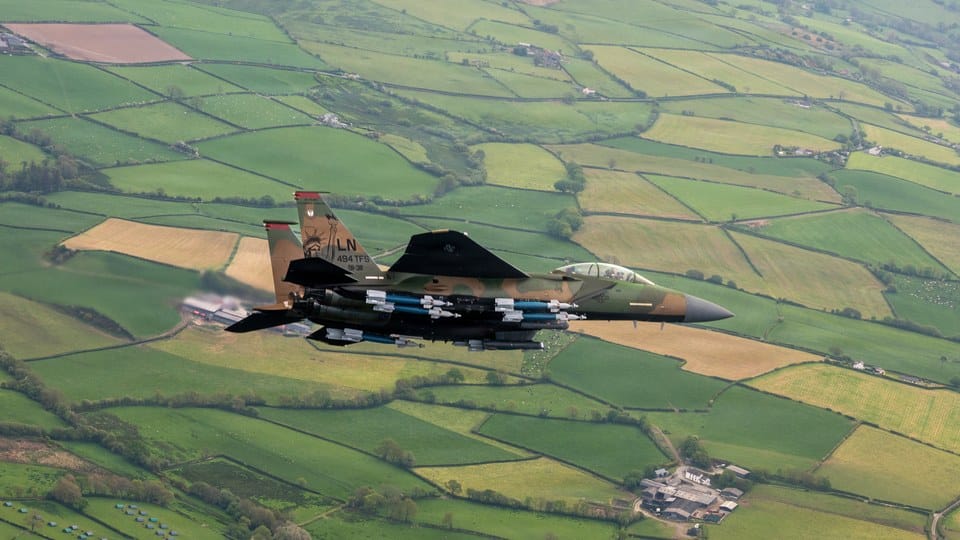
On a grey Welsh morning in early May, hikers lining the ridges above Cadair Idris heard the unmistakable rumble of twin Pratt & Whitney F100 engines reverberating off granite walls. Then it appeared: an F-15E Strike Eagle wearing a paint scheme that had not graced a Western combat jet in four decades — a tri-tone camouflage of tan, dark green, and medium green, an unmistakable throwback to the General Dynamics F-111 Aardvark. The jet — serial number 91-0311, assigned to the 48th Fighter Wing at RAF Lakenheath, England — carved through the Mach Loop on May 7, 2026, loaded with inert practice bombs under its conformal fuel tanks, giving aviation photographers the shot of a lifetime.
Aircraft: F-15E Strike Eagle, s/n 91-0311
Unit: 48th Fighter Wing, RAF Lakenheath, UK
Unveiled: April 28, 2026
Scheme: Tri-tone tan/green F-111 Aardvark camouflage
Occasion: 40th anniversary of Operation El Dorado Canyon (1986)
Tribute to: KARMA 52 crew — Capt. Fernando Ribas-Dominicci & Capt. Paul Lorence
Mach Loop sortie: May 7, 2026
A Scheme Steeped in Sacrifice
The 48th Fighter Wing — the famed "Statue of Liberty Wing" — pulled the wraps off 91-0311 during a ceremony at RAF Lakenheath on April 28, 2026, forty years after American warplanes struck targets in Libya during Operation El Dorado Canyon. That April 1986 mission was a direct response to Libyan-sponsored terrorism, including the bombing of a Berlin discotheque frequented by US servicemembers. The strike package included eighteen F-111F Aardvarks flying from Lakenheath on a gruelling 6,400-mile round trip — at the time, the longest fighter combat mission in history.
One of those Aardvarks never came home. KARMA 52, crewed by Capt. Fernando Ribas-Dominicci and Weapons Systems Officer Capt. Paul Lorence, was shot down over the Gulf of Sidra during the strike on Tripoli. Both airmen were killed. Capt. Ribas-Dominicci’s remains were eventually returned by Libya in 1989 — Capt. Lorence’s were never recovered — but the memory of their sacrifice has never faded inside the Liberty Wing's hangars. The new heritage scheme ensures that memory extends to the ramp, the runway, and the skies over two continents.
Reading the Tail — Every Marking Tells a Story
The camouflage itself is eye-catching, but the real narrative is written in the markings. The nose radome was left in standard operational grey — a practical concession to the radar-absorbent coatings underneath — but from the windscreen aft, the airframe is wrapped in the same Southeast-Asian-style three-tone pattern once worn by Lakenheath's F-111 fleet. The twin tails carry the historic 494th Tactical Fighter Squadron titles and the distinctive "LN" tailcode that has identified Lakenheath jets since the Cold War. A red tail band stretches across each vertical stabiliser, framing the unit's storied lineage.
Look closer and more details emerge: a subtle Statue of Liberty outline, the black panther emblem of the 494th, the silhouette of an F-111F in flight, and — perhaps most poignantly — the inscription "40 Years El Dorado Canyon" in bold lettering.
Into the Loop
Heritage paint jobs are common across the US Air Force, but what happened on May 7 was anything but routine. The camouflaged Strike Eagle entered the famous Mach Loop low-flying training area in Snowdonia, Wales — a narrow valley network where NATO pilots practice terrain-masking at speeds exceeding 400 knots. Aviation photographers who had been tipped off lined the ridgeline above Cad East, their telephoto lenses tracking the tri-tone jet as it banked hard between slopes, afterburner cans glowing against the overcast sky.
The images that emerged were electric. The green-and-tan jet, slung with blue inert munitions, looked as though it had time-travelled from a 1986 mission brief. Social media erupted: within hours, the Mach Loop photos were spreading rapidly across aviation communities on X, Reddit, and specialist forums. For a brief moment, a forty-year-old colour scheme became the most talked-about thing in military aviation.
The 48th Fighter Wing has not disclosed how long 91-0311 will wear its heritage livery. Historically, such schemes remain for a calendar year before the jet returns to standard Mod Eagle grey. Until then, every sortie from Lakenheath — whether it is a routine training hop over the North Sea or another screaming pass through the valleys of Wales — will carry the memory of KARMA 52 on its skin.
Sources: USAF 48th Fighter Wing Public Affairs; aviation photography community reports; open-source flight tracking; Operation El Dorado Canyon historical records.
Related Questions
Why is there an F-15 painted in camouflage?
An F-15E Strike Eagle of the 48th Fighter Wing at RAF Lakenheath was painted in a tri-tone tan-and-green scheme in 2026 as a heritage jet. The camouflage honours the F-111 Aardvark and the crews of the 1986 Operation El Dorado Canyon raid on Libya.
What is the F-15E heritage paint scheme?
It's a special tribute livery applied to F-15E serial 91-0311, wearing the tan and green F-111 Aardvark camouflage of the 1980s. Unveiled on 28 April 2026, it marks the 40th anniversary of Operation El Dorado Canyon.
What was Operation El Dorado Canyon?
Operation El Dorado Canyon was the 1986 U.S. air strike on Libya, in which F-111 bombers flying from Britain were central. The 2026 camouflaged F-15E honours that operation and its 40th anniversary, paying tribute to the crews involved.
Who does the camo F-15E honour?
It is dedicated to the crew of KARMA 52 — Captains Fernando Ribas-Dominicci and Paul Lorence — the F-111 aircrew lost during the 1986 El Dorado Canyon raid. The heritage scheme keeps their sacrifice in memory.
What is the Mach Loop?
The Mach Loop is a series of valleys in Wales where military aircraft practise low-level flying, drawing photographers from around the world. The camouflaged 48th Fighter Wing F-15E flew a Mach Loop sortie on 7 May 2026, showing off its F-111 tribute scheme.
0 Comments