
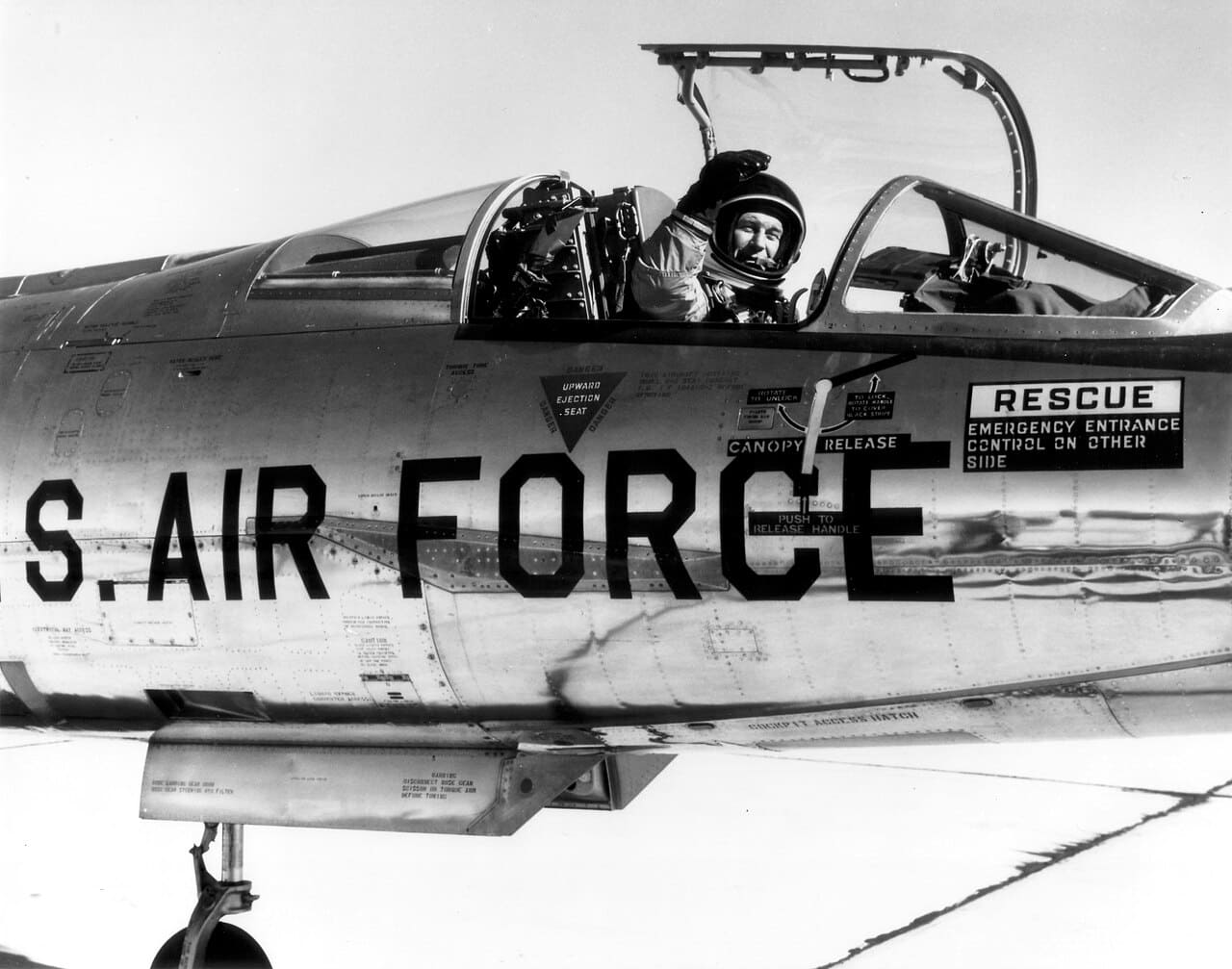
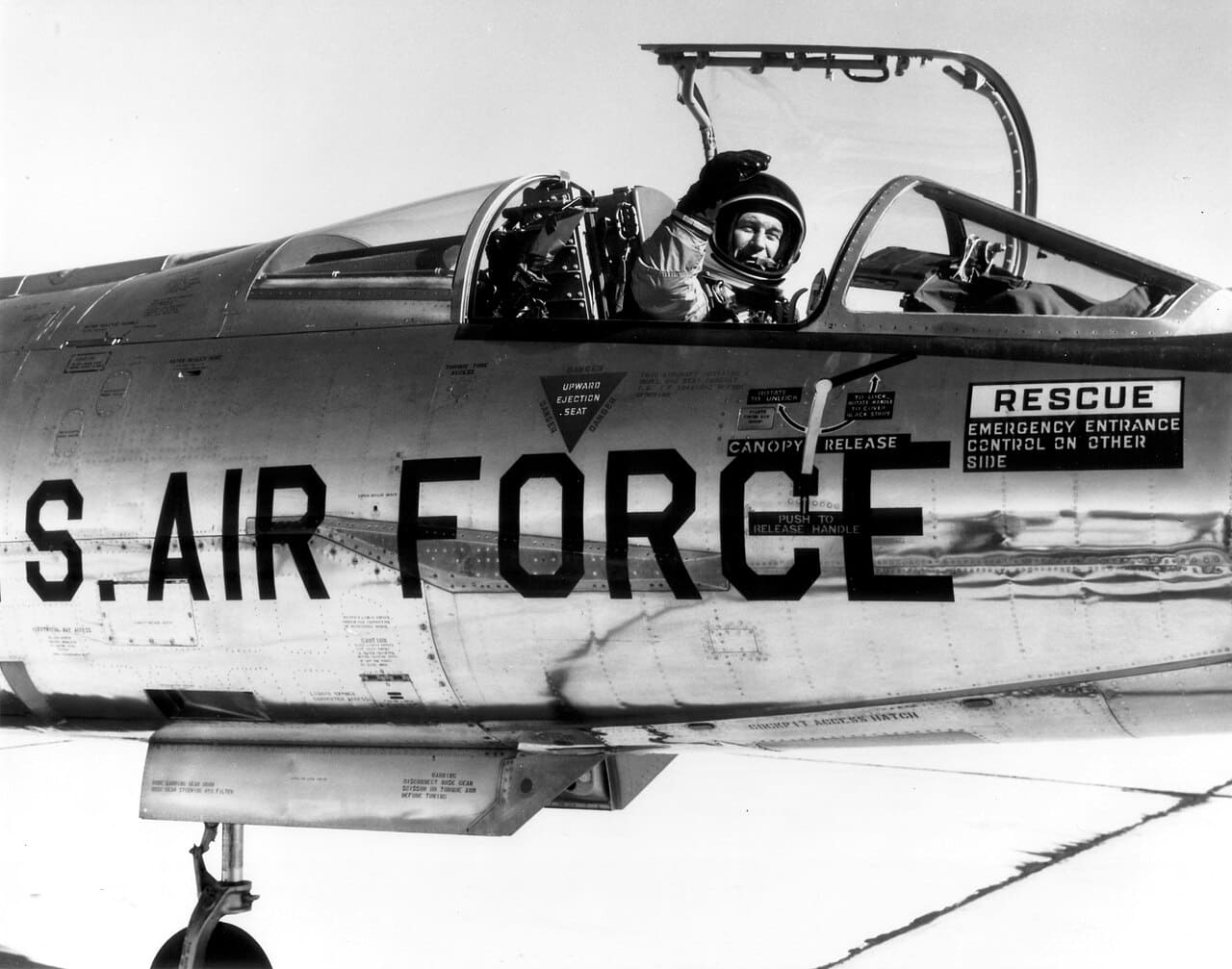
On 10 December 1963 a Lockheed NF-104A — an F-104 Starfighter with a rocket motor bolted to its tail — climbed away from Edwards Air Force Base in the California desert and started clawing for the edge of space. At the controls was Colonel Charles E. “Chuck” Yeager, the man who had broken the sound barrier sixteen years earlier and who was now commanding the Aerospace Research Pilot School. He was wearing a full pressure suit. The aircraft was carrying a Rocketdyne AR2-3 motor burning a mix of JP-4 jet fuel and 90% concentrated hydrogen peroxide as oxidiser. The target altitude was 120,000 feet. Yeager had decided, on this Tuesday morning, to set the world altitude record for an aircraft taking off from a runway under its own power.
He missed by a long way. The aircraft topped out at roughly 101,600 feet — well short of the 108,700 feet he had reached on a build-up flight that same morning — then lost control, entered a flat spin from which it could not recover, and pitched towards the desert floor. Yeager ejected. The seat that should have saved him almost killed him. The next month of his life — the parts that the film The Right Stuff dramatised — were spent in a hospital bed with second- and third-degree burns over the left side of his face and neck. He never tried for an altitude record again.
Quick Facts
| Pilot | Col. Charles E. Yeager (USAF), Commandant, Aerospace Research Pilot School |
| Aircraft | NF-104A Starfighter, USAF serial 56-0762 |
| Date | 10 December 1963 |
| Location | Edwards Air Force Base, California |
| Engine | Standard General Electric J79 turbojet + Rocketdyne AR2-3 rocket motor |
| Maximum altitude reached | approx. 101,600 ft (30,970 m) apex on the accident flight — after 108,700 ft on the same morning’s build-up flight |
| Target | 120,000 ft world altitude record |
| Outcome | Flat spin from apex → ejection at 8,500 ft → ejection seat ignited Yeager’s helmet → severe burns |
| Recovery | About a month of hospital treatment for the burns; recovered without disfigurement |
The aircraft that should not have existed
The NF-104A was one of three F-104A Starfighters modified by Lockheed under a 1962 Air Force contract to serve as a low-cost training platform for astronauts and test pilots destined for the X-15 and the X-20 Dyna-Soar programmes. The Air Force needed a way to give its candidates exposure to zero-gravity, to ballistic flight profiles, and to the experience of flying an aircraft beyond the atmosphere where conventional control surfaces did not work. Building dedicated spaceplanes was expensive. Bolting a 6,000-pound-thrust rocket motor to an existing fighter and calling it close enough — that was the Aerospace Research Pilot School approach.
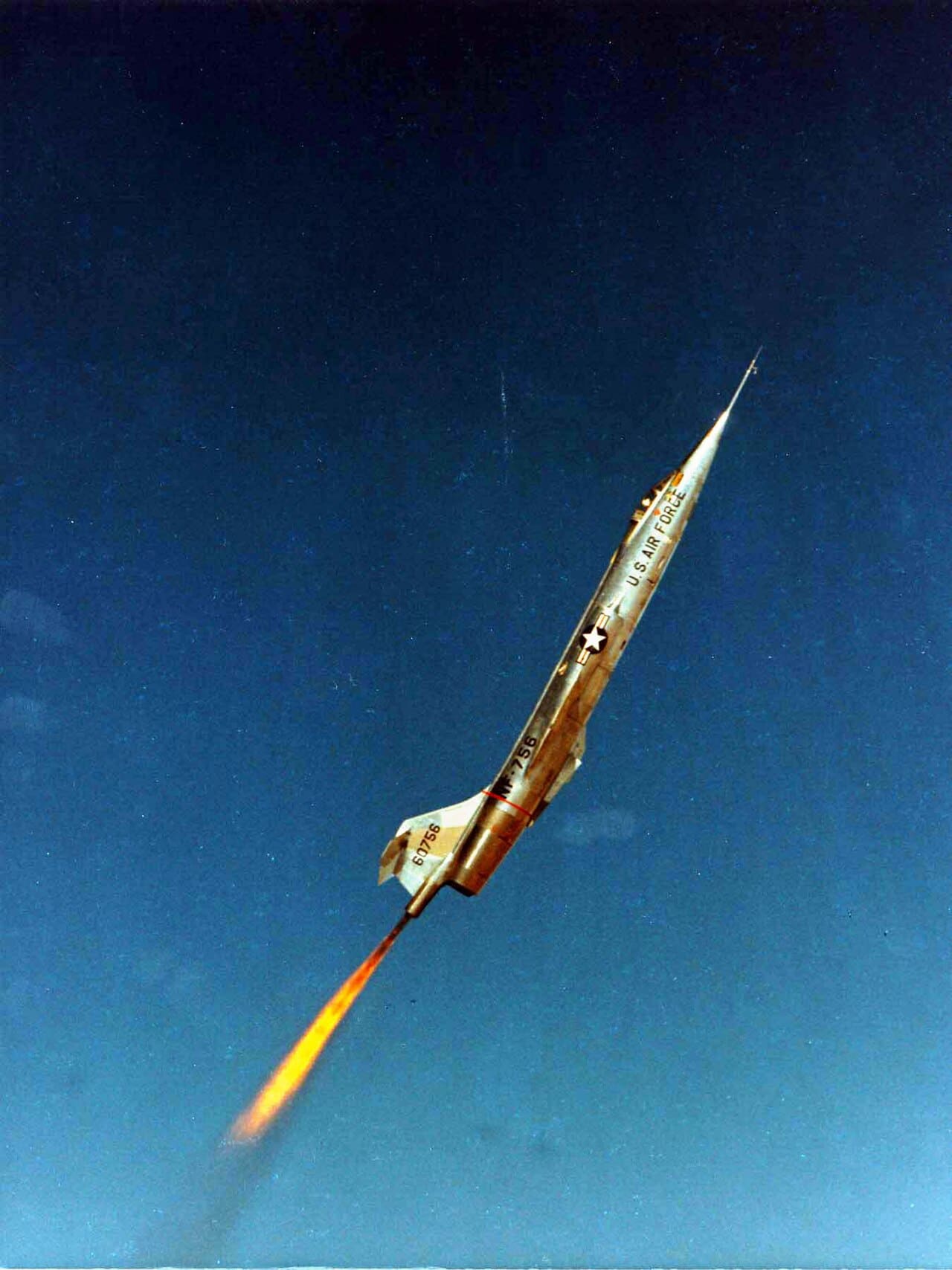
The NF-104A had its normal General Electric J79 turbojet in the fuselage and the Rocketdyne AR2-3 in a small fairing above the tail. To fly the profile, the pilot used the J79 to accelerate to Mach 2 at 35,000 feet, lit the rocket motor, and pitched up into a 70-degree climb. The aircraft would coast through 90,000 feet and apex somewhere above 100,000 feet in a parabolic arc. For about 90 seconds the pilot experienced near-zero gravity, used reaction control jets in the nose and wingtips to maintain attitude — because there was no aerodynamic pressure on the control surfaces — and then began the recovery dive back through the atmosphere.
“Pulled the gear and the rocket came in”
Yeager was 40 years old. He was the commandant of ARPS, the school that trained future test pilots. He had a reputation to maintain. The existing world altitude record for a ground take-off belonged to a Soviet pilot, Georgi Mosolov, who had taken a Mikoyan Ye-66A — a modified MiG-21 prototype — to 113,892 feet in April 1961. Yeager believed the NF-104A could do better. A series of build-up flights had progressively expanded the envelope — Yeager had zoomed to 108,700 feet on the morning of 10 December itself. The afternoon flight, his second of the day, was the record attempt.
The take-off and climb were nominal. At 35,000 feet Yeager engaged the AR2-3. The rocket motor fired correctly. The Starfighter pitched up to 70 degrees, accelerated through Mach 2, and climbed through the upper atmosphere. The cockpit instruments rolled up: 80,000, 90,000, 100,000 feet. But the zoom topped out at roughly 101,600 feet — lower than the morning flight — and the rocket burned out as Yeager came over the apex, the nose still pitched far too high.
The flat spin
At apex, an aircraft’s aerodynamic surfaces have nothing to work against. The atmosphere is too thin for the rudder, the elevator, or the ailerons to produce useful force. The NF-104A used compressed-gas reaction control thrusters in the nose and wingtips — but these were small, and they could not overcome the angular momentum of an aircraft that had begun to yaw. The accident investigation found that the aircraft had come over the top at an angle of attack far beyond the Starfighter’s pitch-up limit — and because the apex was lower than on earlier flights, the dynamic pressure during re-entry was higher, producing a nose-up aerodynamic moment the thrusters could not overcome.
The NF-104A tumbled, recovered to roughly nose-up attitude, and began to fall. At about 70,000 feet it had become a flat spin — rotating around its vertical axis, descending vertically, with no airspeed building because the drag surfaces were all stalled. Yeager went through the entire recovery checklist. Drag chute. Speed brakes. Engine restart. None of it worked. The Starfighter passed through 50,000 feet still spinning. 30,000. 20,000.
At 8,500 feet Yeager pulled the ejection handle.
The seat that nearly killed him
The Lockheed C-2 ejection seat fired cleanly. Yeager separated from the seat at low altitude. The seat-pan, falling free, was equipped with a small rocket motor to push it away from the pilot during separation. The nozzle of that rocket motor, still hot and ejecting flame, swung in its trajectory and struck Yeager directly in the helmet visor as the seat tumbled past him. The visor cracked. Pure oxygen was venting from Yeager’s suit feed line. Hot rocket exhaust met pure oxygen and produced an instant fireball inside the helmet.
Yeager arrived on the desert floor under his canopy with his helmet on fire, his face severely burned, and the parachute cords above him alight from contact with the burning helmet. He got the visor open and the fire out before he reached the ground, and spent about a month in hospital before returning to flight status. He never flew an NF-104A again. The two surviving aircraft kept flying zoom profiles — capped after the accident at 108,000 feet — until the programme ended in 1971.
The Right Stuff dramatised this exact scene. Tom Wolfe’s account of the flat spin, the ejection and the burning helmet runs for pages — and stays remarkably close to the accident record.
Newly released footage from the Edwards Air Force Base History Office showing the complete sequence of Col. Yeager’s NF-104A flight, loss of control, ejection, and recovery on 10 December 1963.
Sources: Wikipedia; The Aviationist; This Day in Aviation; Edwards Air Force Base History Office; Yeager: An Autobiography (Yeager & Janos, 1985); The Right Stuff (Wolfe, 1979).
 English
0 Comments