
| Quick Facts | |
| Aircraft | Aérospatiale/BAC Concorde |
| Manufacturers | Aérospatiale (France) and British Aircraft Corporation (UK) |
| First Flight | March 2, 1969 |
| Service Entry | January 21, 1976 (Air France and British Airways) |
| Retired | November 26, 2003 |
| Speed | Mach 2.04 (2,180 km/h / 1,354 mph) |
| Altitude | Cruised at 60,000 feet — twice normal airliner altitude |
| Atlantic Crossing | New York to London in 3 hours 30 minutes |
| Built | 20 aircraft total (including prototypes) |
| Passengers | 92–128 per aircraft |

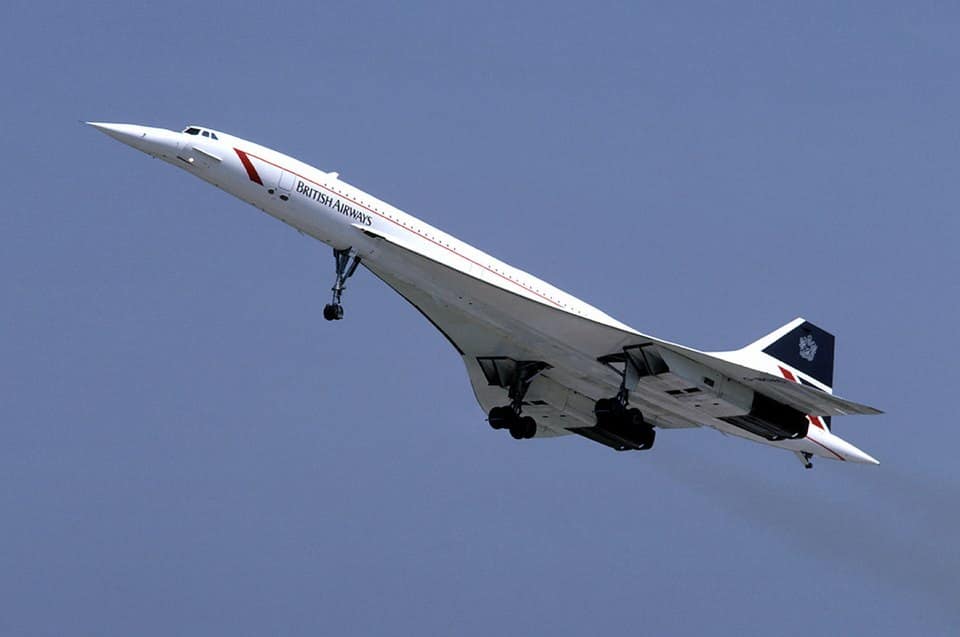
It took off from London at 10:30 in the morning and landed in New York at 9:30 — the same morning. Concorde didn’t just cross the Atlantic. It beat the sun across the Atlantic. For 27 years, passengers could board a needle-nosed, delta-winged aircraft in Europe, fly at twice the speed of sound through the stratosphere at 60,000 feet — high enough to see the curvature of the Earth — and arrive in America before they left.
Then it stopped. And nothing has replaced it.
Concorde remains the only successful supersonic passenger aircraft in history. The Soviet Tu-144, its rival, flew commercially for barely a year before being grounded. No other manufacturer has come close. Two decades after Concorde’s retirement, the fastest way across the Atlantic is still a subsonic Boeing or Airbus plodding along at Mach 0.85 — less than half Concorde’s cruising speed.
Engineering at the Edge
The aircraft was a joint project between France and Britain, born in the early 1960s when both nations believed supersonic travel was the inevitable future of aviation. The engineering challenges were enormous. At Mach 2, air friction heats the aircraft’s skin to over 120°C. The fuselage physically expands in flight — Concorde was measurably longer at cruise speed than on the ground. The distinctive drooping nose existed because the aircraft’s angle of attack during takeoff and landing was so steep that pilots couldn’t see the runway with the nose in its cruise position.
The Olympus 593 engines — developed by Rolls-Royce and SNECMA — produced 38,000 pounds of thrust each with afterburner. They pushed the aircraft through the sound barrier and beyond, leaving a sonic boom in its wake that would rattle windows from 60,000 feet. That boom was Concorde’s curse. It limited the aircraft to overwater supersonic flight only, which meant the lucrative transcontinental US routes were off-limits. London–New York and Paris–New York were essentially the only commercially viable services.
A Machine the World Couldn’t Afford
Concorde was never profitable in the traditional sense. The development costs — split between the British and French governments — were astronomical and never recovered. The aircraft burned fuel at a prodigious rate: roughly 25,600 litres per hour, compared to about 10,000 for a modern 787 carrying three times as many passengers. When oil prices spiked, the economics became brutal.
British Airways and Air France operated it as a prestige service — a flying business card for national pride. Tickets cost the equivalent of a first-class fare on a subsonic jet, but the passengers were a different breed entirely: Wall Street bankers, diplomats, rock stars, and anyone who valued time above all else. On Concorde, you could have breakfast in London and a morning meeting in Manhattan. The aircraft didn’t just sell speed. It sold the most valuable commodity in the world: extra hours.
The end came in stages. The July 2000 crash of Air France Flight 4590 — which killed all 109 people aboard and four on the ground after a tyre burst punctured a fuel tank during takeoff from Paris — shattered Concorde’s safety record. The aircraft was grounded, modified, and returned to service in November 2001. But the economics had shifted. 9/11 cratered transatlantic travel demand. Airbus, which had inherited the maintenance obligations, announced it would stop supporting the type. British Airways and Air France retired their fleets in 2003.
Nothing Has Replaced It
Several companies — Boom Supersonic, Spike Aerospace, Aerion — have announced supersonic successors over the years. None are flying commercially yet. The sonic boom remains an unsolved regulatory problem. The fuel economics remain punishing. The environmental politics of burning that much jet fuel for so few passengers have only gotten harder since 2003.
Concorde sits in museums now — at the Intrepid in New York, at Heathrow, at Le Bourget in Paris, at Filton in Bristol where it was built. Visitors stand beneath the delta wing and try to comprehend that this thing carried people across oceans at twice the speed of a rifle bullet. It looks like it belongs in the future. It belongs to the past. And the gap between those two facts is the saddest thing in aviation.
Sources: BAE Systems Heritage, Smithsonian Air & Space, Airbus Heritage
 English
0 Comments