Congress just told the Air Force it cannot retire a single F-22 Raptor for the next six years.
On June 4, the House Armed Services Committee approved an amendment to the FY2027 National Defense Authorization Act extending the prohibition on F-22 retirements through September 30, 2032. The amendment, introduced by Representative Austin Scott of Georgia and passed by voice vote, protects all 184 remaining Raptors from the boneyard until the end of fiscal year 2032 — five years beyond the current restriction.
The message from Capitol Hill is unambiguous: you do not retire the best air superiority fighter on the planet until you have something to replace it with.
Quick Facts — F-22 Retirement Block
Amendment: HASC FY2027 NDAA (HR 8800), Rep. Austin Scott (R-GA)
Vote: Voice vote; full bill passed 44-12
Protection period: Through September 30, 2032
Fleet protected: All 184 F-22 Raptors
AF wanted to retire: 32 Block 20 jets (training-only)
Upgrade cost: $3.3 billion / ~15 years for Block 20 upgrades
Successor: F-47 (NGAD) — first flight 2028, operational mid-2030s
The Block 20 Problem
The Air Force’s argument for partial retirement was not unreasonable. Of the 184 Raptors, approximately 32 are Block 20 aircraft — the oldest production models, delivered between 1999 and the early 2000s. These jets are used exclusively as trainers. They lack the combat-coded sensor and weapons integration of the newer Block 30 and Block 35 variants and cannot deploy to a fight in their current configuration.
Upgrading each Block 20 to combat standard costs roughly $50 million per jet. Former Secretary of the Air Force Frank Kendall argued the maths did not work: the service could save $1.8 billion between FY2024 and FY2028 by sending those 32 jets to the boneyard and focusing resources on the remaining 152 combat-capable airframes.
Congress disagreed — and not for the first time. The FY2023 NDAA first blocked F-22 retirements and mandated that all Block 20s be upgraded to Block 30/35 standard. Lockheed Martin estimated the full upgrade programme at $3.3 billion over approximately 15 years, including open mission systems, enhanced stealth coatings, electronic warfare upgrades, AIM-260 compatibility, and drone teaming capability. If completed, the combat-coded fleet would grow from roughly 149 to 178 aircraft.
Why Congress Will Not Let Go
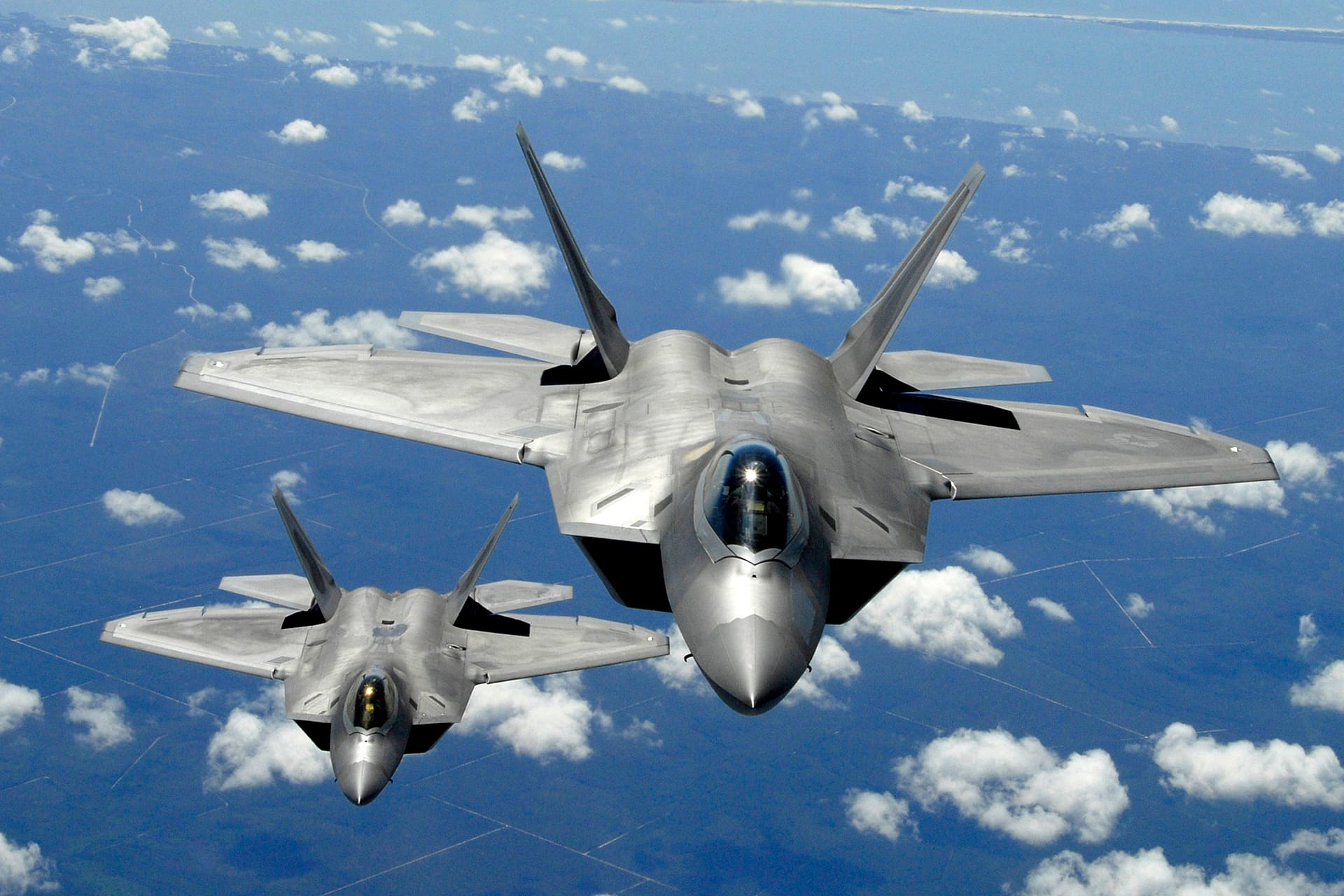
Two F-22 Raptors in formation. All 184 remaining jets are now protected from retirement through fiscal year 2032. U.S. Air Force photo / Wikimedia Commons
The calculus is simple. The Air Force’s fighter fleet has dipped below the congressionally mandated legal minimum of roughly 1,970 combat-coded aircraft — a shortfall of about 70 jets. Representative August Pfluger of Texas called this a “wake-up call.” The F-15C, which shared the air superiority mission with the Raptor for decades, is being retired. The F-15EX Eagle II buy has been halved. And the F-47 — the sixth-generation fighter that will eventually replace the F-22 — is not expected to reach operational capability until the mid-2030s.
That leaves the F-22 as the only dedicated air superiority platform the United States has. Every Raptor that goes to the boneyard is a jet that cannot be built again — the production line was shut down in December 2011 after Secretary of Defense Robert Gates capped procurement at 187 airframes, down from the originally planned 750.
Three have been lost to crashes. The remaining 184 are all there will ever be.
The Readiness Question
Keeping the F-22 flying is not cheap and it is not easy. The mission capable rate dropped to 40.19 percent in fiscal year 2024 — the lowest in roughly 20 years and a sharp decline from 52 percent in FY2023 and 57.4 percent in FY2022. The Pentagon’s 80 percent target has never been met.
The primary culprits are spare parts shortages and stealth coating maintenance. The Raptor requires approximately 30 hours of maintenance for every hour of flight, with roughly one-third of that devoted to maintaining the radar-absorbing coatings that make it invisible. At a cost of roughly $85,000 per flight hour — compared to about $42,000 for the F-35A and $22,000 for an F-16 — the Raptor is the most expensive tactical fighter in the inventory to operate.
But it is also the most capable in the air-to-air arena, and no amount of cost analysis changes the fact that nothing else in the American arsenal can do what it does.
Waiting for the F-47
Boeing won the Next Generation Air Dominance contract — now designated the F-47 — and the FY2027 budget requests $5.03 billion for development on top of $3.4 billion in FY2026. First flight is targeted for 2028, but the engineering and manufacturing development phase runs through late 2031, with operational capability now pushed to the mid-2030s. A 2024 programme pause to reassess requirements and affordability, combined with industrial saturation from the B-21 Raider and T-7A programmes competing for the same engineering talent, has stretched the timeline.
Until the F-47 is flying, tested, and in squadron service, the F-22 is it. Congress knows this. The Air Force knows this. And now, by law, all 184 Raptors will be around to prove it — for at least six more years.
Sources: Air & Space Forces Magazine, The War Zone, Defense News, FlightGlobal, Rep. Austin Scott press release, GAO
First flight 1952. New engines in 2026. Planned retirement: never. The B-52 is getting $48.6 billion in upgrades and will outlive both the B-1B and B-2 — reaching 100 years of service.
From spinning dishes to 1,676 solid-state modules firing simultaneously. How AESA radar gave fighters the ability to track, attack, and jam at the same time — and why cognitive radar is next.
At 9G your blood weighs nine times normal. Here is exactly what happens to your vision, consciousness, and body — and how fighter pilots use G-suits and the AGSM to survive it.


 English
0 Comments