

On April 14, 2026, at Edwards Air Force Base in California, a small flying wing lifted off the runway for the first time. It carried no pilot, no weapons, and no fanfare beyond a brief DARPA press release. The aircraft was the XRQ-73 SHEPARD — Series Hybrid Electric Propulsion AiRcraft Demonstration — and its maiden flight represents one of the most consequential advances in unmanned aerial vehicle technology in a decade.
Built by Northrop Grumman under contract to DARPA and the Air Force Research Laboratory, the XRQ-73 is the product of years of classified and semi-classified research into hybrid-electric propulsion for military drones. Its successful first flight means that the United States military is now one step closer to fielding reconnaissance aircraft that are quieter, more fuel-efficient, and harder to detect than anything currently in the inventory.
🛫 Designation: XRQ-73 SHEPARD (Series Hybrid Electric Propulsion AiRcraft Demonstration)
🏠 Manufacturer: Northrop Grumman (DARPA / AFRL contract)
📅 First flight: April 14, 2026, Edwards AFB, California
⚖️ Weight: ~1,250 lbs (Group 3 UAS)
⚡ Propulsion: Gas turbine generator + electric motor drive
🔍 Predecessor: XRQ-72A Great Horned Owl (classified)
The Technical Architecture: Gas Meets Electric
The SHEPARD employs a series hybrid-electric architecture. This is a precise engineering term with a specific meaning: a gas turbine engine drives an electrical generator, which in turn powers electric motors connected to the propulsive fan or propeller. The combustion engine never directly drives the propulsion system. All thrust is delivered electrically.

This architecture offers several critical advantages for military ISR (Intelligence, Surveillance, and Reconnaissance) platforms. First, electric motors are inherently quieter than turbofan or turboprop engines of comparable thrust. The acoustic signature reduction is substantial — DARPA has previously indicated reductions of 20 dB or more compared to conventional propulsion, which translates to roughly a 90% reduction in perceived noise at a given distance. Second, the series hybrid arrangement allows the gas turbine to operate at its most efficient RPM regardless of flight conditions, improving fuel consumption by an estimated 20–30%. Third, the electrical architecture simplifies power distribution to onboard sensors and payloads.
From Great Horned Owl to SHEPARD: The Classified Lineage
The XRQ-73 does not appear from nowhere. It is the direct successor to the XRQ-72A, a programme known by its unclassified name as the Great Horned Owl. The XRQ-72A was a smaller, lighter demonstrator (approximately 300 lbs) designed to validate the fundamental hybrid-electric propulsion concept at Group 2 UAS scale. Flight testing of the XRQ-72A was conducted under tight security, and much of the programme remains classified.

The jump from the ~300 lb XRQ-72A to the ~1,250 lb XRQ-73 is not merely a matter of scaling. At Group 3 classification, the SHEPARD must contend with significantly different aerodynamic, structural, and thermal challenges. The power management system must handle kilowatts rather than hundreds of watts. The thermal rejection requirements for the gas turbine and electrical components increase non-linearly. That Northrop Grumman achieved first flight successfully suggests that the fundamental engineering problems have been solved.

Operational Implications: Quieter, Further, Cheaper
The military implications of a mature hybrid-electric UAS platform are profound. Consider the current fleet of Group 3 reconnaissance drones. Conventional combustion-powered systems like the RQ-7 Shadow are effective but acoustically conspicuous. At low altitude, they can be heard from several kilometres away — a fact that has compromised tactical surprise in Afghanistan, Iraq, and Syria.
A hybrid-electric platform with SHEPARD’s noise reduction characteristics could operate at altitudes and distances where it is effectively inaudible from the ground. Combined with a flying wing planform optimized for low radar cross-section, the resulting aircraft would be extraordinarily difficult to detect by any means — acoustic, radar, or visual.
The fuel efficiency gains are equally significant for expeditionary operations. A 20–30% reduction in fuel consumption means fewer tanker sorties, smaller logistics footprints, and extended loiter times over target areas. For a military that has spent two decades learning the cost of fuel convoys in hostile territory, these are not abstract advantages.
The Delay Factor: Why 2026, Not 2024?
It is worth noting that the SHEPARD programme was originally projected to achieve first flight in 2024. The two-year delay, while not unusual for experimental aircraft programmes, suggests that the technical challenges of scaling hybrid-electric propulsion were more complex than initially anticipated. Integrating a gas turbine generator with a high-power electrical distribution system in a compact, flight-weight airframe requires solving thermal management, electromagnetic interference, and power electronics challenges simultaneously.
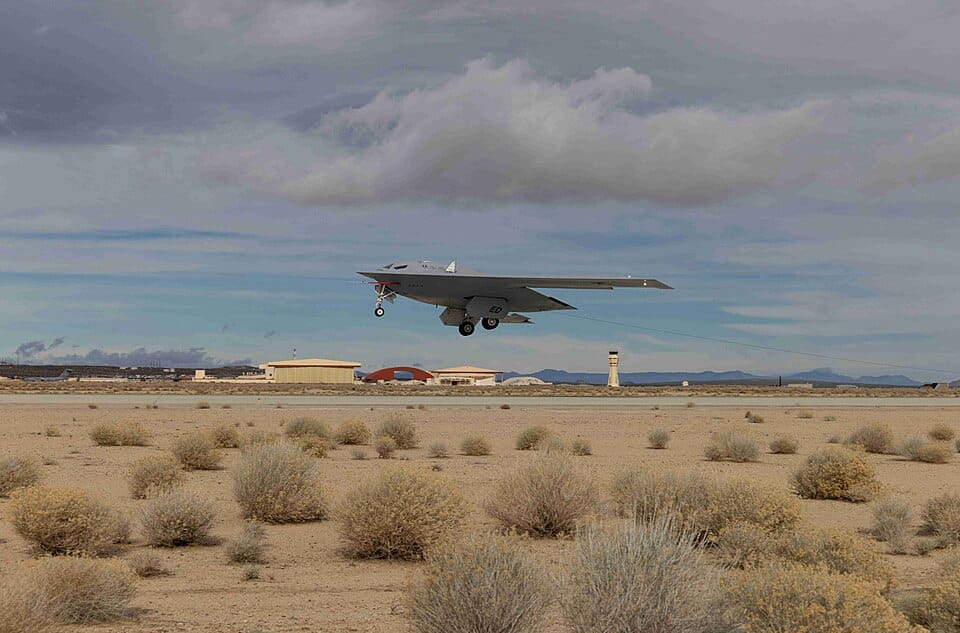
DARPA has not publicly disclosed the specific causes of the delay, which is consistent with the programme’s partially classified status. What matters is that the first flight was successful, and the technology is now validated at operationally relevant scale.
What Comes Next: The Path to Operational Capability
The XRQ-73 is a technology demonstrator, not a production aircraft. The path from a successful first flight to an operational capability fielded at scale involves several additional steps: expanded flight envelope testing, endurance trials, sensor integration, and eventually a transition to a programme of record with a service branch as the customer.
If DARPA and the Air Force follow the typical technology maturation timeline, a production derivative of the SHEPARD concept could enter service in the early 2030s. The more immediate impact may be on existing programmes: the validated hybrid-electric architecture could be retrofitted into current UAS platforms or incorporated into next-generation designs already on the drawing board.
The XRQ-73 SHEPARD is, in the truest sense, a proof of concept. But it is a proof of concept that works, that flies, and that points toward a future in which military reconnaissance aircraft are quieter, more efficient, and more capable than anything currently in service. For the engineers at Northrop Grumman and DARPA, April 14 was a very good day.
Sources: DARPA public release, April 2026; Air Force Research Laboratory; Jane’s Unmanned Aerial Vehicles; Wikimedia Commons (US Government public domain, CC BY-SA).


 English
0 Comments