
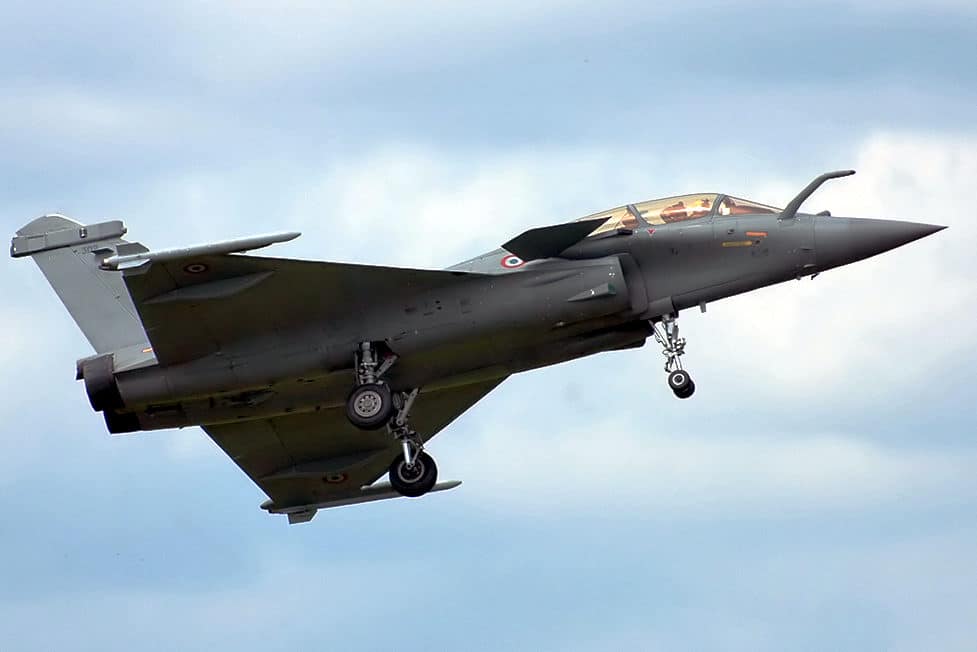
The Dassault Rafale exists because France said no. No to sharing technology. No to compromising on requirements. No to building a European fighter that couldn’t also operate from aircraft carriers. When the Eurofighter consortium told Paris that a navalised variant wasn’t worth the engineering headaches, France walked out and built its own jet. Three decades later, the Rafale has seen more combat than any European fighter of its generation — and the Eurofighter is still waiting for its first air-to-ground kill.
From the deserts of Afghanistan to the skies over Libya, from the Sahel to Syria and Iraq, the Rafale has been France’s instrument of power projection — a true omnirole fighter that can switch from air superiority to deep strike to nuclear deterrence on a single sortie.
✈ Quick Facts
- First flight: July 4, 1986 (Rafale A demonstrator)
- Entered service: 2001 (Marine), 2006 (Armée de l’Air)
- Engine: 2× Snecma M88-2 (each 75 kN with afterburner)
- Max speed: Mach 1.8 (1,912 km/h)
- Combat radius: 1,850 km (with external tanks)
- Variants: Rafale C (single-seat, Air Force), Rafale B (two-seat), Rafale M (carrier)
- Export customers: Egypt, Qatar, India, Greece, Croatia, Indonesia, UAE, Serbia
- Combat operations: Afghanistan (2007), Libya (2011), Mali (2013), Iraq/Syria (2014–present), Yemen area operations
- Nuclear role: Carries ASMP-A cruise missile — France’s airborne nuclear deterrent

Born from a Breakup
In the early 1980s, five European nations — France, Germany, the UK, Italy, and Spain — attempted to build a single European fighter. France wanted a lighter, carrier-capable aircraft. The others wanted a heavier air superiority platform. Neither side would budge. In 1985, France withdrew from what became the Eurofighter program and tasked Dassault with building the Rafale alone.
It was an enormous gamble. France would have to fund the airframe, the engines (Snecma’s M88, developed specifically for the Rafale), the radar (Thales RBE2, Europe’s first production AESA fighter radar), and the weapons systems — all from a single national budget. The result took longer and cost more than anyone predicted, but it produced something the Eurofighter consortium couldn’t: a true omnirole jet that could fight air-to-air, bomb precision targets, conduct reconnaissance, and deliver nuclear weapons — all in one airframe, from both land bases and aircraft carriers.
“The Rafale was designed to do everything because France couldn’t afford two different jets. That constraint became its greatest strength — there’s no mission we can’t fly.”
French Air Force Rafale pilot
Combat Record: Operation by Operation
Afghanistan — Operation Pamir (2007–2012): The Rafale’s first combat deployment. Operating from Dushanbe, Tajikistan and later from Kandahar, Rafales flew close air support and reconnaissance missions. The type dropped its first bombs in combat on March 12, 2007, hitting Taliban positions in the Spin Ghar mountains using GBU-12 laser-guided bombs.
Libya — Operation Harmattan (2011): This was the Rafale’s breakout war. On March 19, 2011, Rafales flew the opening strikes of the NATO intervention, destroying Libyan armor advancing on Benghazi. Over the following months, Rafales conducted both air superiority patrols and precision strikes, often switching roles mid-mission. The SCALP cruise missile saw its first combat use, hitting Gaddafi’s command infrastructure.

Mali — Operation Serval/Barkhane (2013–2022): When jihadist forces threatened to overrun Bamako in January 2013, Rafales flying from Chad struck targets within 24 hours of the French president’s order. The Sahel campaign demonstrated the Rafale’s ability to project power over vast distances in austere conditions, flying 9-hour missions with multiple aerial refuelings.
Iraq and Syria — Operation Chammal (2014–present): France’s contribution to the anti-ISIS coalition. Rafales operating from Jordan, the UAE, and the aircraft carrier Charles de Gaulle have conducted thousands of strike sorties against Islamic State targets. The Rafale’s Damoclès targeting pod and AASM Hammer precision bombs proved particularly effective in urban environments.
The Export Breakthrough
For years, the Rafale’s biggest failure was exports. Egypt broke the drought in 2015 with a 24-aircraft order. Qatar followed, then India (36 aircraft in a politically explosive deal), Greece, Croatia, Indonesia, the UAE, and Serbia. By 2026, the Rafale had become one of the most commercially successful European fighters — a remarkable turnaround for an aircraft that went two decades without a single foreign sale.
“The Rafale spent twenty years being called a commercial failure. Then it became the only Western fighter you could buy that had actually done everything in combat — air-to-air, air-to-ground, SEAD, recon, nuclear strike, carrier ops. The combat record sold the jet.”
Defense industry analyst
The F4 Standard and Beyond
The latest Rafale F4 standard, entering service now, adds a new AESA radar with improved electronic warfare capabilities, the Meteor beyond-visual-range missile, connectivity with drones and other platforms, and enhanced sensor fusion. France has ordered 192 Rafales to date and plans to keep the type in service until at least 2060 — by which point the Rafale will be nearly as old as the Mirage III was when it retired.
Sources: Dassault Aviation, French Ministry of Armed Forces, IISS Military Balance 2026, Jane’s Defence Weekly, The Aviationist, Air & Cosmos
 English
0 Comments