On a bright morning at Bordeaux-Mérignac, the doors of Dassault Aviation’s final assembly hall rolled open to reveal something the business aviation world has been waiting five years to see. The Falcon 10X — the widest-cabin business jet ever designed by a French manufacturer — emerged in full livery on March 10, 2026, marking the official rollout of a programme that aims to redefine ultra-long-range private aviation. First flight is expected within weeks.
The 10X is Dassault’s answer to Gulfstream’s G700 and Bombardier’s Global 8000 — an aircraft built not merely to compete in the ultra-long-range segment, but to dominate it with a cabin so spacious that it blurs the line between private jet and flying apartment. At 2.77 metres wide — that is 9 feet 1 inch — no purpose-built business jet offers more interior width.
Quick Facts
Aircraft: Dassault Falcon 10X
Engines: 2 × Rolls-Royce Pearl 10X
Range: 7,500 nautical miles (13,890 km)
Cabin width: 2.77 m (9 ft 1 in) — widest in business aviation
Passengers: Up to 19
Rollout: March 10, 2026, Bordeaux-Mérignac
First flight: Expected spring 2026
Test aircraft: 3 structurally complete prototypes
Service entry: Projected 2028–2029
Width Is Everything
In business aviation, cabin width is the single most important dimension. It determines whether you can walk past a colleague without turning sideways, whether a bed can be truly flat and wide, whether a dining table seats four comfortably or two awkwardly. Dassault has understood this since the Falcon 900 era, and the 10X takes the philosophy to its logical extreme.
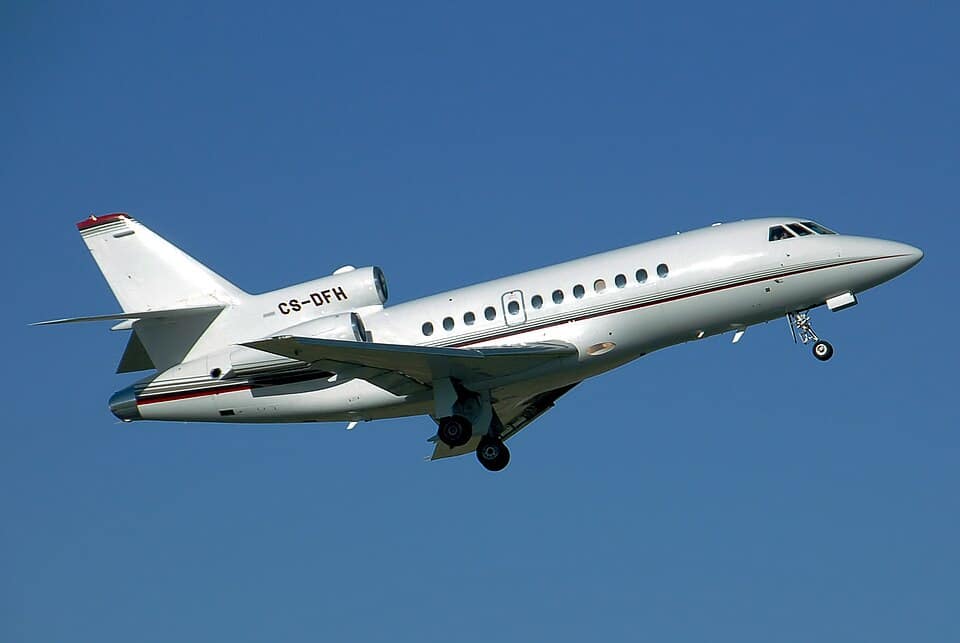
The Dassault Falcon 8X — the Falcon 10X’s predecessor and the current flagship of the Falcon range. The 10X dwarfs it with a cabin nearly a foot wider. Photo: Wikimedia Commons
The 2.77-metre cross-section is wider than most regional airliners. It allows Dassault to offer four distinct cabin zones — a feature typically reserved for narrowbody airline conversions — including a full stand-up shower, a private suite with a proper bed, and a conference area that could pass for a Parisian bureau. The cabin altitude at maximum cruise is maintained at just 3,000 feet equivalent, meaning passengers arrive less fatigued after transcontinental flights. This is not a marginal improvement over the Falcon 8X; it is a generational leap.
The Pearl 10X Powerplant
Rolls-Royce developed the Pearl 10X specifically for this aircraft — a twin-spool turbofan rated at approximately 18,000 pounds of thrust. All engines have been delivered and installed on the test fleet. The Pearl 10X shares its core architecture with the Pearl 700 that powers the Gulfstream G700, but Rolls-Royce has optimised it for Dassault’s specific performance requirements, including the ability to operate from shorter runways and at higher altitudes than competing ultra-long-range jets.
The twin-engine configuration is a deliberate choice. While Dassault’s Falcon 7X and 8X made the trijet layout famous, the 10X’s mission profile — maximum range with minimum operating cost — favours two larger engines over three smaller ones. It also simplifies maintenance and reduces the number of components that need regular inspection, a detail that matters enormously to operators who measure value in cost-per-hour.
Flight Test Campaign
A silhouette comparison of the Dassault Falcon family — the 10X (not shown) will be the largest and longest-range Falcon ever built. Photo: Wikimedia Commons
Three structurally complete prototypes will share the certification workload. The first handles flight envelope expansion and handling qualities. The second focuses on systems integration — avionics, fly-by-wire controls, environmental systems. The third is the cabin conformity aircraft, proving that the production interior meets both comfort standards and safety regulations. Dassault expects the full test campaign to take approximately two years, with European and American certification targeted for 2028–2029.
The fly-by-wire system deserves special mention. Dassault pioneered digital flight controls in business aviation with the Falcon 7X in 2005 and has refined the technology through two subsequent generations. The 10X features a next-generation system with enhanced turbulence mitigation and automatic recovery protections — technologies that trickle down directly from Dassault’s military work on the Rafale fighter.
The Ultra-Long-Range Race
The Falcon 10X enters a market segment that is simultaneously tiny and enormously lucrative. Fewer than a hundred ultra-long-range business jets are delivered each year worldwide, but each one sells for $75 million or more. Gulfstream’s G700 has dominated recent sales, and Bombardier’s Global 8000 is in certification. Dassault is arriving third, but with a cabin-width advantage that neither competitor can match without designing an entirely new fuselage.
For Dassault Aviation, the 10X is more than a product — it is a statement of intent. The company that gave France the Mirage and the Rafale is betting that the same engineering culture can build the finest business jet in the world. The first flight, when it comes, will tell us whether the bet pays off.
Sources: Dassault Aviation, FlightGlobal, Aviation International News, AIAA, CompositesWorld
Before AWACS, air warfare was a knife fight in a dark room. Pilots relied on their own radar, ground controllers with limited visibility, and radio calls that were often confused, late, or wrong. After AWACS, one side had the lights on and the other did not. The...
On May 1, 1960, CIA pilot Francis Gary Powers took off from Peshawar, Pakistan in a Lockheed U-2 spy plane. His mission: fly across the entire Soviet Union at 70,000 feet, photographing military installations, and land in Bodø, Norway. He never made it. A Soviet S-75...
When the Sukhoi Su-47 Berkut rolled out in 1997, it looked like nothing else in the sky. Its wings swept forward instead of back — an aerodynamic concept that promised extraordinary agility, superior low-speed handling, and enhanced controllability at high angles of...




 English
0 Comments