
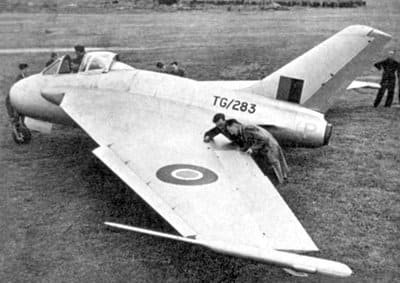
On the evening of 27 September 1946, Geoffrey de Havilland Jr. — son of the great Sir Geoffrey de Havilland — pushed a small, swept-wing experimental jet called the DH.108 Swallow into a high-speed dive over the Thames Estuary. He was evaluating the jet’s high-speed handling ahead of a planned attempt on the world air speed record.
He did not survive. The aircraft broke apart at around Mach 0.9. The wreckage rained into the Thames mudflats. Geoffrey de Havilland Jr. was 36 years old. His death would, in a strange and tragic way, save the lives of every passenger who would ever fly the Comet.
Quick Facts
Aircraft: de Havilland DH.108 “Swallow”
Configuration: Tail-less swept wing, single Goblin turbojet
Crashed: 27 September 1946, over the Thames Estuary
Killed: Geoffrey de Havilland Jr., 36, test pilot and son of the founder
Cause: Severe transonic pitch oscillation — the aircraft broke up at about Mach 0.9
A Family Aircraft Company
To understand the Swallow’s significance, you have to understand the de Havilland family. Sir Geoffrey de Havilland was one of the founding figures of British aviation — the man who designed the Mosquito, the Vampire, and eventually the Comet. His company employed his sons. His youngest, John, had been killed in 1943 when two Mosquitoes collided during testing. Geoffrey Jr., the surviving heir to the family enterprise, was the company’s chief test pilot.
By 1946, the DH.108 was the family’s bid to prove that a tail-less swept-wing configuration could work. The Swallow was small — barely 30 feet long — and built around a single Goblin turbojet. It was meant to be a research aircraft, exploring the handling regime of the swept wing that would eventually fly on the Comet airliner.
The aircraft was capable. Test pilot Eric “Winkle” Brown — who flew the Swallow at the RAE after the fatal crash — found it nimble, responsive, and challenging at the edge of its envelope. He also flagged transonic pitch instability as the major risk.
“At Mach 0.88 it happened. The ride was smooth, then suddenly went all to pieces. As the plane porpoised wildly my chin hit my chest, jerked hard back, slammed forward again, repeated it over and over. My thoughts were grim. This was how it happened. This was how he had died.”
— Captain Eric “Winkle” Brown, who survived the same violent oscillation that killed Geoffrey de Havilland Jr.
The Dive
On 27 September, Geoffrey Jr. took off from Hatfield in the second Swallow prototype. The flight plan called for a high-speed run over the Thames Estuary, including a dive from 10,000 feet to test the aircraft’s behaviour close to the speed of sound.
Shortly after 5:30 pm — he had taken off at 5:26 pm — the small jet entered its steep dive over the estuary. The aircraft accelerated through Mach 0.85 and on toward Mach 0.9. Then suddenly the aircraft was in violent oscillation — wing tip vibration, fuselage flex, pitch oscillations that built rapidly.
At about Mach 0.9, the main spar cracked and the wings folded. The Swallow broke apart. The cockpit, with Geoffrey Jr. still strapped in, fell into the Thames mudflats. His body was found ten days later.
“Geoffrey de Havilland was one of the outstanding test pilots in the country. In the exploration of the unknown threshold of sonic flight, a combination of skill and cool courage are qualities demanding the utmost of test pilots. Geoffrey de Havilland had these qualities in a very high degree.”
— FLIGHT magazine, October 1946
A Lesson Written in Blood
The accident investigation found that the Swallow’s pitch instability — well known but never fully understood — had built into a divergent oscillation that the aircraft’s structure could not survive. The findings reshaped the design philosophy at de Havilland and the broader British industry.
By the time the Comet’s definitive design was settled, the tailless configuration had been abandoned in favour of a conventional tail. The Comet’s modestly swept wing and conservative cruise speed kept it well clear of the transonic regime that had killed Geoffrey Jr. de Havilland.
The Comet would have its own tragedies — fuselage fatigue cracks at the corners of its square windows would take down two airframes in 1954. But the airliner that finally entered service was a safer aircraft for the lessons learned from the Swallow.
Geoffrey Jr. de Havilland had given his life for those lessons. He was the second de Havilland son the family had buried in three years. Supersonic flight itself was finally achieved the following year by Chuck Yeager and the Bell X-1 — but Geoffrey Jr. was among the first to die in its pursuit. He should be remembered.
“A killer. Nasty stall. Vicious undamped longitudinal oscillation at speed in bumps.”Sources: de Havilland Aircraft Museum, RAF Museum archives, Eric Brown’s memoirs.
— Captain Eric Brown’s official assessment of the DH.108
 English
0 Comments