
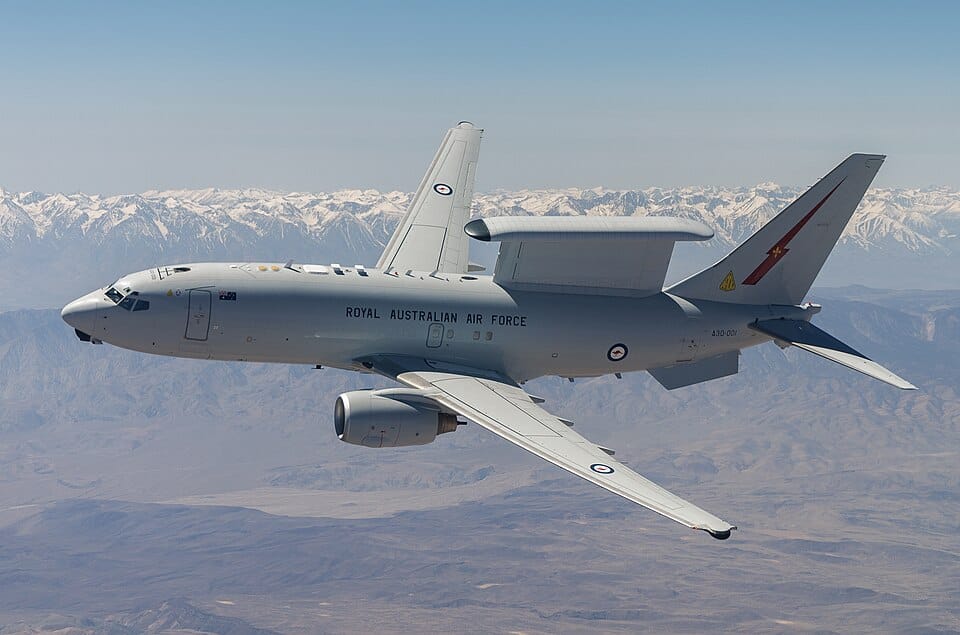
Four months ago, the Pentagon tried to kill the E-7 Wedgetail. Now Defense Secretary Pete Hegseth wants every last one of them. That’s not a policy shift — that’s a full 180 at Mach 0.8.
Hegseth has sent a budget amendment to the White House formally requesting full funding for the Boeing E-7A Wedgetail airborne early warning and control aircraft, reversing the administration’s earlier move to zero out the program. The turnaround came fast — and it came with urgency. The U.S. Air Force’s fleet of aging E-3 Sentry AWACS planes is shrinking faster than anyone planned, and at least one was heavily damaged during operations tied to the Iran conflict. With only a handful of operational E-3s remaining, America’s airborne battle management capability is suddenly looking very thin.
Congress had already seen this coming. Lawmakers allocated more than $1 billion toward the Wedgetail program after the Pentagon tried to pull the plug — one of the more dramatic congressional reversals in recent defense budget history. Now Hegseth has caught up to where Congress already was. “The E-7 has a future,” the Defense Secretary said. He wasn’t kidding.
Quick Facts
- Aircraft: Boeing E-7A Wedgetail (737-700 AEW&C)
- Role: Airborne early warning and battle management
- Decision: Hegseth reverses course — full funding requested
- Budget Amendment: Sent to White House (May 2026)
- Congressional Funding: $1 billion+ already allocated by Congress
- E-3 Status: Fleet severely depleted; at least one heavily damaged in Iran operations
- Program Origin: Originally developed for Royal Australian Air Force
From Zero to Full Speed: The Budget Reversal
The original Pentagon plan was stark. The FY2026 budget proposal wiped the Wedgetail line entirely — a zero. The reasoning, such as it was, leaned on the usual cost arguments: the E-7 was an unproven foreign design (it entered service with the Royal Australian Air Force in 2009), and the Air Force was already stretched thin across competing procurement priorities.
Congress didn’t buy it. Defense appropriators on both sides of the aisle have watched the E-3 Sentry fleet deteriorate for years. The 707-based aircraft, which first flew as an AWACS platform in 1975, has been nursing aging airframes through patch-and-pray maintenance cycles. When operations against Iran put additional stress on the remaining fleet — and damaged at least one aircraft severely enough to remove it from service — the urgency became impossible to ignore.
The House Armed Services Committee led the charge, restoring E-7 funding over the Pentagon’s objections. The Senate followed. By the time Hegseth’s office drafted the budget amendment now heading to the White House, Congress had already moved more than a billion dollars into Wedgetail procurement and development. The Pentagon’s about-face isn’t a surprise — it’s a catch-up.

What the E-7 Actually Brings
The E-7A Wedgetail isn’t just a newer box strapped to a newer plane. It represents a fundamental leap in airborne battle management capability. The centerpiece is the Northrop Grumman MultiRole Electronically Scanned Array (MESA) radar — a fixed, 360-degree active electronically scanned array that can track hundreds of targets simultaneously in both air and maritime environments. Compare that to the E-3’s rotating rotodome, a design concept from the Nixon administration, and the difference is generational.
The 737-based platform also brings significant logistics advantages. The 737 is the most common airliner in the world — parts, training, and maintenance infrastructure already exist at virtually every air base on earth. Contrast that with the E-3, whose 707 airframe hasn’t been in commercial production since 1991. Keeping the Sentry flying has become an exercise in creative scavenging for increasingly rare components.
Australia, Turkey, South Korea, the United Kingdom, and the NATO alliance already operate or have ordered the Wedgetail — with the U.S. now set to become the largest operator. The RAAF’s Wedgetails have already seen operational deployments, giving the platform a real-world track record that the Pentagon had previously downplayed.

The Iran Factor: What Damage Does to a Fleet
The Iran conflict has accelerated timelines across multiple U.S. Air Force programs, but its impact on the AWACS fleet has been particularly acute. The E-3 Sentry operates in contested airspace on the edges of conflict zones — providing the critical radar picture that allows strike packages to operate without flying blind. That exposure comes with risk.
With at least one E-3 now out of action due to battle damage sustained during Iranian-theater operations, the operational fleet has shrunk to a level where sustained AWACS coverage is becoming a planning constraint rather than a planning assumption. Air Force commanders requesting sorties are being told “when available” rather than “yes.” That is a capability crisis in slow motion.
The Wedgetail cannot solve this problem overnight. Even with the budget amendment approved and contracts signed, the first USAF E-7s won’t reach initial operational capability for several years. In the meantime, the Air Force will lean harder on E-3s from allies — particularly the NATO E-3 fleet and Australia’s Wedgetails — to fill coverage gaps. It is a workable stopgap, but not a comfortable one.
Seven Installations, One New Mission
The Wedgetail program will require significant infrastructure investment beyond the aircraft themselves. The MESA radar system demands new ground support equipment, updated communications architectures, and revised tactics — the E-7 operates differently enough from the E-3 that crews won’t simply slide from one cockpit to the other. Training pipelines will need to be built essentially from scratch for U.S. operators.
Boeing has already stood up production and modification lines in the United States. The company’s experience with the Australian and British programs provides a head start, but scaling to USAF quantities — potentially dozens of aircraft — represents a significant ramp. The budget amendment will need to address not just aircraft procurement but the full ecosystem of parts, simulators, and training infrastructure.
The Pentagon’s reversal is, in the end, a victory for the operators who have been sounding the alarm about AWACS capability for years. The E-3 was magnificent in its time — it transformed air warfare in the 1980s and kept that edge through the 1990s and 2000s. But time catches everything. The Wedgetail is ready. The question now is whether the funding pipeline can move fast enough to meet the operational need.
Sources: U.S. Department of Defense, Defense News, Air & Space Forces Magazine, Congressional Budget Office, Boeing Defense

 English
0 Comments