
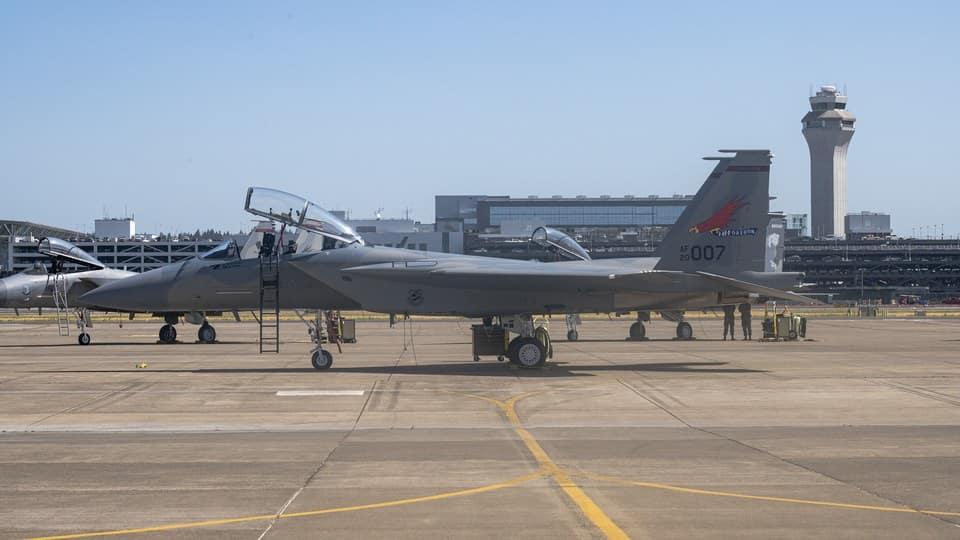
Quick Facts
- New target: 267 F-15EX Eagle II jets (up from 129)
- FY2027 order: 24 aircraft at $3 billion
- Replaces: Aging F-15C/D and eventually F-15E Strike Eagle fleet
- Weapons capacity: 29,500 lbs across 23 hardpoints — more than any US fighter
- Manufacturer: Boeing, St. Louis
Why Double Down on a 1970s Design?
The answer lies in a Pentagon evaluation that read like a love letter. Earlier this year, the Department of Defense’s operational testing office concluded that the F-15EX is “operationally effective in all its air superiority roles, including defensive and offensive counter-air against surrogate fifth-generation adversary aircraft.” That’s Pentagon-speak for: it can hold its own even against stealth fighters in exercises. The F-15EX carries the APG-82 AESA radar, an all-glass digital cockpit, the Eagle Passive/Active Warning Survivability System (EPAWSS) for electronic warfare, and 23 weapons stations capable of hauling nearly 30,000 pounds of ordnance. No other American fighter comes close on payload.
The Budget Behind the Buy
The doubling is possible because the Air Force’s overall FY27 budget rises roughly 25 percent, with procurement spending jumping about 30 percent. Air Force Secretary Troy Meink framed it as a paradigm shift: “FY 2027 moves beyond the trade-off between modernization and readiness” by funding both simultaneously. At 267 jets, the fleet could support 13 squadrons of 21 aircraft each. That’s enough to stock active-duty wings, Air National Guard units, and overseas rotational forces — filling a fighter shortfall that Air Force leaders have warned about for years.Goodbye, Strike Eagle?
The most significant implication is for the F-15E Strike Eagle. The dual-role workhorse has been in service since 1988 and flew combat missions from Desert Storm to the ongoing operations over Iran, where an F-15E was shot down on April 3. The airframes are aging, maintenance costs are climbing, and the avionics are generations behind the Eagle II. The Air Force now explicitly plans to “begin to recapitalize the aging F-15E fleet” with F-15EX purchases. For the Strike Eagle community, it’s both an ending and a continuation — the same basic airframe, reborn with digital bones.
What It Means for the Fighter Fleet
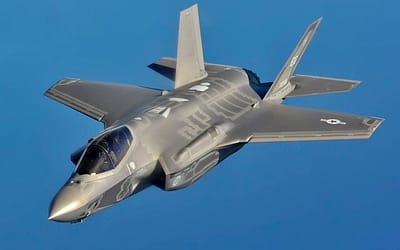
The F-15EX expansion doesn’t come at the expense of stealth. The F-35 Lightning II remains the Air Force’s primary fifth-generation fighter, with 85 jets ordered in the most recent batch. And the F-47, the new sixth-generation air dominance platform, continues its development alongside Anduril’s YFQ-44A Fury drone wingman. But where the F-35 brings stealth and sensor fusion, the Eagle II brings brute-force capacity: the ability to carry a dozen AIM-120 AMRAAMs, or a mix of standoff weapons that would require two or three F-35 sorties to match. In a high-volume conflict — exactly the kind of fight the Pentagon is planning for — having a truck that can haul ordnance matters as much as having a scalpel. The Eagle II’s 20,000-hour airframe life means jets delivered today will still be flying in the 2060s. For a design that first flew in 1972, that’s not a bad run.Sources: Breaking Defense, Air & Space Forces Magazine, U.S. Air Force

 English
0 Comments