
| Quick Facts | |
| Event | F-15E Strike Eagle shot down over Iran |
| Date | April 3, 2026 |
| Operation | Epic Fury (ongoing since February 28, 2026) |
| Aircraft | Boeing F-15E Strike Eagle (two-seat) |
| Crew | Pilot + Weapon Systems Officer; one rescued, one status unknown |
| Significance | First confirmed US fixed-wing combat loss in the Iran campaign |

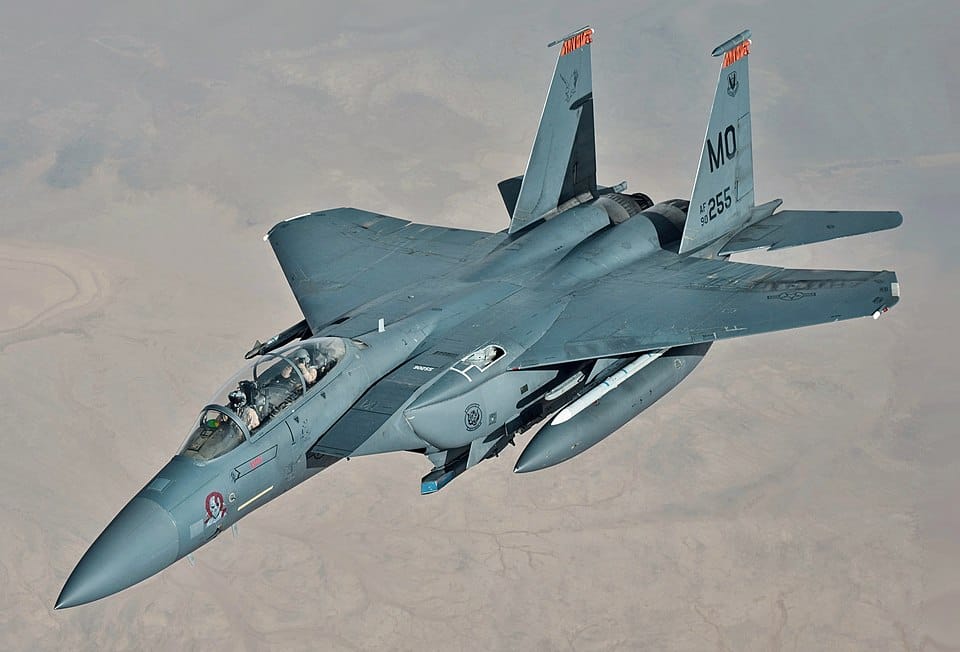
An American F-15E Strike Eagle has been shot down over Iran, marking the first confirmed loss of a US fixed-wing combat aircraft since Operation Epic Fury began on February 28. Search and rescue operations are underway for the jet’s two-person crew.
Related: BUFFs Over Iran: B-52s Now Dropping JDAMs Overland
The Strike Eagle went down over central Iran on the morning of April 3. Within hours, Iranian state media broadcast images of wreckage scattered across a desert site, claiming the kill for the Islamic Revolutionary Guard Corps’ air defence network. Tehran initially identified the aircraft as an F-35 — but debris photographs circulating online clearly show the distinctive conformal fuel tanks and twin-engine layout of the F-15E.
US Central Command has not released an official statement identifying the aircraft type, but multiple US officials speaking to American media have confirmed the loss of an F-15E. President Trump has been briefed.
One Rescued, One Missing
The F-15E carries a crew of two: a pilot in the front seat and a weapon systems officer in the rear. According to a Western source cited by Israeli media outlet N12, one crew member has been successfully recovered by US search and rescue forces. The status of the second crew member remains unconfirmed, though Iranian local media claim a capture may have occurred.
Combat search and rescue is one of the most dangerous missions in modern air warfare. Extracting a downed aviator from hostile territory requires a complex chain of assets — helicopters, fixed-wing cover, aerial refuelling, and real-time intelligence. The US military has maintained dedicated CSAR capabilities in the region since Epic Fury began, anticipating exactly this scenario.

The Strike Eagle’s Combat Pedigree
The F-15E Strike Eagle entered service in 1988 as a dual-role fighter — equally capable of air-to-air combat and precision ground attack. It has been the backbone of American deep-strike capability in every major conflict since Desert Storm, dropping laser-guided bombs on Iraqi armour in 1991, hunting Scud missile launchers in the western desert, striking Taliban positions in Afghanistan, and flying thousands of sorties over Iraq and Syria against ISIS.
It is not, however, a stealth aircraft. The F-15E relies on speed, electronic warfare, and mission planning to survive in contested airspace — a very different approach from the low-observable F-35. Against a sophisticated, layered air defence system like Iran’s — which includes Russian-supplied S-300 batteries and domestically produced systems — the Strike Eagle operates at significant risk.
Iran’s air defences have been a known threat since well before Epic Fury. The country operates a mix of legacy Soviet-era systems and newer indigenous designs, concentrated around strategic sites and major cities. The strike packages flying over Iran have relied on a combination of standoff weapons, electronic attack from EA-18G Growlers and the newly deployed EA-37B Compass Call, and overwhelming force to suppress these defences.
What This Means
Today’s shootdown is a stark reminder that air superiority does not mean invulnerability. The US has conducted more than five weeks of continuous air operations over Iran with relatively few losses — but Iran’s air defence network, while degraded, is far from destroyed. Every sortie over Iranian territory carries real risk for the crews involved.
The fate of the second crew member will dominate the next news cycle. If confirmed captured, it would mark the first American prisoner of war in the conflict — a development with enormous political and military implications. For now, the search continues.
This is a developing story. We will update this post as more information becomes available.
Sources: Air and Space Forces Magazine, The War Zone, CNN, CNBC, Axios
 English
0 Comments