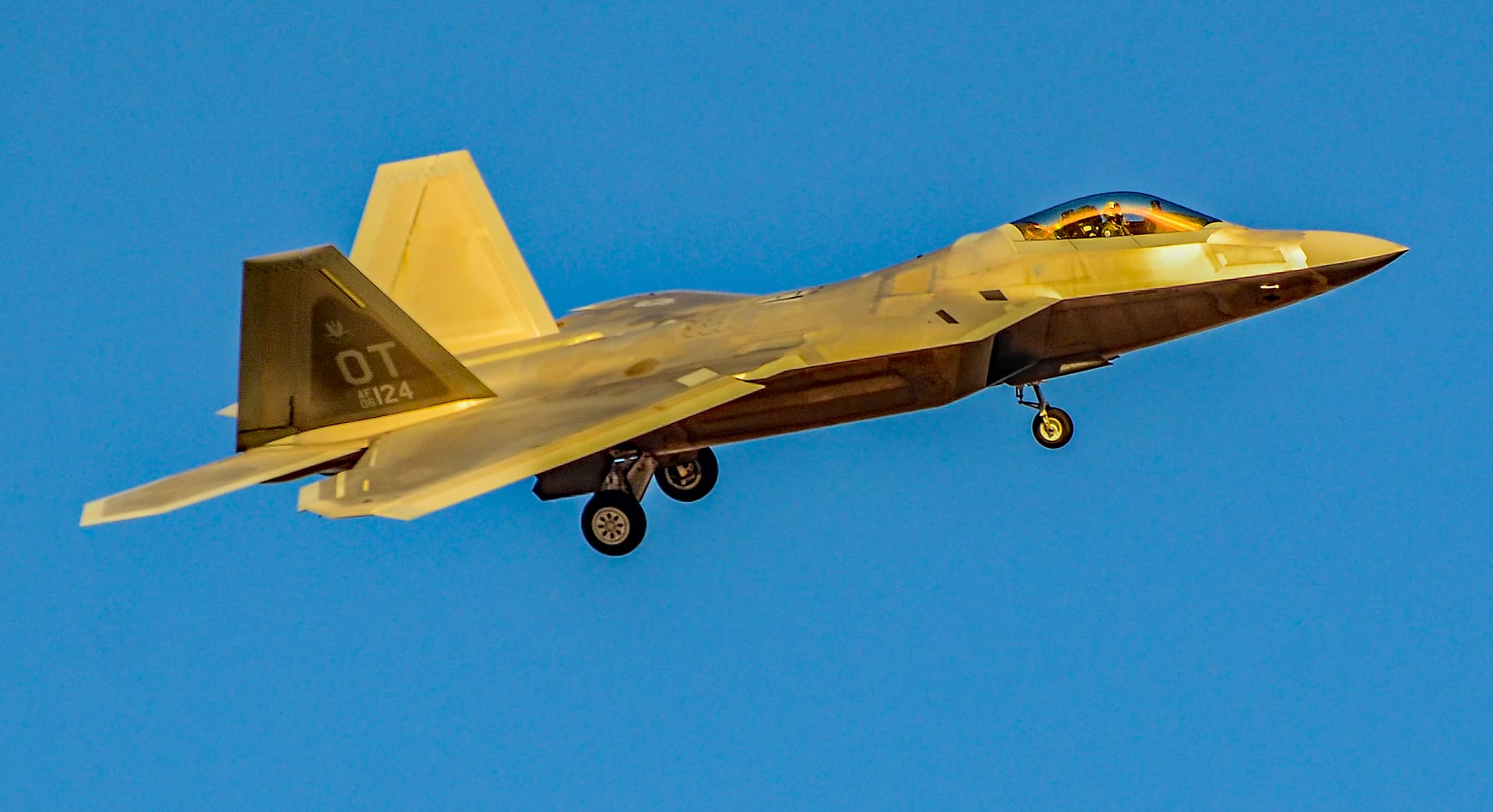
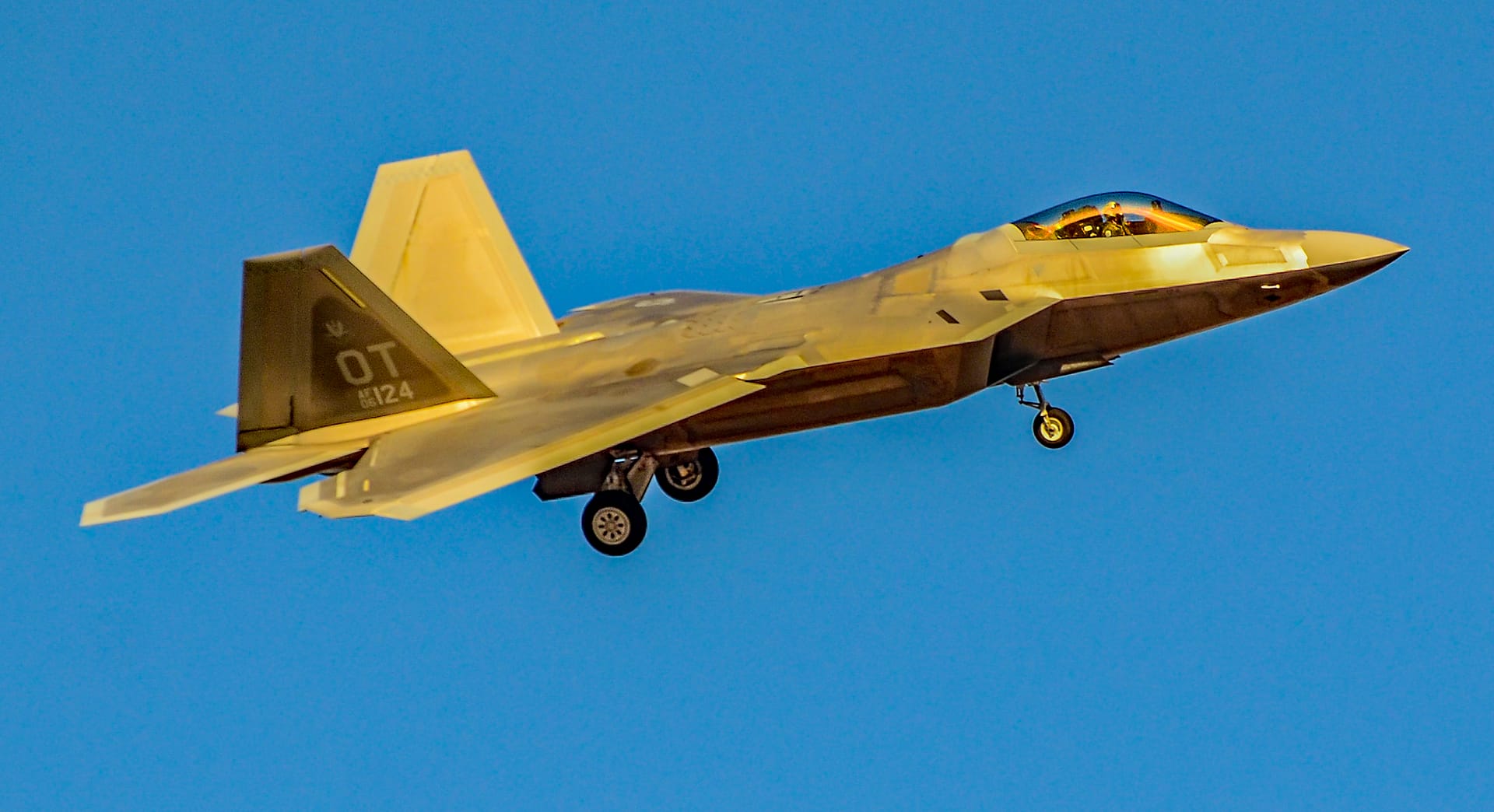
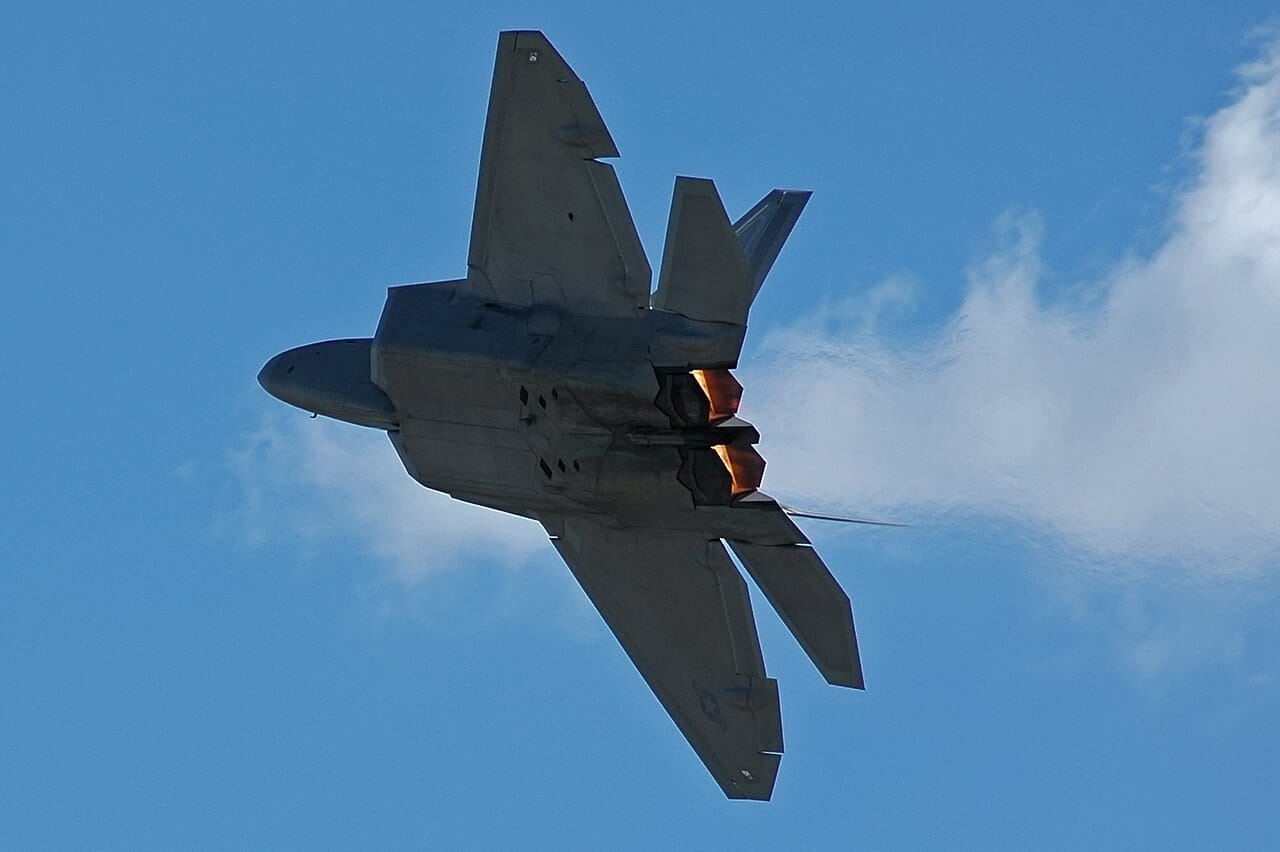
Aviation photographer Jarod Hamilton captured the sharpest images yet of an F-22A Raptor flying with both stealthy external fuel tanks and specialised sensor pods at Edwards Air Force Base on March 21, 2026 — providing the clearest look to date at a significant upgrade package being developed for America’s premier air superiority fighter.
What Was Observed
The Raptor was photographed carrying two identical pods on wing stations — at least one featuring a transparent nose section consistent with an infrared search and track (IRST) sensor or optical targeting system. The aircraft was also carrying new external fuel tanks designed with reduced-radar-cross-section geometry, a notable development given that the F-22 has historically operated in a clean, tank-free configuration to preserve its stealth signature.
Flying in formation with the F-22 were an NKC-135R Stratotanker and a B-52H — the latter itself carrying inert AGM-181 LRSO missiles on its wing pylons, indicating a coordinated strategic aircraft test package operating out of Edwards’ 419th Flight Test Squadron.
Filling a Long-Standing Gap
The F-22 was originally designed in the early 1990s without an integrated IRST system — a capability that was cut during post-Cold War budget reductions. Unlike the F-35, which carries an embedded electro-optical targeting system as a core feature, the Raptor has relied on external data sources and GPS-guided weapons when optical designation is required. The new pods would address this gap, giving the F-22 an independent passive targeting capability that works without emitting radar signals that could betray the aircraft’s position.
IRST systems are increasingly relevant in modern air combat: they detect the heat signature of aircraft engines and exhaust plumes, allowing a fighter to track and engage targets without switching on radar. As adversary aircraft have grown more sophisticated in detecting radar emissions, passive optical sensors have become a higher priority across multiple air forces.
Stealth External Tanks
The addition of stealthy drop tanks is a separate but equally significant development. The F-22’s combat radius has been a noted limitation in Pacific theatre planning scenarios — the distances involved in potential operations across the Western Pacific demand greater range than the internal fuel load provides. Standard external tanks degrade the aircraft’s radar cross-section substantially; the new low-observable tanks aim to provide added fuel while preserving, at least partially, the stealth characteristics that make the F-22 viable in contested airspace.
Both the pods and the tanks had been observed on F-22s previously — initial sightings date to March 2024 — but the March 2026 photographs represent the closest and clearest imagery of the systems to date. The Air Force made no effort to conceal the equipment, leading some analysts to suggest the public sighting may be intentional, serving as a visible signal of capability development.
Sources: The War Zone · Aviation Week & Space Technology