
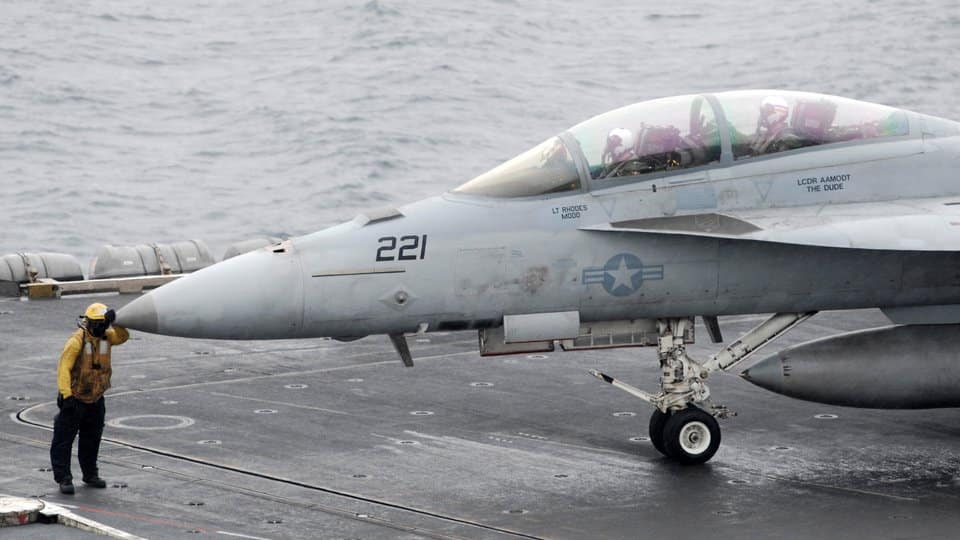
The Pentagon is not letting another sixth-generation fighter slip the way the F-35 did. In a quiet but significant move on May 7, 2026, the Defense Department’s top acquisition official took direct oversight of the U.S. Navy’s F/A-XX next-generation stealth fighter — elevating the programme to ACAT-1, the small club of weapons programmes deemed critical to national security and personally overseen at the Office of the Secretary of Defense level.
It is the procurement equivalent of giving a program a black-tie escort to the front of the queue.
The decision lands at a fragile moment. F/A-XX is the carrier-based counterpart to the Air Force’s F-47, and the Navy has spent five years watching the programme stall. Lockheed Martin was eliminated from the competition early in 2025. Boeing and Northrop Grumman remain the two finalists. A contract award is now expected in August 2026 — the first hard date the programme has had in years.
Quick Facts
Programme: F/A-XX Next-Generation Carrier Fighter
New status: ACAT-1 (Acquisition Category 1)
Oversight: DoD Office of the Under Secretary of Defense for Acquisition and Sustainment
Finalists: Boeing, Northrop Grumman
Eliminated: Lockheed Martin (early 2025)
Contract decision: August 2026 (planned)
Operational target: Mid-to-late 2030s
Replaces: F/A-18E/F Super Hornet
What ACAT-1 Actually Means
ACAT-1 designation is not a marketing label. It triggers a different governance regime entirely — the programme reports to the Under Secretary of Defense for Acquisition and Sustainment, not just the Naval Air Systems Command. Decisions on cost overruns, capability trades, and schedule slippage now go through the Pentagon’s top procurement officer rather than the Navy alone.
For F/A-XX, this means three things. First, the program gets first call on engineering and industrial resources. Second, it gets cover from any future budget raids. Third — and most importantly for Boeing and Northrop — it gets a contract.
Why Now?
The Air Force’s F-47 sixth-gen programme is already locked in and funded. The Navy is roughly two years behind, and the Pentagon has heard alarms from the Indo-Pacific Command about the carrier air-wing gap that will open in the early 2030s when Super Hornets start aging out. A sixth-gen carrier fighter is not a luxury; it’s the centrepiece of how the U.S. plans to fight at sea in 2035.
Elevating F/A-XX to ACAT-1 is the Pentagon’s way of saying: this is not getting cancelled, slipped, or value-engineered into a Super Hornet Block 4.
The Boeing-Northrop Race
Boeing has been heavily favoured in some circles after winning the F-47 — but that double-win risks an industrial-base argument against awarding both sixth-gen contracts to the same prime. Northrop, which built the B-21 and the X-47B unmanned carrier demonstrator, has the stealth and carrier-suitability credentials. The August decision will redraw American combat aviation for a generation.
For now, F/A-XX has what it has not had in five years: priority, oversight, and a date on the calendar.
Sources: Bloomberg, U.S. Naval Institute News, Air & Space Forces Magazine.

 English
0 Comments