
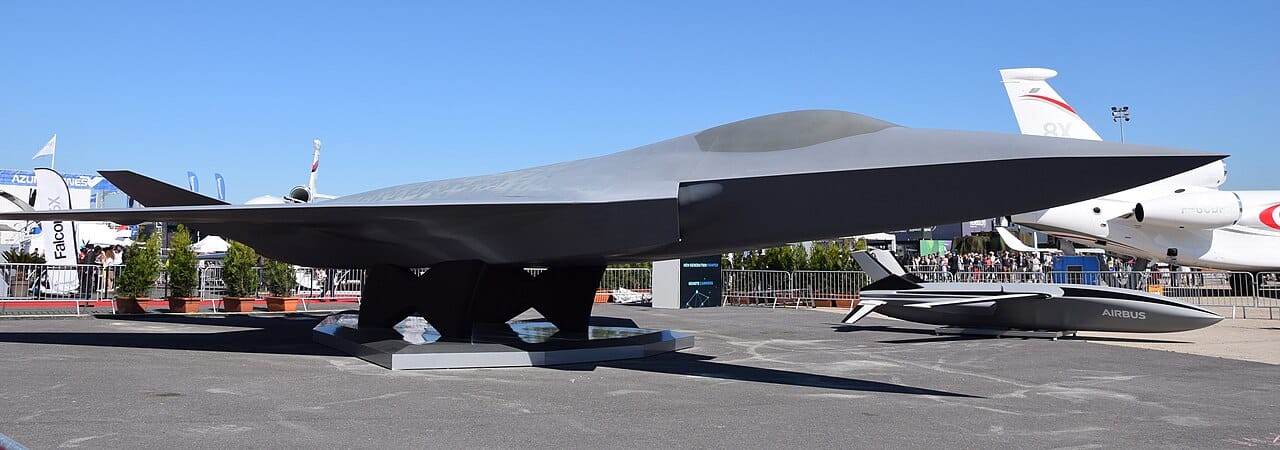
It was supposed to be Europe’s answer to the F-35. A continental sixth-generation fighter, jointly built by France, Germany and Spain, flanked by drone wingmen and tied together by a “combat cloud” stretching from Brest to Bavaria. Six years and several billion euros later, the partnership is in pieces — and the man who may have just sealed its fate is a German chancellor who barely spoke about it in his campaign.
On 18 February 2026, Friedrich Merz sat down with the German political podcast Machtwechsel and delivered a line that one European defence minister immediately translated into a death notice. “The French need, in the next generation of fighter jets, an aircraft capable of carrying nuclear weapons and operating from an aircraft carrier,” Merz said. Then he added the dagger: “That’s not what we currently need in the German military.”
Within hours, Belgium’s defence minister Theo Francken — whose country had joined FCAS as an observer — posted three words on X that crystallised what insiders had whispered for over a year. “SCAF is dead.” The Future Combat Air System, the most ambitious aerospace project on the continent, had just been declared a corpse by a politician who would have been one of its customers.
“There will be no Franco-German sixth-generation fighter jet,” he added in a follow-up post. “Belgium was an observer in the program. We will reassess our position.” For a NATO defence minister whose country was supposed to be a future customer, that is about as final as it gets without an official press release.
While Paris and Berlin Fight, London, Rome and Tokyo Build
The other story Merz’s interview accidentally amplifies is what the Brits and Italians are doing with their own sixth-gen project. The Global Combat Air Programme — GCAP, born from BAE Systems’ Tempest concept and Japan’s F-X requirement — is in a different stage of life. There is a signed treaty governing it, a Reading-based international governmental organisation running it, and a digital-twin programme already churning out flying surfaces in the wind tunnel. Entry into service is targeted at 2035 — five years before FCAS’s official date, and probably ten years before the rebuilt French and German programmes can field anything real.
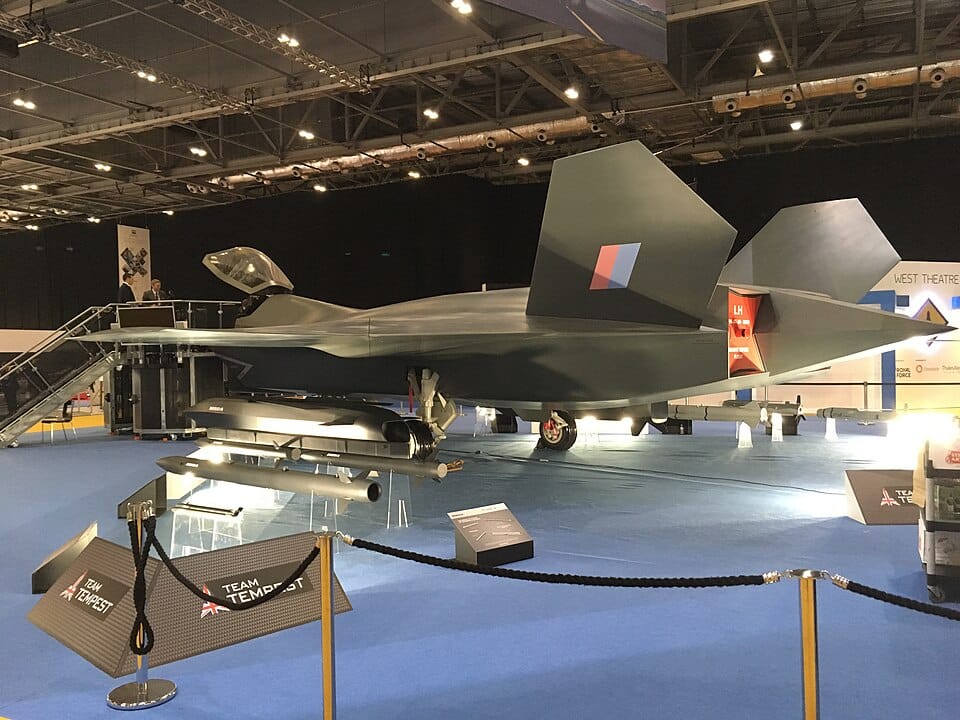
GCAP’s politics are no less complicated than FCAS’s — Britain post-Brexit, Italy juggling NATO and continental loyalties, Japan facing a Pacific arms race — but the project has one structural advantage Paris and Berlin do not. None of the three GCAP partners has serious continental territorial pride to bruise. BAE leads the manned-aircraft work, Leonardo does the electronics, Mitsubishi Heavy Industries does the structures and Pacific integration, Rolls-Royce and Avio Aero do the engines. The pecking order was set out before contracts were signed. Nobody is trying to retrofit it.
Italy has now publicly said it would consider letting Spain or Germany join GCAP if FCAS collapses. Switzerland, Sweden and Saudi Arabia are all watching. The Times of London reported in March 2026 that Riyadh has begun preliminary contract talks for GCAP airframe purchases.

What Comes Next: Two Fighters, Maybe Three
The most realistic outcome that German and French officials now privately admit is a divorce with shared custody of the cousins. Dassault gets to lead a French-Spanish (or French-Belgian, or French-only) NGF, almost certainly using the Rafale F5 as a bridge platform and Safran’s M88 engine as the technological launching pad. Airbus and Indra build a Germano-Spanish jet of their own — probably more Eurofighter-evolution than clean-sheet design. The combat cloud and drone-wingman work, the parts of FCAS that did not depend on a single piloted airframe, are kept alive as a hedge.
For Dassault, divorce may quietly be the preferred outcome. The Rafale order book is currently the strongest it has been since the type entered service — India is finalising a 114-aircraft contract, Indonesia, Egypt, Greece, Croatia and the UAE are all customers, and Saudi Arabia is reportedly back in discussions. A wholly French sixth-gen platform, exportable on French terms, with French software and French combat-cloud certification, is now commercially plausible in a way it was not in 2017.

For Germany, the calculus is harder. Berlin has gone all-in on the F-35A as its nuclear-capable platform of choice, but the Luftwaffe still needs a long-term Eurofighter successor and a credible role for Airbus Defence and Space — a national champion whose civil-aviation half is already wobbling. A wholly German-Spanish next-generation fighter is plausible on paper, but the price tag, even split with Madrid, is brutal.
And then there is the awkward question nobody in Brussels wants to ask out loud: can Europe actually support three sixth-generation fighter programmes — GCAP, an evolved Rafale-successor, and an Airbus-led NGF — at a moment when the continent is also trying to rebuild its munitions stockpiles, scale up Ukraine support, and prepare for whatever Donald Trump decides about NATO in 2027?
Francken doesn’t think so. Neither does Paul Taylor, the European Policy Centre analyst. Neither, behind closed doors, does most of the European Defence Agency. Three programmes is two too many — and the one with a treaty, a working international organisation, an export pipeline, and an entry-into-service date in the 2030s is the one Europe will keep. The other two will eventually be allowed to go without a funeral.
The Final Word
FCAS was never really a fighter programme. It was a Franco-German political reconciliation project that happened to involve aircraft. As long as Paris and Berlin needed each other for symbolic reasons, the project could survive almost any technical disagreement. The moment a chancellor decided the symbolism was no longer worth the engineering price, the project stopped making sense. Merz didn’t kill FCAS — the disagreement over Dassault’s workshare killed it. Merz just stopped pretending it was alive.
Sources: Breaking Defense (Tim Martin, 18 February 2026); European Policy Centre commentary by Paul Taylor; The Times of London on Rafale exports; ECFR analysis "The trouble with FCAS"; Machtwechsel podcast (German); Military Watch Magazine; Wikimedia Commons for photography.

 English
0 Comments