The drone that killed a $21 million helicopter cost less than a decent pair of headphones.
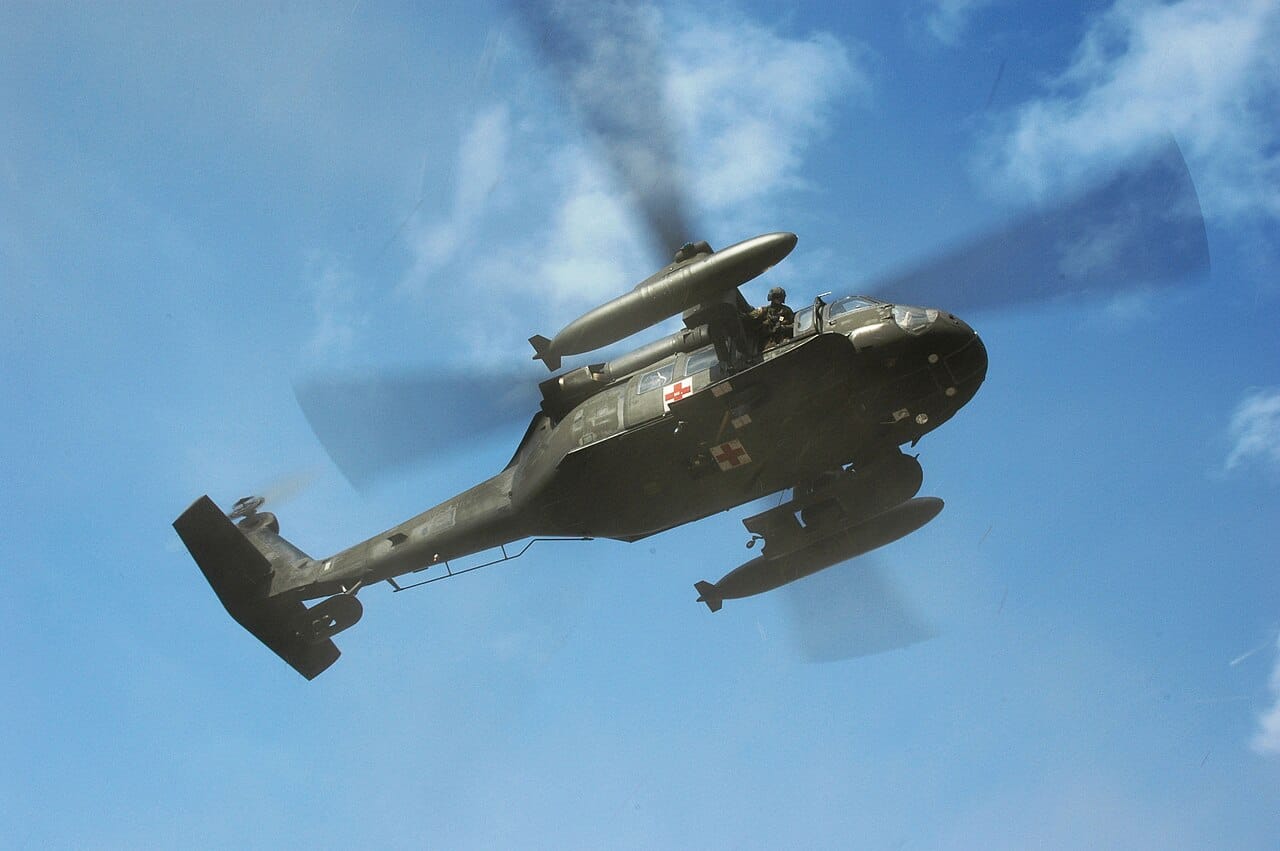
On March 23, an Iran-backed militia launched a first-person-view drone at Victory Base Complex near Baghdad International Airport. The target was an HH-60M Black Hawk — a medical evacuation variant assigned to Charlie Company, 2nd Battalion, 4th Regiment, 4th Infantry Division Combat Aviation Brigade. The drone flew low, threaded through the base’s perimeter, and slammed into the parked helicopter. A second FPV drone hit an AN/MPQ-64 Sentinel radar nearby, destroying it as well.
No air defenses engaged either drone. No interception was attempted. The footage, released by the militia, shows both strikes in crisp, uninterrupted first-person video — the kind of quality that suggests either fiber-optic control links or an extremely short launch distance.
The Cost Equation Nobody Can Solve
The numbers are brutal. An FPV drone of the type used in this attack can be assembled for $300–$500 using commercial components. The HH-60M MEDEVAC Black Hawk it destroyed carries a price tag of roughly $21 million. The Sentinel radar was worth several million more.
This is the asymmetry that keeps defense planners awake. You cannot build a cost-effective defense when the attacker’s entire weapon costs less than a single round of ammunition from the defender’s system. And the attacker needs no runway, no logistics chain, no trained pilot — just a laptop, a controller, and a line of sight.
Ukraine has been demonstrating this math for four years. Now it has arrived at American bases in the Middle East.
Parked Aircraft: The Softest Target
What makes this strike particularly sobering is the vulnerability it exposed. The Black Hawk was not in flight. It was not performing a mission. It was sitting on a ramp, presumably serviced and ready — and completely defenseless.
Aircraft on the ground have always been vulnerable. The Israeli Air Force proved this in 1967 when it destroyed the Egyptian Air Force on its runways in the opening hours of the Six-Day War. But that required hundreds of jet sorties and meticulous planning. This required a single drone operator with a camera feed.
U.S. Secretary of War Pete Hegseth had previously acknowledged the escalating threat: “Emerging technologies — we see it in battlefields, in far-flung places, and we see it on our own border in small unmanned aerial systems. They target and bring harm on all warfighters, our people, our bases.”
“The sinews of war are infinite money.”
— Marcus Tullius Cicero
Where Were the Defenses?
Victory Base Complex is not an obscure forward operating post. It sits adjacent to Baghdad International Airport and has been a cornerstone of the American military presence in Iraq for over two decades. It should have counter-drone capabilities. The fact that two FPV drones penetrated the base, selected their targets, and struck without any visible countermeasure response raises serious questions about force protection.
The War Zone noted that similar drone incursions had occurred at the same base earlier in March. This was not a surprise attack exploiting an unknown vulnerability. It was a repeat strike against a known weakness.
The implications extend far beyond Iraq. If a handful of commercial drones can destroy multi-million-dollar military assets on a well-established American base, the same tactic can work at any air base, any forward operating location, anywhere in the world.
The age of cheap precision has arrived. And the parking ramp just became the most dangerous place on a military base.
Sources: The War Zone, Defense Express
 English
0 Comments