Gripens Shadow Russian Sub Through Scandinavian Waters

by | Apr 12, 2026 | Military Aviation, News | 0 comments

On April 10, 2026, the Swedish Armed Forces released photographs that tell a story in a single frame: two JAS 39 Gripen fighters flying overwatch above a Russian Kilo-class submarine as it transited the Kattegat — the narrow strait between Sweden and Denmark that connects the Baltic Sea to the North Sea. Below them, a Visby-class corvette shadowed the submarine on the surface. It was a layered NATO intercept package, executed in Swedish waters, and it has become almost routine. The images, published on the Swedish military’s official social media channels, are striking. The Gripens are low, the submarine is surfaced, and the Visby-class corvette — one of the most advanced stealth warships in any navy — trails at a discreet distance. The message is clear: we see you, and we are here.

Quick Facts

Date: April 10, 2026

Location: Kattegat strait — between Sweden and Denmark

Russian vessel: Kilo-class diesel-electric attack submarine

Swedish response: JAS 39 Gripen fighters (airborne overwatch) + Visby-class corvette (surface tracking)

Context: Russian submarine transits through Scandinavian waters have become a near-weekly occurrence

The Kattegat: NATO’s Northern Chokepoint

The Kattegat is one of the most strategically important waterways in northern Europe. Every Russian submarine heading from the Baltic Fleet’s bases to the open Atlantic must pass through it. The strait is shallow, narrow, and heavily monitored — a natural chokepoint where detection is almost guaranteed if you know what to look for. And Sweden, which joined NATO in 2024, knows exactly what to look for.
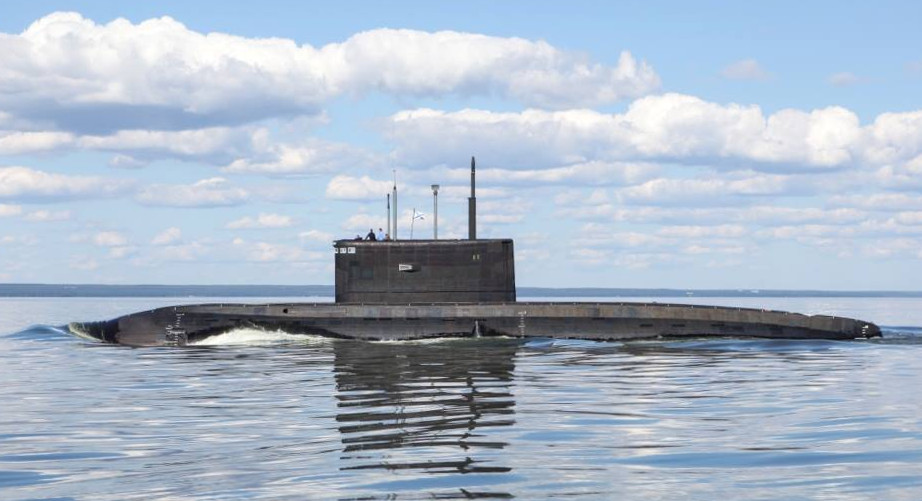
Russian Kilo-class submarine Krasnodar surfaced
A Russian Kilo-class submarine — the same type escorted through the Kattegat by Swedish forces. These diesel-electric boats are among the quietest conventional submarines in the world. Wikimedia Commons
Kilo-class submarines carry Kalibr cruise missiles capable of striking land targets at ranges exceeding 1,500 kilometres. A single Kilo transiting the Kattegat is not just a submarine passing through — it is a mobile launch platform capable of reaching targets deep in Western Europe. That is why every transit gets the full treatment: fighters above, corvettes alongside, and every sensor in the Swedish inventory pointed in one direction. Swedish Navy officials have stated that Russian submarine transits through Scandinavian waters have become an almost weekly occurrence. The scale and regularity of these movements represent a systematic pattern rather than isolated incidents. For Sweden’s military, each transit is both a routine operation and an opportunity to sharpen the skills that NATO will depend on if the Baltic ever heats up.

Sweden’s New Role in NATO

Two years ago, these photographs would not have existed — at least not publicly. Sweden’s accession to NATO in March 2024 transformed its military posture from one of quiet vigilance to active deterrence. Publishing intercept photos sends a deliberate signal: Sweden is not merely watching. It is showing that it is watching. The country brings formidable capabilities to the alliance. The Gripen is one of the few Western fighters designed from the ground up for dispersed operations — it can operate from highways, be refuelled and rearmed by conscript ground crews in under ten minutes, and get airborne again before an adversary can target the improvised airstrip. In a conflict scenario where fixed air bases might be hit early, this survivability is priceless. The photographs from the Kattegat are not just documentation. They are deterrence in action — a reminder that the Baltic is no longer a space where Russian submarines move unseen. Sources: The Aviationist, Swedish Armed Forces, Kyiv Post

Related Posts

The Tiny Radio That Saved One Airman

The Tiny Radio That Saved One Airman

The wounded officer sat in darkness on a rocky mountainside, bleeding from shrapnel wounds, surrounded by hostile terrain. His F-15E had gone down fourteen hours earlier in Iranian airspace. The search helicopters had cycled through their on-station time. The dark had...

Pentagon Lasers Cleared for U.S. Skies

Pentagon Lasers Cleared for U.S. Skies

On Friday, April 11, 2026, the FAA and Pentagon quietly shook hands on something unprecedented: a federal framework allowing the U.S. military to operate high-energy laser weapons against drones in civilian airspace without forcing emergency airport closures. It...

0 Comments

Submit a Comment

Your email address will not be published. Required fields are marked *

en_USEnglish