

Imagine two fighter pilots closing on each other at a combined speed of Mach 3. One switches on his radar — and in doing so, announces his presence to every sensor within 200 kilometres. The other keeps his radar silent, yet sees his opponent clearly on a display, tracking him passively by the heat his aircraft radiates. No emissions. No warning. The first pilot never knows he is being watched until a missile is already on the way.
This is the promise of IRST — Infrared Search and Track — and it is transforming modern air combat. In a world where stealth aircraft are designed to defeat radar, the oldest form of detection — heat — is making a dramatic comeback.
Quick Facts
- What it stands for: Infrared Search and Track
- How it works: Passively detects infrared (heat) radiation from aircraft engines, skin friction, and exhaust plumes
- Key advantage: Completely passive — emits no signal, cannot be detected or jammed electronically
- Typical detection range: 50–100 km head-on, 100–150+ km from rear aspect (varies by system and target)
- Pioneer: First operational IRST appeared on the Soviet MiG-23 in the 1970s
- Current leaders: Eurofighter PIRATE, Rafale OSF, Su-35 OLS-35, Lockheed Martin IRST21
- Newest adopter: F/A-18E/F Super Hornet Block III (IRST21 pod), F-16 Block 70/72 (Legion-ES embedded)
- Cannot provide: Precise range data on its own (requires triangulation or laser rangefinding)
The Physics: Seeing Heat in a Cold Sky
Every object with a temperature above absolute zero emits infrared radiation. A fighter jet — with engines burning fuel at over 1,500°C, airframe surfaces heated by friction at high speed, and a hot exhaust plume stretching metres behind it — is an infrared beacon against the cold background of the upper atmosphere. IRST systems exploit this fundamental physics by using highly sensitive infrared detectors, typically operating in the mid-wave (3–5 μm) or long-wave (8–12 μm) bands, to scan the sky for these thermal signatures.
The detector array captures an infrared image of the sky and applies sophisticated algorithms to distinguish aircraft from background clutter — clouds, terrain, solar reflections, and other heat sources. Once a target is identified, the system locks on and tracks it continuously, providing bearing and elevation data to the pilot’s display. More advanced systems can estimate range through triangulation or by analysing the angular rate of change of the target.
Why Radar Alone Is No Longer Enough
For decades, radar has been the primary sensor for air-to-air combat. Active electronically scanned arrays (AESAs) can detect targets at ranges exceeding 200 km and provide precise range, bearing, and velocity data. But radar has a fundamental vulnerability: it emits electromagnetic energy, and that energy can be detected, tracked, and exploited.
Modern radar warning receivers (RWRs) can alert a pilot the instant they are being painted by an enemy radar, giving them time to manoeuvre, deploy countermeasures, or simply turn away. Electronic warfare suites can jam enemy radars, flooding them with false returns. And stealth technology — radar-absorbent materials, carefully shaped airframes, and internal weapons carriage — can reduce an aircraft’s radar cross-section to the size of a marble.
IRST sidesteps all of these defences. A stealth aircraft may be invisible to radar, but it still produces heat. Its engines still burn fuel. Its skin still heats up from aerodynamic friction. And unlike radar jamming, there is no practical way to electronically jam an infrared sensor — you cannot make your aircraft colder than the surrounding air.
The Pioneers: Soviet IRST from the Cold War
The Soviet Union understood the value of passive detection long before the West took it seriously. Soviet fighters from the MiG-23 onward carried IRST sensors as standard equipment — a small, spherical glass housing typically mounted ahead of the windscreen. The early systems were crude by modern standards, offering limited range and poor resolution, but they gave Soviet pilots a capability that most Western fighters lacked entirely.
The MiG-29 and Su-27 families carried improved IRST systems — the OEPS-29 and OLS-27 respectively — that could detect targets at ranges of 40 to 70 km. These systems were integrated with the aircraft’s radar and weapons systems, allowing pilots to track targets passively and launch infrared-guided missiles without ever emitting a radar signal. Western analysts were initially dismissive of these systems, but their tactical value became apparent during joint exercises after the Cold War ended.

The Modern Generation: PIRATE, OSF, OLS-35, and IRST21
Today’s IRST systems are a quantum leap beyond their Cold War predecessors. The most prominent systems currently in service represent decades of refinement in detector technology, signal processing, and systems integration.
PIRATE (Passive Infra-Red Airborne Track Equipment) — Built by Leonardo for the Eurofighter Typhoon, PIRATE is widely regarded as the most capable IRST system in Western service. Operating in both mid-wave and long-wave infrared bands simultaneously, it can detect and track multiple targets at ranges reportedly exceeding 90 km head-on and 150 km from the rear. PIRATE is fully integrated with the Typhoon’s CAPTOR-E radar and can provide weapons-quality tracking data for missile engagements.
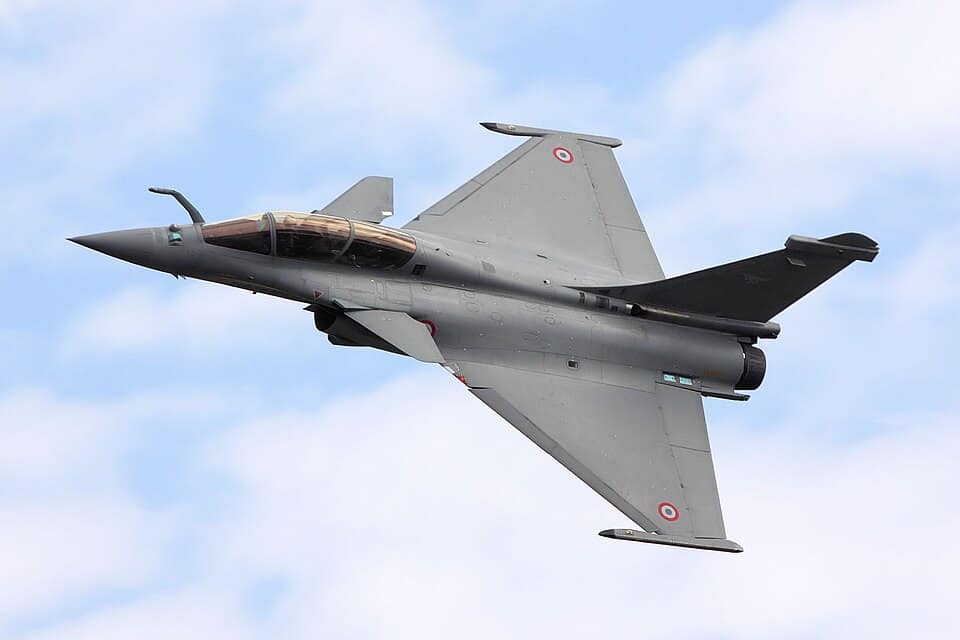
OSF (Optronique Secteur Frontal) — Dassault’s Rafale carries the Thales OSF system, which combines an IRST sensor with a television camera and laser rangefinder in a single integrated package. The OSF provides passive detection, identification, and ranging — a complete targeting solution without radar. The latest F4 standard Rafale features a significantly upgraded OSF with improved detection ranges and resolution.
OLS-35 — Russia’s Su-35S carries the OLS-35, an advanced evolution of the Soviet IRST tradition. With reported detection ranges of 90+ km head-on and over 150 km from the rear, the OLS-35 includes a laser rangefinder capable of measuring distance to targets at up to 30 km, providing the precise range data that pure IRST systems lack.
IRST21 — Lockheed Martin’s IRST21 (formerly known as the Legion Pod) brings long-wave IRST capability to U.S. Navy and Air Force fighters. Initially deployed as an external pod on the F/A-18E/F Super Hornet centreline fuel tank station, the IRST21 is now being integrated as an embedded sensor on the F-16 Block 70/72 as the Legion-ES variant. A $328.5 million contract was recently awarded for this next-generation embedded configuration.
The Stealth Problem: Can IRST See What Radar Cannot?
This is the question that drives much of the current investment in IRST technology. The answer is nuanced but increasingly clear: yes, but with caveats.
A fifth-generation stealth aircraft like the F-22 Raptor or F-35 Lightning II is optimised to minimise its radar cross-section. But radar stealth has no effect on infrared signature. The F-35’s engine, for example, still produces significant heat — and while its exhaust system is designed to reduce the infrared signature compared to non-stealthy aircraft, it cannot eliminate it entirely. At shorter ranges — typically inside 50 to 80 km — a modern IRST system can detect and track even stealth-optimised targets.
The tactical implications are profound. In a scenario where two stealth-equipped forces face each other, radar may be unable to detect targets at tactically useful ranges. IRST becomes the primary sensor for initial detection and tracking, with radar used only for final targeting — or not at all, if the IRST provides sufficient data for a missile engagement.

Fusion: IRST as Part of the Sensor Suite
No modern air force treats IRST as a standalone system. The real power comes from sensor fusion — combining IRST data with radar, electronic support measures (ESM), datalink information from other aircraft, and even satellite feeds to build a comprehensive picture of the battlespace.
A Typhoon pilot, for example, can use PIRATE to passively detect a target at long range, then correlate that track with radar data from a wingman or an AWACS aircraft transmitted via Link 16. The combined data provides bearing, range, altitude, and velocity without the Typhoon ever emitting a signal. The pilot can then engage with a beyond-visual-range missile guided by the IRST track, with the radar never switching on.
This “silent kill” capability is what makes IRST so valuable in the modern battlespace. It turns the fundamental weakness of radar — its need to emit energy — into a tactical advantage for the side with better passive sensors.
The Limits of IRST
For all its advantages, IRST is not a magic solution. The technology has inherent limitations that prevent it from replacing radar entirely.
First, IRST provides angular data (bearing and elevation) but not range. Without range, a pilot knows the direction to a target but not how far away it is. Advanced systems mitigate this with laser rangefinders or triangulation algorithms, but the fundamental limitation remains.
Second, IRST performance degrades significantly in certain atmospheric conditions. Humidity, cloud cover, rain, and temperature inversions can all reduce detection ranges by absorbing or scattering infrared radiation. A radar can see through clouds; an IRST often cannot.
Third, IRST scan rates are slower than modern radars. An AESA radar can electronically steer its beam across a wide volume of sky in milliseconds. An IRST typically uses a mechanically scanned mirror or a staring array with a more limited field of view, making it slower to build a complete picture of the surrounding airspace.
These limitations mean that IRST will complement radar rather than replace it — but in the specific scenarios where stealth aircraft face each other at medium ranges, IRST may well be the sensor that makes the difference between seeing and being seen.
Sources: Leonardo PIRATE IRST documentation, Lockheed Martin IRST21 programme data, Eurasian Times, Air Force Technology, Colonel Konstantinos Zikidis (Hellenic Air Force), Wikipedia — Infrared Search and Track
 English
0 Comments