
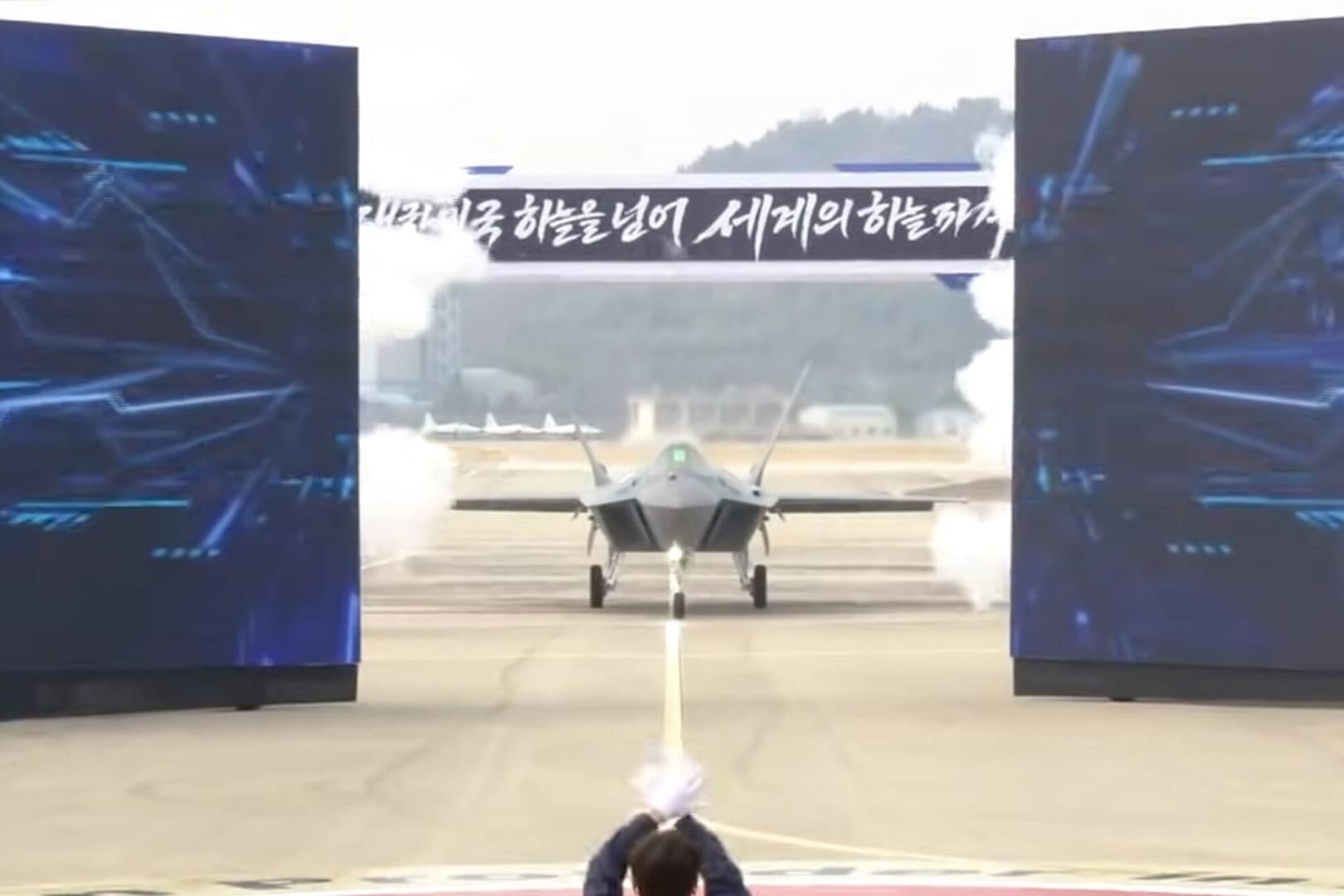
On 7 May 2026, South Korea’s Defense Acquisition Program Administration (DAPA) issued a declaration that aviation analysts had been watching for three years: the KF-21 Boramae is fully combat suitable. Three years of exhaustive testing. Six prototype airframes. More than 1,600 accident-free sorties. Over 13,000 individual test conditions validated — and the campaign closed two months ahead of schedule. South Korea now belongs to the same elite tier as the United States, Russia, China, France, the United Kingdom, Sweden, and Germany. That is not a marketing claim. It is a statement of industrial and technological fact.
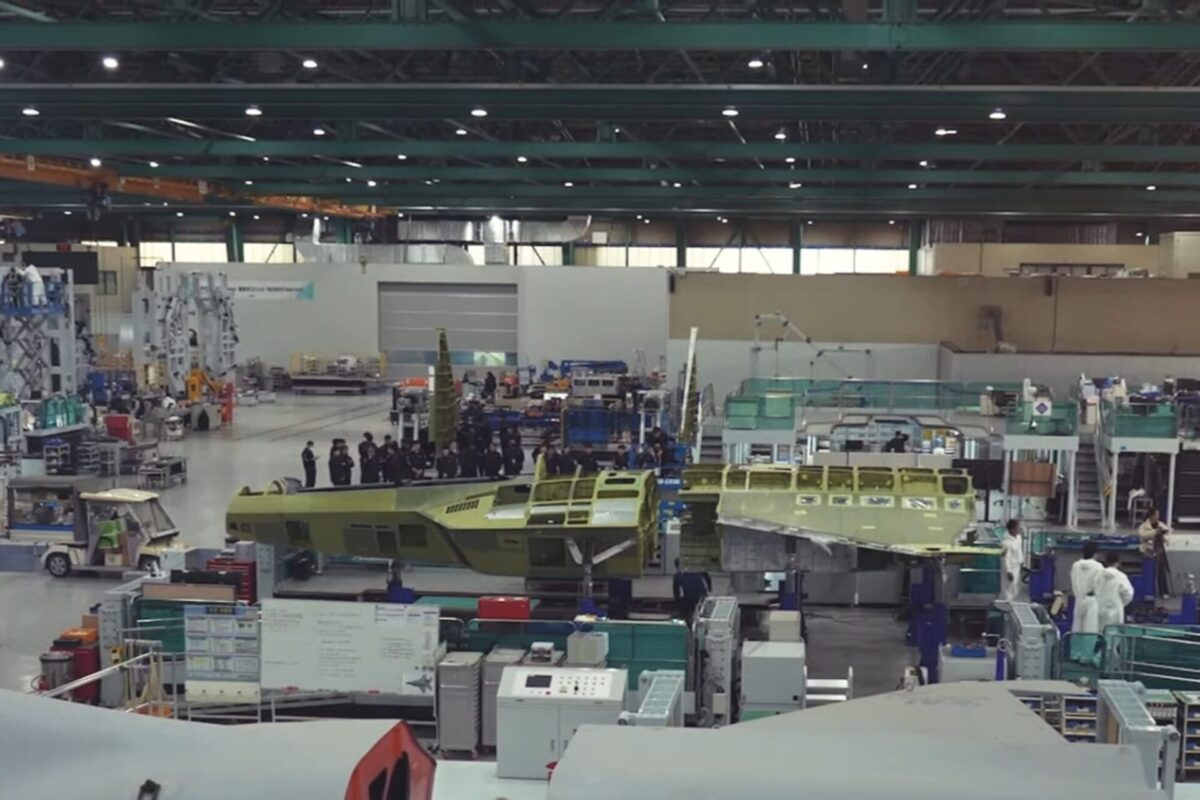
The production clock is already running. Korea Aerospace Industries (KAI) rolled out the first mass-produced Boramae at its Sacheon facility on 25 March 2026, in the presence of President Lee Jae-myung. Twenty-one days later, on 15 April, the aircraft completed its maiden production flight. ROKAF deliveries begin in the second half of 2026, with operational deployment projected for September.
For a nation that was still acquiring foreign fighters under technology-transfer restrictions barely a decade ago, this moment represents a qualitative leap in strategic autonomy. The KF-21 is not a license-built variant or a kit-assembly program. It is a clean-sheet Korean design, flying with a domestically-developed AESA radar and carrying locally-integrated weapons. That combination required twenty-five years of national commitment and 8.8 trillion won (approximately $6.06 billion) to achieve.
Quick Facts: KF-21 Boramae Combat Readiness
- DAPA declaration: 7 May 2026 — fully combat suitable
- Test campaign: ~1,600 sorties across 6 prototypes, 13,000+ test conditions, July 2022 – January 2026
- First production rollout: 25 March 2026, KAI Sacheon
- First production flight: 15 April 2026
- System development closes: June 2026
- First ROKAF delivery: Second half of 2026
- Block I (air-to-air): 40 aircraft by 2028
- Block II (multirole — air-to-ground / anti-ship): 80 aircraft from early 2027
- Manufacturer: Korea Aerospace Industries (KAI), Sacheon
- Program cost: 8.8 trillion won (~$6.06 billion USD)
Three Years, 1,600 Sorties, Zero Accidents
The numbers behind the combat suitability declaration are as significant as the declaration itself. Between July 2022 and January 2026, DAPA’s six KF-21 prototypes accumulated 1,600 sorties without a single airframe loss or serious incident. The 13,000-plus individual test conditions cover everything from aerial refueling at altitude to supersonic weapons separation, from high-angle-of-attack stability maneuvers to nighttime low-visibility operations. The campaign closed two months ahead of its planned schedule — a rarity in modern fighter development programs of this complexity.
A provisional combat suitability assessment was granted in May 2023, confirming basic supersonic performance and weapons compatibility. The final evaluation went considerably deeper: integrated systems maturity under operational loads, the Hanwha Systems APY-016K AESA radar performance across the engagement envelope, and behavior at the extremes of the flight envelope. In May 2024 the KF-21 exceeded Mach 1.8 — the highest speed ever recorded by a domestically-produced Korean aircraft. That same month, a Meteor missile test guided by the AESA radar tracked a drone target at 87 km range and passed within one meter — a precision result that validated the entire sensor-to-shooter chain.
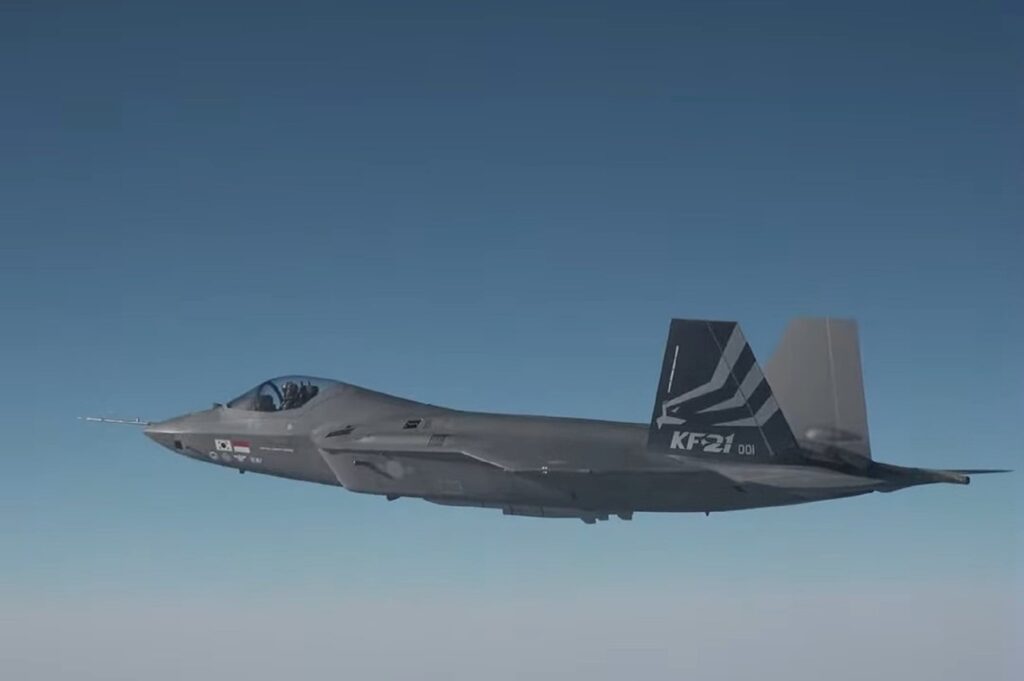
The aerial refueling milestone, validated on 19 March 2024 using a KC-330 tanker, extended the aircraft’s operational reach well beyond its approximately 1,000-km combat radius. The first nighttime aerial refueling trial, conducted on 8 April 2025 under low-visibility conditions, was completed on the first attempt — demonstrating all-weather long-range operational credibility rather than favorable-conditions performance.
Technical Specifications
| Parameter | KF-21 Boramae | Context / Comparison |
|---|---|---|
| Generation | 4.5 | Same tier as Rafale, Eurofighter Typhoon, F/A-18E/F |
| Engines | 2 × GE F414-GE-400K (≈98 kN each w/ afterburner) | Same engine family as Gripen E and Super Hornet |
| Max Speed | Mach 1.81 (≈2,200 km/h) | F-35A: Mach 1.6 / Eurofighter: Mach 2.0 |
| Combat Radius | ~1,000 km | F-16C: ~550 km / F-35A: ~1,100 km |
| Ferry Range | 2,900 km | Rafale: ~3,700 km |
| Empty Weight | 11,600 kg (25,574 lb) | Eurofighter: ~11,000 kg / Gripen E: ~8,000 kg |
| Max Takeoff Weight | 25,400 kg (56,000 lb) | F/A-18E: 29,900 kg / Gripen E: 16,500 kg |
| Dimensions (L × WS) | 16.9 m × 11.2 m | F-35A: 15.7 m × 10.7 m |
| AESA Radar | Hanwha APY-016K (~1,000 T/R modules) | Detection: 150–200 km; simultaneous tracks: 20 |
| Unit Cost (est.) | 30–40% below Rafale / Eurofighter | Competitive with F-16V and Gripen E/F |

Block I Today, Block II Tomorrow
The combat suitability declaration covers the KF-21 Block I — the air-to-air variant configured for fleet air defense and beyond-visual-range engagements. Its primary weapons are the IRIS-T AIM-2000 short-range infrared missile and the Meteor active-radar BVR missile, both of which completed live separation testing by mid-2023. The initial ROKAF acquisition calls for 40 Block I aircraft delivered by 2028.
Block II activates the Boramae’s full multirole potential. Equipped for precision air-to-ground strike and anti-ship operations, Block II aircraft enter service from early 2027, with 80 airframes planned. DAPA accelerated the Block II strike timeline in August 2025. A domestic short-range air-to-air missile program is also underway, intended to eventually replace the licensed IRIS-T and eliminate the last significant foreign weapons dependency from the ROKAF’s KF-21 loadout.
Both blocks are governed by an Open Mission Systems (OMS) architecture — a modular software framework that allows new weapons and sensors to be integrated without rewriting core avionics code. That flexibility will determine how quickly the KF-21 absorbs future upgrades: standoff weapons, advanced electronic attack pods, and potentially a thrust-vectoring engine variant for post-stall maneuverability. The comparison to a smartphone operating system is imprecise but useful: the Boramae is designed to be updated, not replaced, as the threat environment evolves.
Good to Know: How the KF-21 Compares
The KF-21 occupies the 4.5-generation tier alongside the Rafale, Eurofighter Typhoon, F/A-18E/F Super Hornet, and Saab Gripen E. It is not intended to replace the ROKAF’s F-35As, which occupy a distinct fifth-generation capability bracket. The Boramae’s role is to replace aging F-4 Phantom II and F-5 Tiger II fleets numerically while delivering sensor and mission-systems performance that legacy types cannot approach.
Against the Gripen E, the comparison is instructive: both use the GE F414 engine family, but the KF-21 is heavier, carries more fuel, and delivers roughly twice the combat radius. The Boramae carries a larger payload and flies a more powerful AESA radar. The Gripen’s advantages are base footprint, low operating cost, and a proven export record spanning 30 years. Saab built the Gripen program across four decades; Korea built the KF-21 in eleven years of full-scale development — which is the more remarkable engineering achievement depends on your priorities.
The KF-21 is not stealthy in the fifth-generation sense. Internal weapons carriage is limited, and all-aspect radar cross-section reduction is incremental rather than transformative. However, its integrated electronic warfare suite, AESA radar with advanced electronic steering, and reduced frontal RCS collectively improve survivability in contested environments compared to any legacy fourth-generation type. At a unit cost 30 to 40 percent below the Rafale or Eurofighter, it offers a capability-per-won ratio that will attract serious attention from air forces with serious budgets.
What It Means for the Region
South Korea shares a land border with one of the most heavily-armed states on earth and operates within detection range of Chinese fourth- and fifth-generation fighters stationed across the Yellow Sea. The ROKAF needed a numerically significant, modern fleet that it could sustain, upgrade, and — critically — maintain control of without exposure to export restrictions or political leverage from foreign suppliers. The KF-21 provides all three guarantees simultaneously.
President Lee Jae-myung made that argument explicitly at the March rollout ceremony, linking the Boramae to national goals spanning engine independence, advanced materials, and systems sovereignty. Hanwha Systems’ APY-016K AESA radar — developed domestically, now operational — is the clearest evidence that the program investment produced transferable technology, not merely a finished product. The GE F414 engines are assembled under license in Korea, with engineers accumulating turbofan knowledge that future indigenous powerplant programs will draw on directly.
The export dimension is real, though still nascent. DAPA has named the UAE as a prospective customer; Poland and other NATO flank states rebuilding depleted fleets are credible long-term targets. The KF-21’s operational service entry provides the reference record that export campaigns require. A combat-proven 4.5-generation fighter at significantly below Eurofighter pricing is a proposition that will demand attention.
What KAI and DAPA have accomplished since 2015 is genuinely significant by any measure. A nation with no indigenous supersonic fighter tradition built a competitive 4.5-generation aircraft in eleven years of full-scale development, validated it through the most demanding test campaign in Korean aerospace history, and is now delivering production aircraft to its air force. The Boramae is not a trophy. It is a weapon — and it is ready.
Sources: Defense Acquisition Program Administration (DAPA), AeroTime Hub, Army Recognition, AviationNews.eu, Korea Herald, Breaking Defense, The War Zone


 English
0 Comments