
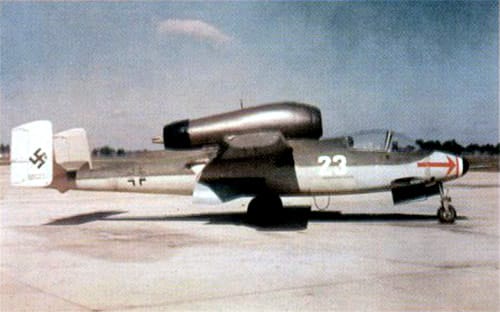
QUICK FACTS
| Designation | Heinkel He 162A Volksjaeger (“People’s Fighter”) |
| Nicknames | Salamander, Spatz (Sparrow) |
| First Flight | December 6, 1944 |
| Time from Drawing Board | 90 days to first flight |
| Engine | BMW 003E-1 turbojet (1,764 lbf thrust) |
| Maximum Speed | 905 km/h (562 mph) at sea level |
| Construction | Plywood, steel, and minimal aluminum |
| Armament | 2 x 20mm MG 151/20 cannons |
| Completed | ~116 delivered; ~800 in various production stages |
A Specification Born of Desperation
By September 1944, the Luftwaffe was being destroyed. Allied bombers roamed over Germany virtually at will. The Messerschmitt Me 262, the world’s first operational jet fighter, was proving devastatingly effective — but it was complex to build, consumed vast quantities of strategic materials, and required experienced pilots who were increasingly difficult to find. On September 8, 1944, the Reichsluftfahrtministerium (RLM) issued the Volksjaeger specification. The requirements read like a wartime shopping list written by a man with nothing left in the cupboard: a single-engine jet fighter that could be built in under 1,000 man-hours, using non-strategic materials (wood, steel, minimal aluminum), powered by the available BMW 003 turbojet, with a top speed of at least 750 km/h. Most remarkably, it was to be simple enough for pilots with minimal training — as little as 30 hours of glider time — to fly in combat. Ernst Heinkel’s team won the contract. Their design was elegant in its simplicity: a conventional low-wing monoplane with the BMW 003 turbojet mounted in a nacelle on top of the fuselage, behind the cockpit. The top-mounted engine kept the intake clear of debris on rough airfields and allowed for a short, sturdy landing gear. The twin vertical stabilizers, angled outward in a distinctive V-tail arrangement, kept the control surfaces out of the jet exhaust.Ninety Days From Paper to Flight
The speed of development was staggering even by wartime standards. Heinkel submitted detailed design drawings on October 29, 1944. The first prototype flew on December 6 — just 38 days later. This remains one of the fastest development cycles in aviation history, a record born not of efficiency but of existential panic.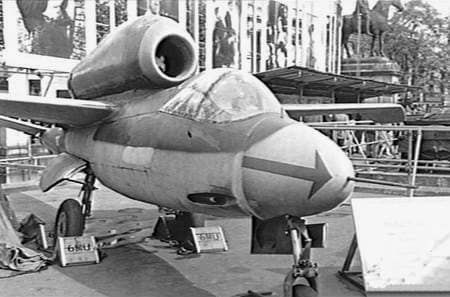
“It was a superb aeroplane in its element, but quite a handful to take off and land. Never met better flying controls yet they could easily be so mishandled. It was no aeroplane to let embryo pilots loose on.”
Capt. Eric “Winkle” Brown — Royal Navy Test Pilot, RAE Farnborough
The Deadly Flaw
Gotthold Peter’s death on December 10 exposed the He 162’s fatal vulnerability. The Tego-Film adhesive used to bond the plywood components was not only inadequate for the stresses of high-speed flight — it was actively corrosive, weakening the wood joints over time. Subsequent aircraft used improved Dinamit Nobel adhesive, but structural integrity remained a concern throughout the program. The aircraft had other dangerous characteristics. The engine nacelle’s position above and behind the center of gravity created a nose-down pitching moment during engine failure — precisely the wrong direction when you were close to the ground. Abrupt rudder inputs could cause the aircraft to snap-roll. And the ejection seat, while innovative for its time, blew the pilot directly into the jet intake if activated at certain speeds.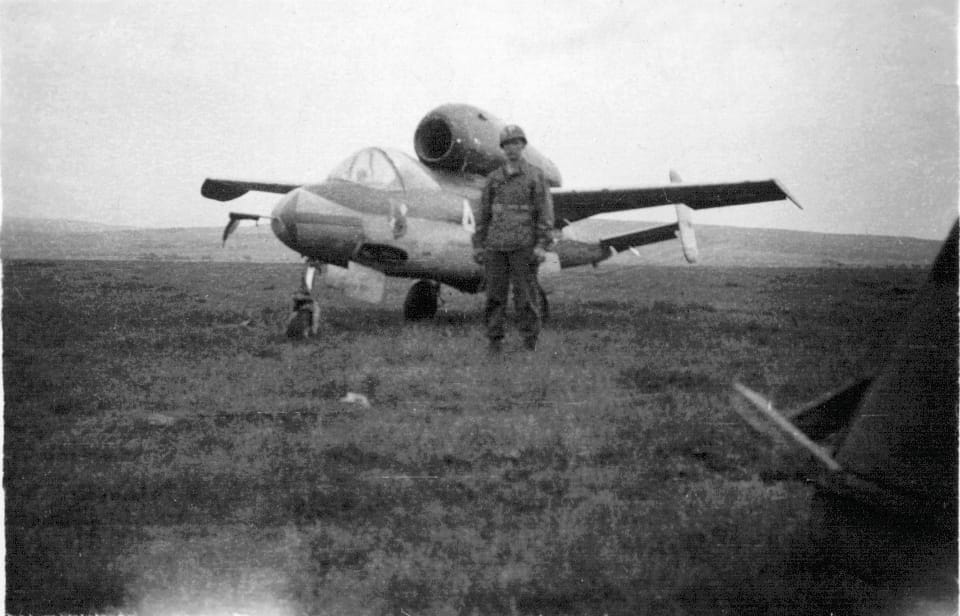
JG 1 “Oesau” — Too Late for War
In February 1945, the first He 162s were delivered to I./Jagdgeschwader 1 “Oesau” at Parchim. The unit’s pilots, experienced Focke-Wulf Fw 190 veterans, began conversion training — a far cry from the Hitler Youth conscripts originally envisioned for the cockpit. The training was painfully slow. The He 162 demanded respect, and every takeoff and landing was an exercise in careful precision. The unit relocated to Leck airfield in Schleswig-Holstein in April 1945, where they attempted combat operations in the war’s final weeks. The results were meager: a handful of inconclusive engagements, and at least one confirmed aerial victory — the shooting down of a British aircraft.“The Volksjaeger was a first-class combat aircraft in the right hands. But the right hands were exactly what Germany no longer had in sufficient numbers.”
Oberleutnant Emil Demuth — Pilot, I./JG 1, He 162 Operational Unit
What Might Have Been
When Allied troops swept through Germany’s factories in May 1945, they found approximately 800 He 162s in various stages of completion. Underground production facilities at Nordhausen — the same salt mines that produced V-2 rockets using slave labor from the Mittelbau-Dora concentration camp — contained hundreds of fuselages and wings awaiting assembly. The He 162 represents one of aviation’s most uncomfortable paradoxes: a genuinely innovative aircraft, built with slave labor, designed for teenage pilots, and fielded too late to matter. Its top-mounted engine configuration would later influence the design of several postwar aircraft, and its use of mixed-material construction foreshadowed the composite airframes of the modern era. Captain Eric Brown, who tested more aircraft types than any pilot in history, considered it one of the best-handling jets he had ever flown. Had the war continued even a few months longer, and had Germany been able to field the He 162 in numbers with experienced pilots, it could have been a serious threat to Allied air superiority. Instead, it remains a monument to what desperate genius can produce — and a reminder that no amount of engineering can overcome a war already lost.Sources: Imperial War Museum, Bundesarchiv, WW2 Database, Eric Brown “Wings of the Luftwaffe,” Heinkel company records


 English
0 Comments