
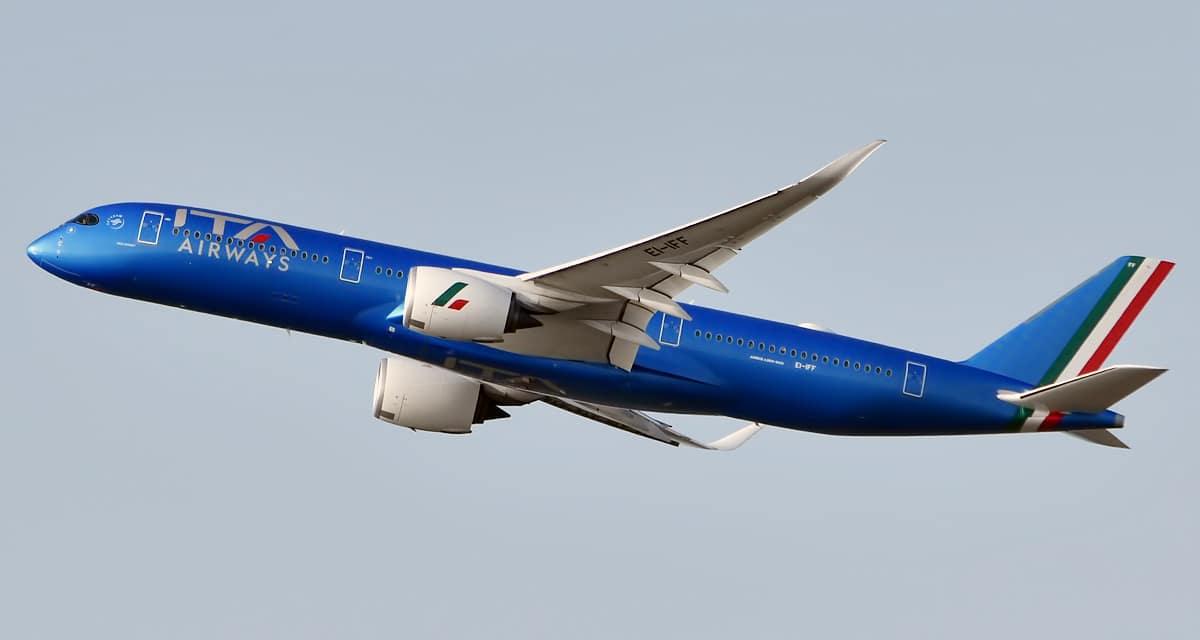
For 75 years, Italy had its own flag carrier. From the founding of Alitalia in 1946 to its 2021 liquidation, the airline was a national institution — and, for the last three decades of its life, a national embarrassment. Repeated state bailouts, repeated insolvencies, repeated rescue operations. The 2021 successor airline, Italia Trasporto Aereo — ITA Airways — was born from the wreckage with a smaller fleet, a fresh livery, and an explicit mandate to be sold off.
In May 2026, Lufthansa Group announced it is exercising its call option to lift its stake in ITA Airways from the current 41 per cent to 90 per cent, with a further option on the Italian state’s final 10 per cent from 2028. The deal, expected to close in early 2027 subject to regulatory approval, would all but complete the longest-running airline consolidation saga in European aviation history. Italy will, in effect, no longer have an independent flag carrier. Rome and Milan will be Lufthansa hubs.
| Acquiring group | Deutsche Lufthansa AG (Frankfurt) |
| Target | ITA Airways (Italia Trasporto Aereo, Rome) |
| Current Lufthansa stake | 41 per cent (acquired January 2025 for €325 million) |
| Path to full control | Call option to 90 per cent exercised May 2026 (closing expected early 2027); option on the final 10 per cent from 2028 |
| ITA fleet (May 2026) | ≈ 100 aircraft (A220, A320neo family, A330neo, A350-900) |
| Italian government stake | Drops to 10 per cent on completion, with a Lufthansa option on the remainder from 2028 |
The deal Brussels did not want to approve
European competition authorities have spent thirty years trying to keep European flag carriers independent. The Lufthansa–ITA deal is the most consequential breach of that doctrine in the post-pandemic era. To win European Commission approval in 2024, Lufthansa Group was forced to hand ITA slots at Milan-Linate to a rival (easyJet became the remedy taker) and to conclude agreements strengthening rival carriers on selected long-haul routes between Italy and North America. None of that prevented the central outcome — Italy’s flag carrier becoming part of the German aviation group.
A consortium led by the US fund Certares, backed by Air France-KLM and Delta, had been the other serious contender for ITA — but its exclusive negotiating position lapsed in late 2022 and the incoming Italian government reopened the process. Lufthansa’s clean position — already owning Swiss International, Brussels Airlines, Eurowings, and Austrian Airlines — made it the only credible buyer left.

What changes in Rome and Milan
From a passenger perspective, the ITA brand will persist for at least three to five years. The airline will be slotted into the Lufthansa Group’s integrated network alongside Swiss, Austrian, Brussels, and Eurowings, with code-shares, joint frequent-flyer recognition, and shared catering contracts. Long-term, however, ITA is likely to follow the trajectory of Swiss — which retains its identity, livery, and Zurich hub, but is operationally fused with Lufthansa’s overall fleet planning and yield management.
For Italy, the political question is more sensitive. The country has lost (or is in the process of losing) Fiat, Pirelli, and Edison to foreign owners over the past decade. Adding Alitalia/ITA to that list will not play well with Italian aviation unions, several of which have called industrial action over the deal. The Meloni government has, however, publicly endorsed the transaction — a striking shift from the standard Italian political position on national champions.


Europe’s three-group future
With ITA absorbed, Europe’s commercial aviation industry is settling into three large multi-airline groups: Lufthansa Group, Air France-KLM, and International Airlines Group (BA, Iberia, Aer Lingus, Vueling, LEVEL). Below them sit the low-cost giants Ryanair, EasyJet, and Wizz Air. The era of independent European flag carriers is effectively over — TAP Air Portugal and Finnair are the last two left in any meaningful sense — TAP is already in the middle of a privatisation contest, with Lufthansa Group and Air France-KLM among the suitors, and Finnair is widely seen as a future consolidation candidate.
For travellers, the consolidation has produced both lower average fares on competitive routes and reduced choice on non-competitive ones. For aviation history, it brings to a close one of the longest dramas in European industrial policy — Alitalia, by any other name, finally has an owner that can pay its bills.
Sources: Scramble, Reuters, Aviation Week, Financial Times.

 English
0 Comments