
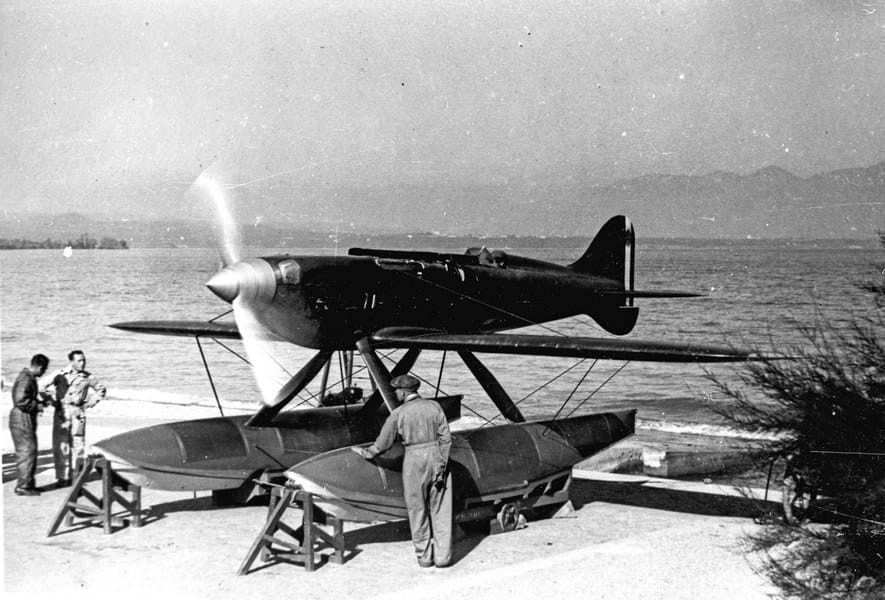
On 23 October 1934, at the Italian seaplane base of Desenzano del Garda on Lake Garda, a bright red aircraft with two enormous counter-rotating propellers screamed across the water at 440.681 miles per hour. The pilot, Warrant Officer Francesco Agello, climbed out of the cockpit a record holder. He had set the world absolute speed record — for any aircraft, of any kind, anywhere.
That record stood, in the seaplane category, for the next ninety years. It still stands today. The aircraft was the Macchi MC.72. Italy built five of them. None ever fired a shot in anger. And yet the MC.72 may be one of the most extraordinary aircraft ever assembled.
Quick Facts
Aircraft: Macchi-Castoldi MC.72
Designer: Mario Castoldi
Maiden flight: 22 June 1931
Powerplant: Fiat AS.6, two V-12s coupled end-to-end — 3,100 hp
Propeller: Two counter-rotating three-blade props
Top speed: 709 km/h (440.681 mph) — 23 October 1934
Pilot at record: Warrant Officer Francesco Agello
Built: 5 examples (only 1 surviving)
A Schneider Trophy That Never Was
The MC.72 was Italy’s intended entrant for the 1931 Schneider Trophy — the prestigious international seaplane race that drove much of pre-war piston-engine development. Britain won that 1931 contest outright with the Supermarine S.6B, the direct ancestor of the Spitfire, retiring the trophy for good. Italy never got to race the MC.72.
So instead, Macchi did the only thing left: it kept refining the aircraft and went after the absolute speed record. And in 1933, then again in 1934, it took the record by a wider margin each time.
An Engine Like a Train
The MC.72’s heart was the Fiat AS.6 — not one engine, but two V-12s coupled end to end, geared to drive two counter-rotating propellers on the same shaft. The arrangement solved the torque problem that had limited every other racing seaplane: a single huge propeller spinning at 3,000 hp generated enough rotational torque to flip the airframe on takeoff. Counter-rotating props cancelled it.
The engine produced 3,100 horsepower in record-trim. To put that in context, the contemporary British S.6B made 2,300 hp. The Spitfire that would fight the Battle of Britain six years later made 1,030 hp.
A Record That Refuses to Die
“The flight of 23 October 1934 established an absolute world speed record for all aircraft types — a record which stood until 30 March 1939, when Hans Dieterle flew a prototype Heinkel He 100 at 746.6 km/h.”
Fédération Aéronautique Internationale (FAI) — ratification of Francesco Agello’s 440.681 mph record
The MC.72’s 440 mph mark remains the all-time piston-engine seaplane speed record. No floatplane built since — and many have been tried — has come close. The combination of brute power, low-drag floats, and counter-rotating propellers turned out to be a one-time alignment of engineering possibilities that nobody has bothered to repeat.
One MC.72 survives, on display at the Italian Air Force Museum at Vigna di Valle, just outside Rome. It still wears the bright red paint Macchi delivered it in. Standing next to it, the aircraft does not look its age. It looks like it might still go.
How Italy built the fastest seaplane in the world — the MC.72 story.
Sources: Italian Air Force Museum, Janes Historical Aircraft, Flight magazine archives.

 English
0 Comments