
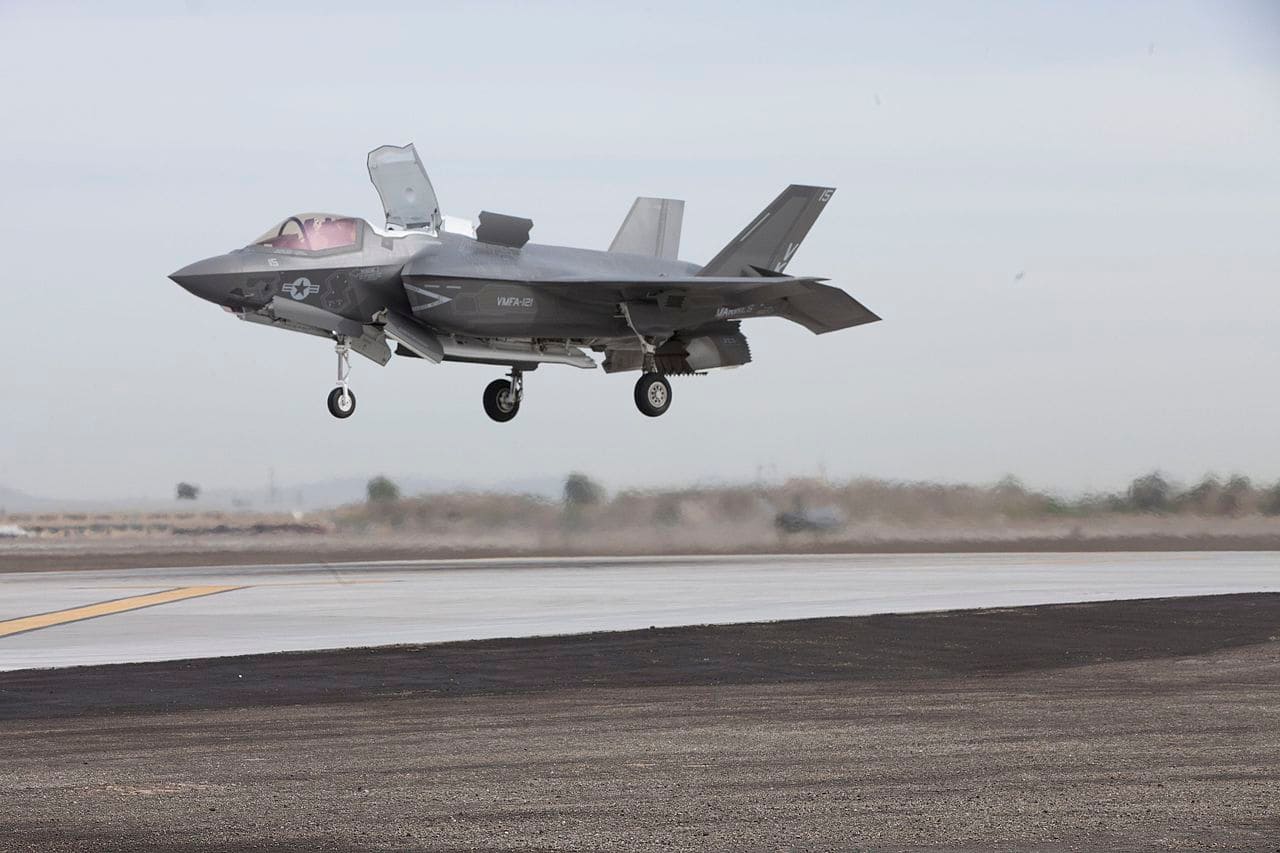
The U.S. Marine Corps is surging fifth-generation fighters into the Middle East at a scale that signals a fundamental shift in the region’s air war. As of late March 2026, a dual-track F-35 deployment is unfolding simultaneously—carrier-based F-35Bs aboard the USS Tripoli heading a 3,500-strong amphibious expeditionary force, while land-based F-35Cs touch down at RAF Lakenheath for what amounts to a historic first: the F-35C’s inaugural combat deployment from a continental air base.
The sheer convergence of multiple F-35 variants and deployment platforms reveals the operational tempo the Pentagon is willing to sustain. At roughly $1 billion per day, this conflict is reshaping military logistics and readiness planning.
Amphibious Assault: F-35Bs at Sea
The USS Tripoli (LHA-7) Amphibious Ready Group arrived in the Middle East theater on March 27, 2026, carrying the second F-35B variant in earnest. This America-class “big deck” amphibious assault ship is built for exactly this scenario—a floating air base capable of launching and recovering short-takeoff, vertical-landing stealth fighters alongside Osprey tiltrotors, helicopters, and the 31st Marine Expeditionary Unit’s ground-combat elements.
What makes the Tripoli deployment significant isn’t just the presence of F-35Bs—it’s the scale. Three thousand five hundred Marines and sailors operate as a cohesive task force, with the ship’s flight deck serving as the operational hub. The F-35B’s STOVL capability transforms the amphib into a genuine power-projection platform, able to operate from austere locations and respond to contingencies across a vast geographic footprint.
The Navy has simultaneously positioned the USS Boxer heading toward the same region with its own complement of fifth-generation stealth fighters. The overlapping deployments suggest planners expect sustained operations, not a brief show of force.
Breaking History at Lakenheath
Meanwhile, something unprecedented is happening in England. Five F-35Cs from VMFA-311, the “Tomcats” squadron, arrived at RAF Lakenheath on March 24, 2026—the vanguard of a ten-aircraft deployment that departed Marine Corps Air Station Miramar, California on March 10. For the first time in program history, the F-35C—the Navy’s fleet-oriented variant designed exclusively for carrier operations—is conducting a land-based combat deployment.
The F-35C’s wings fold for hangar stowage aboard aircraft carriers. Its landing gear handles arrested landings at 150+ knots. Deploying it from a land base inverts the program’s core design philosophy, and doing so in a combat zone demonstrates both operational flexibility and a willingness to exploit the type’s advanced sensors and strike capabilities from unexpected launch points.
RAF Lakenheath sits roughly 4,300 kilometers from the Middle East conflict zone—close enough for sustained rotational presence and ISR contributions, yet sufficiently removed to provide strategic depth. The presence of carrier-optimized F-35Cs operating from a British base also deepens coalition interoperability and signals Allied commitment.
The Scale of Commitment
Three separate platforms. Two F-35 variants. Multiple theater entries. The Marines aren’t hedging—they’re doubling down. The F-35B’s STOVL capability and the F-35C’s payload and range represent complementary offensive tools. The Tripoli provides organic air support for the ground element, while the Lakenheath detachment offers sustained strike and ISR operations across a wider area of operations.
Sustaining this deployment at $1 billion per day speaks to the Pentagon’s calculation that fifth-generation capability, once demonstrated, becomes operationally irreplaceable. The F-35’s sensor fusion, electronic warfare integration, and multi-domain targeting authority justify the cost—particularly when adversaries operate older, less integrated air-defense networks.
The convergence of USS Tripoli’s amphib task force and the Lakenheath F-35C detachment marks a turning point. The Marine Corps is no longer testing F-35B amphibious operations or experimenting with F-35C land basing. It’s executing them at combat scale, in real time, under pressure. The Middle East has become the proof-of-concept theater for the next generation of expeditionary air warfare.
Sources: The War Zone; CBS News; Stars and Stripes; CNN
 English