
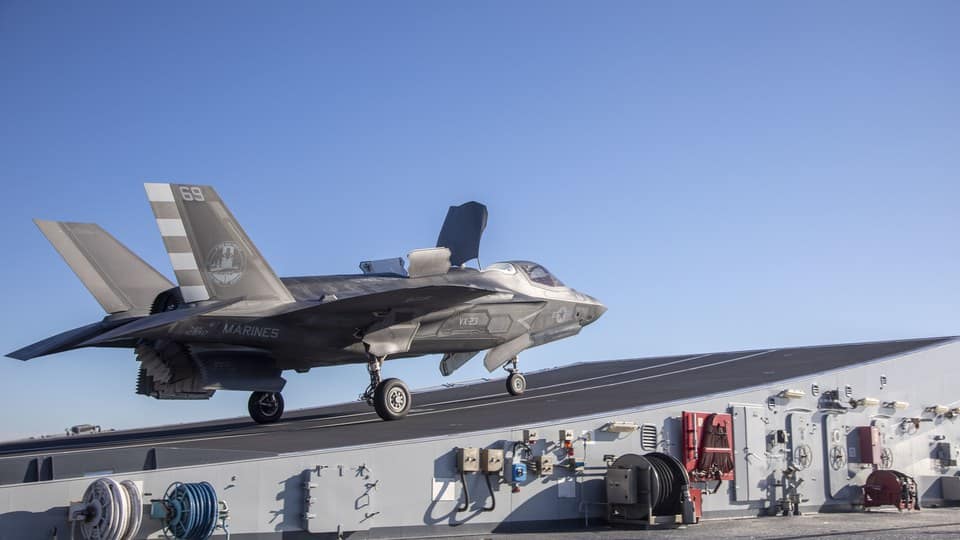
Quick Facts
Service: United States Marine Corps
Programme: Sixth-generation fighter concept (unnamed)
Timeline: Post-2041 (5–10 years from initial concept work)
Current Fighter: F-35B/C Lightning II (transition to all Block 4 fleet ~10 years away)
Design Approach: “Fast follow” of Navy F/A-XX and Air Force F-47 programmes
Bridging Capability: Collaborative Combat Aircraft (CCA) drones
Source: 2026 Marine Corps Aviation Plan
The Quiet Entry
When the Marine Corps published its 2026 Aviation Plan in February, most analysts focused on the immediate priorities — F-35 Block 4 upgrades, MV-22 sustainment, the CH-53K ramp-up. Buried deeper in the document was a small but significant nod to a future sixth-generation fighter requirement. The Deputy Commandant for Aviation has since confirmed that the service is beginning to explore what it might want in a future crewed combat aircraft. The emphasis is on exploring. The Marines are not rushing to issue a formal requirement. They are watching what the Air Force does with the F-47 and what the Navy does with the F/A-XX, and positioning themselves to follow quickly once those programmes mature. A senior Marine general put it plainly: sixth-generation fighters are primarily an Air Force mission. The Marines will augment the fifth-generation force with a sixth-generation element when the technology is ready and the operational need is clear. That timeline is approximately 2041 — five to ten years after the service completes its transition to an all-Block 4 F-35 fleet, which itself is roughly a decade away.The Drone Bridge
Between now and 2041, the Marines plan to use Collaborative Combat Aircraft — autonomous wingman drones — as the bridge to sixth-generation capability. CCAs will fly alongside F-35s, extending the manned fighter’s sensor reach, weapons load, and survivability without requiring a new manned platform. This is not a holding pattern. The Marines see CCAs as a proving ground for the autonomy, artificial intelligence, and network technologies that will define sixth-generation warfare. By the time the service is ready to commit to a crewed sixth-gen fighter, the autonomous systems that will accompany it will already be combat-tested. The Marine Corps’ approach reflects institutional pragmatism. The F-35B — the short-takeoff-and-vertical-landing variant that operates from amphibious assault ships and austere forward bases — is the most expensive and most complex version of the Lightning II. Developing a Marine-specific sixth-gen fighter from scratch would be prohibitively costly. Following the Navy’s lead, adapting the F/A-XX design for Marine requirements, is the only financially realistic path.What “Something Like the F/A-XX” Means
The general’s comment that a Marine sixth-gen fighter would probably look something like the F/A-XX is revealing. It implies that the Marines anticipate a carrier-capable, stealthy, long-range platform — not a specialised STOVL variant like the F-35B. This raises questions. The Marine Corps has built its entire force structure around the ability to operate from amphibious ships and expeditionary airfields. A conventional carrier-launched fighter would require the Marines to operate from Navy carriers or from long, prepared runways — a departure from the distributed, austere-basing concepts that define Marine aviation. The alternative is that the Marines are keeping their options open. A sixth-gen fighter that borrows the F/A-XX’s stealth, sensors, and weapons architecture but incorporates a different propulsion or launch system — perhaps leveraging VTOL technologies being developed for programmes like the X-BAT — would be the best of both worlds. For now, the Marines are doing what Marines do best: watching, learning, and preparing to move fast when the moment arrives.Sources: Breaking Defense, The War Zone, Air & Space Forces Magazine, Militarnyi
 English
0 Comments