

On 1 November 1950, UN pilots over North Korea encountered something they had not expected: a swept-wing jet fighter faster, more agile, and better armed than anything in their inventory. The MiG-15 appeared above the Yalu River — the border between North Korea and China — and demonstrated immediately that the Soviet Union had not been idle while the West was building the F-86 and the Meteor. What followed over the next three years in the airspace around the Yalu was the first sustained jet-versus-jet air campaign in the history of warfare, fought by pilots from the most powerful air forces on Earth, and largely kept secret from the public on both sides.

The MiG-15: A Shock to the West
The Mikoyan-Gurevich MiG-15 was not the aircraft the West expected the Soviet Union to be flying in 1950. It was swept-wing — a configuration that allowed high-subsonic speeds — powered by a copy of the Rolls-Royce Nene engine that the British government had naively sold to the Soviets in 1946, and armed with a 37mm and two 23mm cannons capable of destroying a B-29 heavy bomber with a single burst. It could climb to 50,000 feet faster than any Western fighter and outpaced the straight-winged jets the UN forces were flying in Korea.
The MiG-15 immediately demonstrated its lethality against the Boeing B-29 Superfortresses that had been conducting daylight bombing raids into North Korea largely unmolested. After a year of mounting losses — culminating in the disastrous “Black Tuesday” raid of October 1951 — daylight strategic bombing operations were suspended in favour of night missions. The US Air Force had to rush its most capable fighter to theatre: the North American F-86 Sabre.
MiG Alley
The air combat concentrated in the northwestern corner of Korea, in the corridor between the Yalu River to the north and a line approximately 100 miles south. UN pilots called it "MiG Alley." The MiGs would take off from bases in Manchuria (safe from UN attack under the rules of engagement that prohibited cross-border operations), climb to altitude over the Yalu, engage UN aircraft, then retreat back across the river if hard-pressed. UN fighters were forbidden from pursuing them — a politically constrained conflict that gave the MiG pilots a sanctuary the Western pilots deeply resented.
The MiG-15 had advantages at high altitude: better climb rate, faster top speed, and heavier armament. The F-86 was superior at lower altitudes and in turning combat, had a more advanced gunsight, and was somewhat easier to fly to its limits. The matchup was closer than either side wished to admit publicly. UN air forces claimed a kill ratio of approximately 10:1 in favour of the F-86. Post-war analysis, including Soviet and North Korean records declassified after the Cold War, suggests the actual ratio was closer to 2:1 — still favourable to the UN, but nothing like the margin claimed at the time.
UN pilots were told not to cross the Yalu — the MiGs were untouchable in their Chinese sanctuaries. The Americans resented it, sometimes broke the rule, and knew what this was: a politically constrained war fought in the sky over Korea.
— MiG Alley, 1950–1953The Secret Pilots
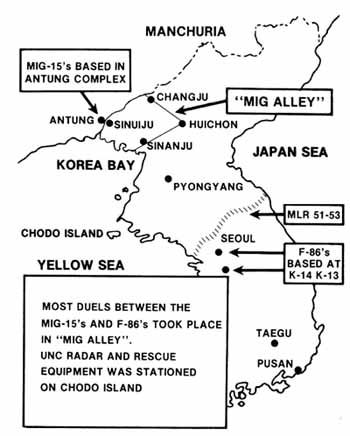
One of the most carefully kept secrets of the Korean War was that many of the MiG-15 pilots were not North Korean or Chinese — they were Soviet. Stalin authorised Soviet pilots to fly in Korean markings as early as November 1950, initially to defend Manchurian airspace from potential US attack, then to provide experienced pilots to train Chinese and North Korean forces and engage UN aircraft. Soviet pilots flew the bulk of MiG combat sorties over Korea — post-Cold War records credit the Soviet 64th Fighter Aviation Corps with over 60,000 sorties during the war.
Both sides knew this and both sides declined to make it public, for the obvious reason that it made the Korean War something much more dangerous than a limited proxy conflict: it was an active shooting war between US and Soviet pilots. Soviet pilots were under orders not to fly beyond the bomb line into UN-controlled territory or over open water, so that no Soviet airman could fall into UN hands and turn the open secret into a diplomatic crisis. The rules were not always followed with perfect consistency.
What Korea Changed About Air Combat
The Korean air war produced a generation of lessons that shaped Western air power doctrine for decades. The gun-armed dogfight was not dead, as some had predicted — Korea proved that close-range manoeuvring combat still decided the air war — a lesson that was promptly forgotten in the missile age and had to be learned again over Vietnam fifteen years later. The importance of pilot training over aircraft performance was repeatedly demonstrated: superior pilots in inferior aircraft consistently defeated technically better aircraft flown by poorly trained opponents.
Korea also produced the concept of "DACT" — Dissimilar Air Combat Training — the deliberate practice of having pilots fly against aircraft with different performance characteristics to learn how to defeat them. The Top Gun school at Miramar, established after Vietnam, was the direct descendant of the lessons of MiG Alley. Every modern air combat training programme traces its intellectual lineage to the first jet-versus-jet battles fought over the Yalu River in the winter of 1950.
Sources: USAF Historical Division; Yefim Gordon & Vladimir Rigmant, MiG-15 (2001); Allan Millett, The War for Korea 1950-1951 (2010); declassified Soviet aviation records; National Air and Space Museum.
Related Questions
What was MiG Alley?
MiG Alley was the nickname for the airspace near the Yalu River, on the North Korea-China border, where the first sustained jet-versus-jet air combat in history took place during the Korean War. From late 1950, Soviet-built MiG-15s clashed there with UN fighters, above all the American North American F-86 Sabre.
What made the MiG-15 so dangerous?
The MiG-15 shocked the West in 1950. It had swept wings for high-subsonic speed, a powerful engine copied from the Rolls-Royce Nene, and heavy armament of one 37mm and two 23mm cannons capable of downing a B-29 in a single burst. It could outclimb and outpace every straight-winged UN jet in Korea.
Which fighters fought in MiG Alley?
The two main adversaries were the Soviet MiG-15 and the American North American F-86 Sabre. The MiG-15’s arrival forced the US to rush its best swept-wing fighter, the Sabre, to Korea. Stranger threats appeared too, like the slow biplane night raiders described in Bedcheck Charlie.
When did jet-versus-jet combat first happen?
Sustained jet-versus-jet air combat began on 1 November 1950, when MiG-15s appeared over the Yalu River during the Korean War. It was the first time two jet-equipped air forces fought each other, opening a new era in aerial warfare - including little-known clashes like one US pilot’s secret dogfight against seven MiGs.
Why did the US stop daylight B-29 raids over Korea?
The MiG-15 made daylight bombing too costly. After mounting losses to the cannon-armed jets - culminating in the disastrous "Black Tuesday" raid of October 1951 - the US Air Force suspended daylight strategic bombing in favour of night missions. The B-29 could no longer operate unmolested over North Korea.
Where was MiG Alley located?
MiG Alley lay in the northwestern corner of North Korea, around the Yalu River that forms the border with China. Soviet, Chinese, and North Korean MiG-15s operated from sanctuaries across the river, which made the area the most dangerous airspace of the Korean War for UN pilots.
0 Comments