On 9 March 1979, test pilot Jean-Marie Saget lifted a giant delta off the runway at Istres and climbed into a sky that belonged, for a few glorious minutes, to the most powerful fighter ever built in Europe. The Dassault Mirage 4000 — twin SNECMA M53 engines, compound delta wing, Mach 2.3 capable — was everything the French Air Force said it wanted. And France refused to buy a single one.
The story of the Mirage 4000 is one of the great tragedies of European aviation. A private venture funded largely by Marcel Dassault’s own fortune, it outperformed every contemporary in its class. It could have given France an aircraft to rival the F-15 Eagle a full decade before the Rafale entered service. Instead, the government chose the smaller, cheaper, single-engine Mirage 2000 — and the most capable European fighter of the Cold War era was left to rot.
Units built: 1 prototype (never entered production)
Fate: Preserved at Musee de l’Air et de l’Espace, Le Bourget
Un avion en avance sur son temps
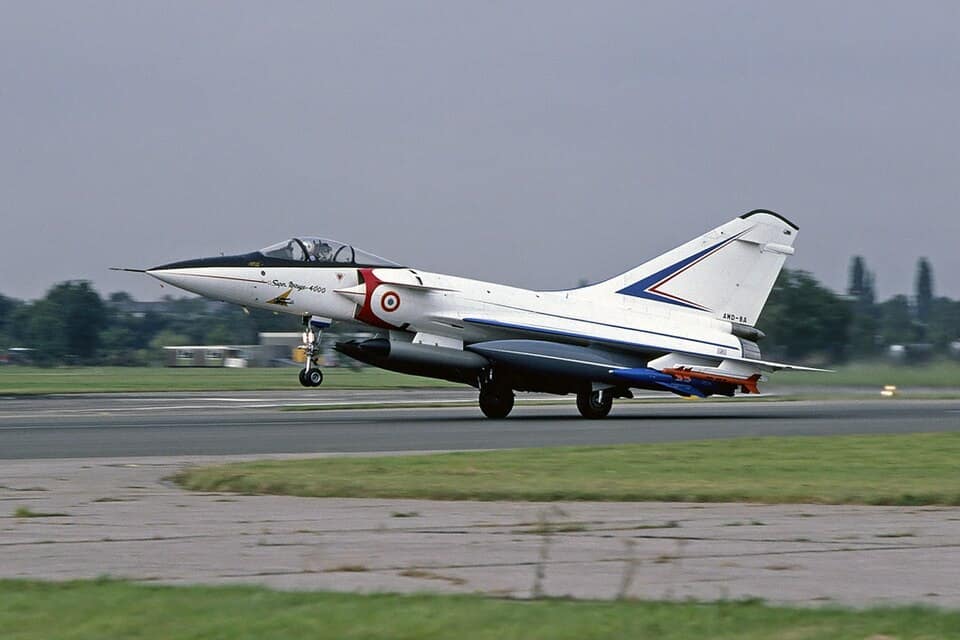
The Mirage 4000 was essentially a scaled-up, twin-engine Mirage 2000. But scaling up a delta fighter is not a linear exercise. The twin M53 engines gave the 4000 a thrust-to-weight ratio that matched the F-15. The larger airframe carried more fuel, more weapons, and a bigger radar. The delta wing worked with canard foreplanes — the jet’s signature feature — and fly-by-wire controls to give it agility that belied its size. In flight testing, it consistently demonstrated performance that put it in the same class as the Eagle and ahead of everything else in European service.
The sole Mirage 4000 prototype — now preserved at the Musee de l’Air et de l’Espace at Le Bourget. Wikimedia Commons
Dassault’s vision was clear: France needed a heavy air-superiority fighter to complement the lighter Mirage 2000. The 4000 would handle the high-end threat — Soviet Flankers, Foxhounds, the coming generation of beyond-visual-range combat. The 2000 would handle everything else. It was the same high-low mix logic that gave America the F-15 and F-16.
Pourquoi la France a dit non
The French government looked at the Mirage 4000 and saw a budget crisis. Twin-engine fighters cost roughly twice as much to buy and operate as single-engine fighters. The Mirage 2000 could be procured in larger numbers for the same money. And France in the late 1970s was not in the mood for defence spending ambition — the economy was slowing, inflation was rising, and the political will for a premium air-superiority platform simply was not there.
Marcel Dassault had funded the prototype largely from company resources, betting that the aircraft’s performance would speak for itself. It did — but performance alone was not enough. Saudi Arabia and other Gulf states expressed interest, but without a French government commitment to anchor the programme, no export customer was willing to be the launch buyer for a single-prototype aircraft with no production infrastructure.
L’heritage du Mirage 4000
The technology developed for the 4000 did not go to waste. Much of it — the fly-by-wire system, the compound delta aerodynamics, the structural design philosophy — fed directly into the Rafale programme that Dassault began in the mid-1980s. In a sense, the Rafale is the Mirage 4000’s child: a twin-engine, delta-canard, omnirole fighter that finally delivered on the promise the 4000 had made a decade earlier.
The sole prototype flew 336 times over its career before being retired to the Musee de l’Air et de l’Espace at Le Bourget, where it sits today — a monument to what might have been. In a parallel universe where France funded the Mirage 4000 in 1980, Europe would have had an F-15 equivalent a full fifteen years before the Eurofighter Typhoon entered service. The Cold War air balance over Central Europe might have looked very different.
Instead, the most powerful fighter ever built in Europe made 336 flights and went to a museum. Marcel Dassault’s gamble produced a masterpiece. France’s accountants filed it under “too expensive.” History filed it under “what if.”
Sources: Dassault Aviation, Musee de l’Air et de l’Espace, Wikipedia, Key.Aero
Before AWACS, air warfare was a knife fight in a dark room. Pilots relied on their own radar, ground controllers with limited visibility, and radio calls that were often confused, late, or wrong. After AWACS, one side had the lights on and the other did not. The...
On May 1, 1960, CIA pilot Francis Gary Powers took off from Peshawar, Pakistan in a Lockheed U-2 spy plane. His mission: fly across the entire Soviet Union at 70,000 feet, photographing military installations, and land in Bodø, Norway. He never made it. A Soviet S-75...
When the Sukhoi Su-47 Berkut rolled out in 1997, it looked like nothing else in the sky. Its wings swept forward instead of back — an aerodynamic concept that promised extraordinary agility, superior low-speed handling, and enhanced controllability at high angles of...


 English
0 Comments