
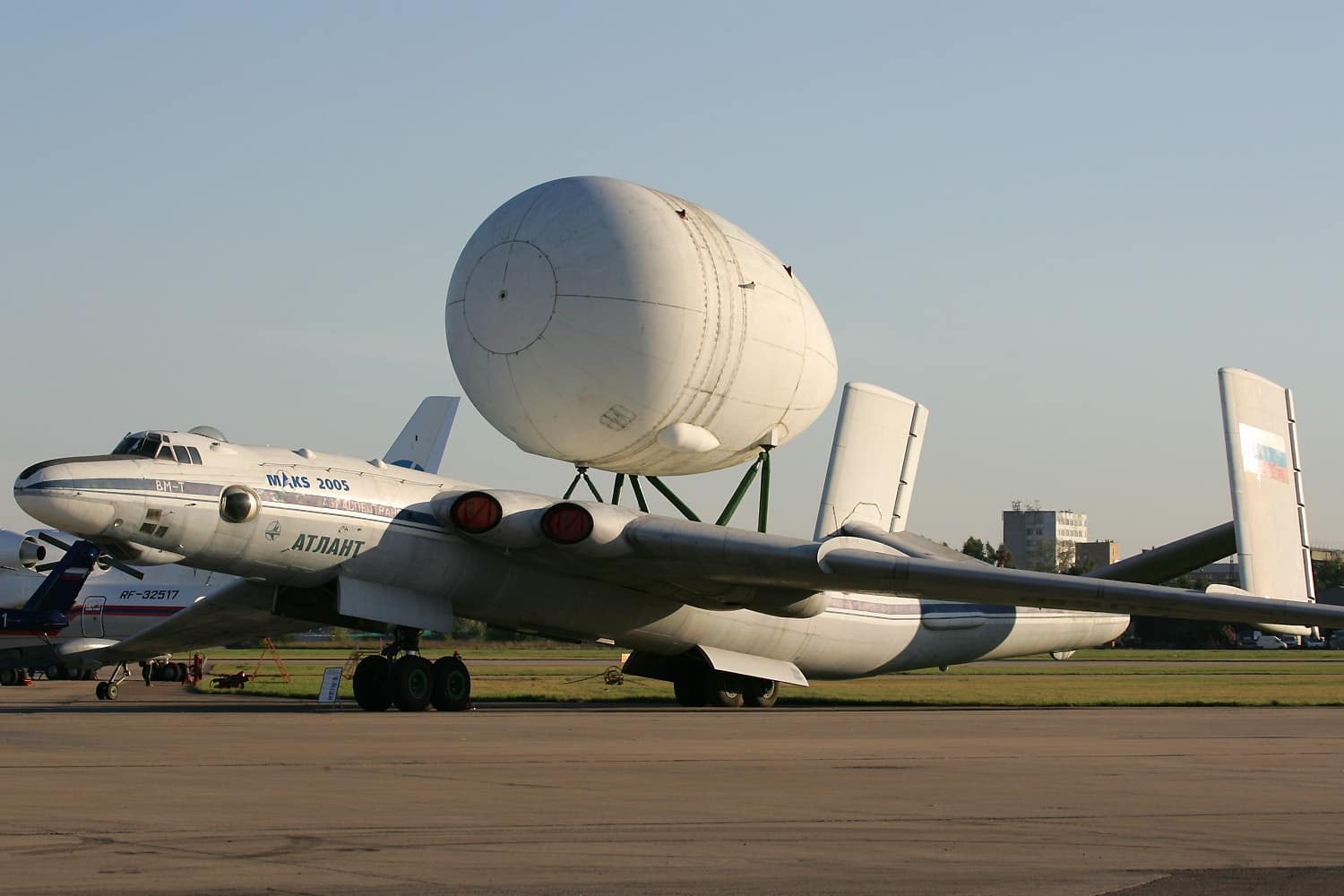
The cargo on the back of the aircraft is roughly twice as wide as the aircraft itself. The cargo also weighs 50 tonnes. The cargo is a Soviet Buran space shuttle missing its vertical stabiliser, strapped to the spine of a strategic bomber from which the original tail surfaces have been removed and replaced with twin oversized end-plates the size of barn doors. The whole machine is taking off from a 1980s Soviet airfield with no airline-style ground equipment in sight. And nobody, outside the Buran-Energia programme, was supposed to know the aircraft existed.
The Myasishchev VM-T Atlant — built from the bones of the cancelled M-4 Bison strategic bomber — is the most improbable piggyback transport in aviation history. Two were built. They flew 150 missions to Baikonur Cosmodrome. They carried Energia rocket stages and the Buran orbiter itself across thousands of kilometres of Soviet airspace at a time when the outside world knew almost nothing of the aircraft’s existence.
Quick Facts
Designer: Myasishchev Experimental Design Bureau (OKB)
Based on: Myasishchev 3M (development of M-4 Molot / NATO “Bison”)
First flight: 29 April 1981 — with external cargo, 6 January 1982
Built: 2 aircraft
Max external payload: 50 tonnes
Total Baikonur missions: ~150
Replaced by: Antonov An-225 Mriya (1988)
Surviving airframes: 2 (Zhukovsky and Dyagilevo air bases)
Why the Soviets needed a flying truck
The Buran-Energia programme — the Soviet response to the American Space Shuttle — was built around two enormous components: the Energia heavy-lift rocket, which had a 7.7-metre-diameter core stage, and the Buran orbiter itself, which had a 23.92-metre wingspan and weighed about 62 tonnes empty. These components were manufactured at plants in Moscow and Kuibyshev. They had to reach the Baikonur Cosmodrome in southern Kazakhstan — a distance of roughly 2,000 kilometres.
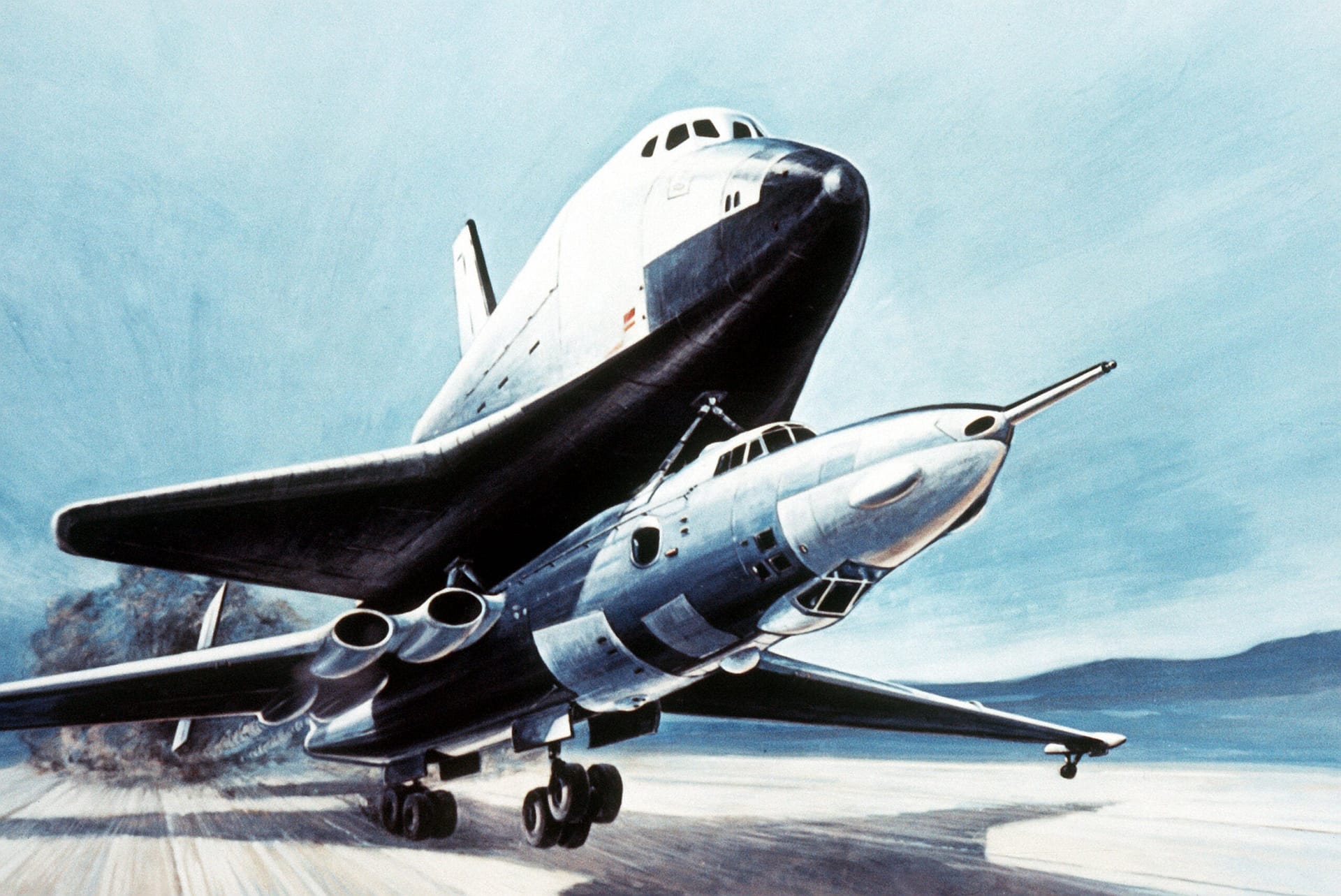
Soviet railways could not handle them. The components were physically wider than the maximum allowed cross-section for rail transport between Moscow and Baikonur. The two ways out were either to build a brand-new rail line at vast expense — which the Soviet government rejected in 1978 — or to fly the components piggyback on an existing aircraft modified for the purpose.
Vladimir Mikhailovich Myasishchev’s bureau, which had spent the 1950s building the M-4 Bison strategic bomber and then watched it become obsolete to ICBMs, was given the contract. The bureau had a stockpile of 3M airframes — the upgraded variant of the M-4 — sitting at depot. Three of these were converted into the VM-T configuration. The conversion was massive: the entire tail section was removed and replaced with twin oversize end-plate fins on a dihedral horizontal stabiliser, the fuselage spine was strengthened to carry external loads, and a specialised load-attachment frame was added.
The flying programme
The first VM-T flew without cargo on 29 April 1981. The first cargo flight followed on 6 January 1982. Operational missions started immediately. Between 1982 and 1989 the two operational VM-Ts (the third airframe was used as a ground test article) flew approximately 150 missions between Zhukovsky airfield, Kuibyshev (where the Energia core stages were assembled) and Yubileyniy airfield at Baikonur.
The aircraft carried five different load configurations: the Buran orbiter with its vertical stabiliser removed; the Energia core stage; an upper-stage fuel tank that was three times the diameter of the VM-T’s own fuselage; auxiliary booster sections; and an oversized fairing for non-shuttle payloads. The maximum external payload of 50 tonnes corresponded to a takeoff weight increase that pushed the modified 3M airframe to its limit.
The other 50-tonne flying truck
By 1988 the VM-T fleet was being phased out in favour of a much larger replacement — the Antonov An-225 Mriya. The Mriya was a clean-sheet design specifically built for the Buran-Energia programme, with six engines, a 88-metre wingspan and a 250-tonne payload capacity. The first Mriya was rolled out at Antonov’s Kyiv factory in November 1988. It carried the Buran orbiter on its maiden public appearance — the 1989 Paris Air Show — strapped to its spine in a photograph that would become one of the most famous images in 1980s Soviet aerospace.
The VM-Ts were retired from Buran service. The Buran programme itself was cancelled in 1993 after a single uncrewed orbital flight. The VM-Ts kept flying occasional cargo missions through the 1990s for the Russian space programme, then went into preservation. One airframe (RF-01502) is now at Zhukovsky International Airport in the care of TsAGI and the Gromov Flight Research Institute. The other (RA-01402) sits at Dyagilevo air base near Ryazan.
The Mriya, of course, did not survive 2022. Russian forces destroyed the only flyable An-225 at Hostomel airfield outside Kyiv during the opening days of the war in Ukraine. The Buran orbiter that the Mriya carried at Paris in 1989 had already been destroyed in 2002, when the roof of its storage hangar at Baikonur collapsed.
The two VM-T Atlants are now the only surviving aircraft directly associated with the Buran-Energia programme. They sit, large and improbable, on Russian airfields. The cargo they were built to carry — the Soviet shuttle, the Energia core, the dream of matching the American space programme — is gone. The aircraft themselves remain, like a pair of vast empty trucks parked on the runway of a closed factory.
Sources: Myasishchev VM-T Wikipedia entry; Buran-Energia.com (Vincent Touche); GlobalSecurity.org; SimpleFlying; Russian Aviation magazine archives.


 English
0 Comments