
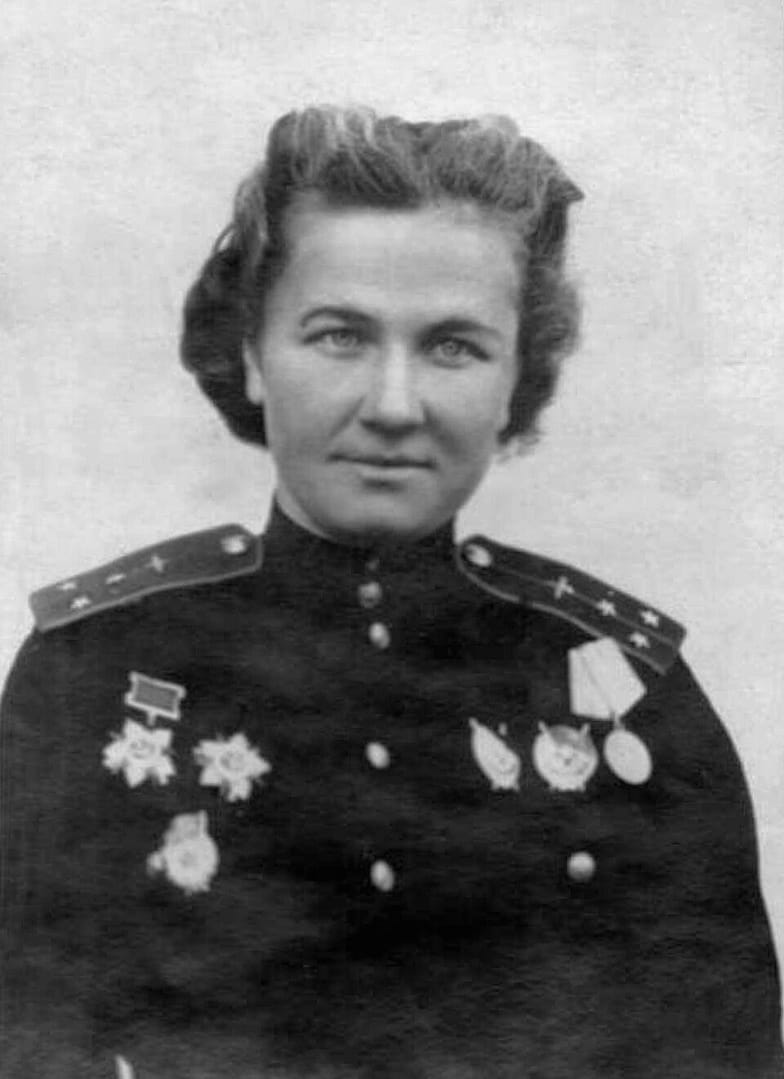
On a summer night in 1942, somewhere over the burning fields of the Donbas, a young Ukrainian woman cut her engine at 800 meters and let her tiny biplane glide silently toward a German ammunition depot. No radar. No radio. No parachute. Just the wind whispering across fabric wings and the sound of her own breathing. She released her bombs, restarted the engine in a gut-wrenching dive, and climbed back into the darkness. Then she did it again. And again. Eight times before dawn.
Her name was Nadezhda Popova, and over the course of the Great Patriotic War, she would fly 852 combat missions as a pilot in the legendary 588th Night Bomber Regiment. Shot down multiple times, wounded, burned, and buried in grief after losing the man she loved in battle, Popova kept climbing back into the cockpit of her Polikarpov Po-2. Not because she had to. Because she chose to.
This is not a story about statistics or squadron designations. This is a story about a woman who refused to let the war take anything from her without a fight.
Quick Facts
Pilot: Nadezhda Vasilyevna Popova (1921–2013)
Combat missions: 852 night sorties
Aircraft: Polikarpov Po-2 (U-2) biplane
Unit: 588th Night Bomber Regiment
Awards: Hero of the Soviet Union, three Orders of the Red Star, Order of Lenin
Service period: 1941–1945
A Girl From the Steppe
Nadezhda Popova was born in 1921 in the village of Shabanovka, in what is now Ukraine’s Donetsk Oblast. She grew up watching aircraft at a local gliding club and made her first solo flight at fifteen. By the time Germany invaded the Soviet Union in June 1941, she was already a trained pilot and flight instructor. She was nineteen years old.
When the Wehrmacht rolled into her hometown, Popova watched German soldiers execute her brother. The rage and grief that filled her in that moment never left. She volunteered immediately for Marina Raskova’s newly formed all-female aviation regiments, one of the most remarkable experiments in military history. No other nation in World War II fielded entire combat units staffed exclusively by women, from pilots and navigators to mechanics and armorers.

Flying a Crop-Duster Into Combat
The aircraft assigned to Popova’s regiment was the Polikarpov Po-2, a wood-and-canvas biplane designed in 1928 as a crop-duster and flight trainer. It had an open cockpit, a maximum speed of roughly 150 km/h, and could carry only two bombs under its lower wings, each weighing around 100 kilograms. It had no armor, no self-sealing fuel tanks, no guns of any kind, and no radio. If a tracer round hit the fabric, the entire aircraft could become a fireball in seconds.
But the Po-2 had one devastating advantage: it was almost invisible. The little biplane flew so slowly and so low that German radar could not detect it. Searchlights and anti-aircraft guns, calibrated for faster targets, struggled to track it. Popova and her fellow pilots developed a terrifying tactic. They would climb to altitude, cut the engine, and glide silently over their targets. German soldiers on the ground reported hearing nothing but a faint whooshing sound, like a broomstick sweeping through the air. That eerie whisper is what earned the regiment its fearsome reputation among German troops.
The Rhythm of a Night Mission
A typical night for Popova began at dusk and ended at dawn. She would fly between five and eight sorties per night, sometimes more. Each mission followed the same harrowing pattern: take off from a darkened field, navigate by moonlight and landmarks, approach the target at altitude, cut the engine, glide down through searchlight beams and flak, release bombs, restart the engine in the dive, and race back to base at treetop level. The entire round trip might take thirty minutes.
The navigator sat behind the pilot, holding a map and a flashlight with red cellophane taped over the lens to preserve night vision. There was no heated cockpit. In winter, temperatures at altitude dropped to minus thirty degrees Celsius. Frostbite was routine. Popova later recalled that the cold was sometimes worse than the fear.

Shot Down and Back the Same Night
During the Battle of the Caucasus in 1942, Popova’s Po-2 was caught in a searchlight cone. Anti-aircraft fire shredded the aircraft. Her navigator was wounded. Popova was hit in the leg. The engine failed. She somehow wrestled the shattered biplane down into a rough landing behind Soviet lines, dragged her navigator out of the wreck, found another aircraft, and flew two more missions before sunrise.
This was not an isolated incident. Over the course of the war, Popova was shot down or forced to crash-land multiple times. She was burned when a fuel line ruptured. She counted 42 patches on her aircraft after one particularly brutal mission. Each time, she returned to the air. The regiment’s ground crews, all women, became extraordinarily skilled at repairing battle-damaged Po-2s with little more than plywood, fabric, and wire.

Love and Loss at 800 Meters
During the war, Popova fell in love with Semyon Kharlamov, a fighter pilot stationed near her regiment’s base. Their relationship was one of the few bright spots in a life consumed by combat. In 1943, Kharlamov was shot down and killed. Popova later said she flew her next missions through a haze of tears, barely able to see her instruments. But she flew. That was the point. Flying was not an escape from grief. It was an answer to it.
After the war, Popova married another pilot, Semyon Popov, and settled in Moscow. She became an instructor and public figure, but she rarely spoke about her wartime experiences until decades later. When journalists finally asked her what it had been like, she paused and said simply that she was afraid every single time, but that fear had never been a reason not to go.
A Legacy Written in Moonlight
Nadezhda Popova died in Moscow on July 8, 2013, at the age of 91. She had flown 852 combat missions, been shot down multiple times, and earned some of the Soviet Union’s highest military honors, including the title Hero of the Soviet Union. But what made Popova extraordinary was not the medals or the mission count. It was the fact that she flew a plywood airplane into a wall of anti-aircraft fire, night after night, for three years, and never once considered stopping.
The 588th Night Bomber Regiment flew a combined total of over 23,000 sorties during the war. Twenty-three of its pilots were awarded the title Hero of the Soviet Union. Thirty-two of its members did not come home. They flew in an aircraft that was obsolete before most of them were born, armed with bombs they had to release by hand, navigating by the stars over a continent on fire. They were, by any measure, among the bravest aviators who ever lived.
Sources: Nadezhda Popova obituary (New York Times, 2013), “A Dance with Death” by Anne Noggle (1994), Soviet military archives, “Night Witches” by Bruce Myles (1981), Russian Ministry of Defense historical records.

 English
0 Comments