
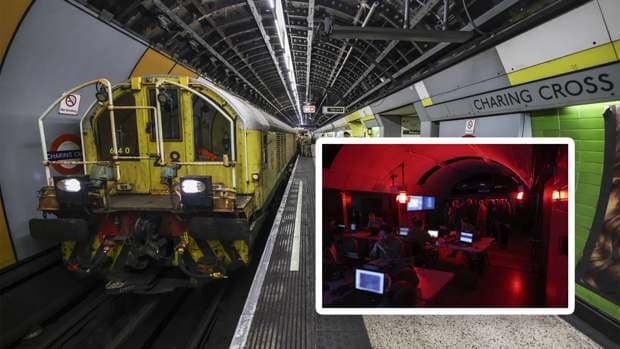
Eighty-six feet beneath Trafalgar Square, behind a nondescript grey door in a Tube corridor, five hundred soldiers bent over glowing screens while commuters streamed past, oblivious. No one above ground suspected a thing. This was Exercise Arrcade Strike, and the disused Jubilee line platforms at Charing Cross had become, for one week in May, a NATO war room.
The British Army, leading NATO’s Allied Rapid Reaction Corps, had quietly turned a forgotten pocket of the London Underground into a hardened command post. The choice was deliberate, and rather elegant: hide the nerve centre of a corps in plain sight, deep below one of the busiest capitals on earth, where Russian missiles, drones and electronic eyes cannot find it.
It was equal parts Cold War theatre and twenty-first-century deterrence — a rehearsal for a war planners hope never comes.
Quick Facts
- Exercise: Arrcade Strike, run by the Allied Rapid Reaction Corps (ARRC)
- Location: Disused Jubilee line platforms, Charing Cross Underground — ~86 ft (26 m) below central London
- Scale: Up to 500 staff; command of ~100,000 personnel across land, sea, air, space and cyber
- Scenario: Fictional 2030 Russian offensive in the Baltics, HQ imagined in Tallinn, Estonia
- Purpose: A survivable command post, hidden from aerial surveillance and hardened against strikes
- Throughput: More than 10 terabytes of data per day, fused by the AI platform Project Asgard
A war room beneath the city
The two platforms once carried Jubilee line trains, until the 1999 extension rerouted the line through Westminster and left them dark. Since then they have served as a film set — the tunnels stood in for a secret lair in the James Bond film Skyfall — and as occasional operational space. In May 2026 they served NATO.
The ARRC is NATO’s premier deployable corps headquarters, headquartered at Imjin Barracks in Gloucestershire and staffed by personnel from 21 member states. Exercise Arrcade Strike was its sternest test in a generation: could it plan and command a corps-sized fight, on land and at sea, in the air and in space, from a single concealed bunker?
Why go underground
The logic is brutal and modern. A command post is the brain of a corps, and on today’s battlefield it is among the most hunted targets of all. Long-range missiles, loitering drones and electronic surveillance can locate and strike a conventional headquarters within minutes of it switching on a radio.
So the Army has been moving its brains ever deeper. “We have moved from operating in tents and open environments, to commercial buildings, to aircraft hangars, and now to underground locations,” one commander explained during the exercise. Below ground, the corps shrinks its signature, hides from the sky, and improves its odds of surviving the first blow.

The air and the algorithm
From the platforms the headquarters reached far beyond London. The fictional fight, set in 2030, saw Russian forces pour into the Baltics; the ARRC, its makeshift HQ imagined in Tallinn, had to deter, strike and — if necessary — restore NATO territory. That meant orchestrating the air domain: jamming enemy communications, hunting drones, and integrating fires across every dimension at once.
The enabler was Project Asgard, an AI-driven targeting web that ingests feeds from sensors, satellites and intelligence sources, then fuses and visualises them for commanders. More than ten terabytes flowed through the tunnels each day — roughly three months of non-stop high-definition streaming — compressing the time from seeing a target to striking it from hours into minutes.
Hidden in plain sight
Secrecy was theatre as much as tradecraft. Personnel arrived in civilian clothes and changed into uniform only after passing secure barriers, blending into the rush-hour crowd a few corridors away. A barcode system tracked who was underground at any moment, while passenger trains kept calling at the live station every ninety seconds.
One soldier drew the obvious historical line. “Winston Churchill was hidden underground in London in the Second World War, so it’s nothing new,” said Corporal Ismaila Ceesay, a born-and-bred Londoner. “It worked for him.” The platforms at Charing Cross sit only minutes from Churchill’s wartime war rooms and the modern Whitehall bunkers.
Smuggling a headquarters into the Tube
Building the command post was a feat of quiet logistics. Equipment moved by unmarked civilian vans to Ruislip in the small hours, then onto a Transport for London engineering train — the kind that normally hauls maintenance gear — and straight to the Charing Cross platform. A week of construction followed, with 22 Signal Regiment threading high-tech communications through the warren of tunnels.
The constraint was the point. A warehouse, the usual venue, is a wide-open box. These platforms are a labyrinth of curving tunnels and narrow ledges — awkward to wire, but far harder to find and far better to survive in.

A glimpse of the forgotten platforms
For those who have never seen the abandoned half of Charing Cross, the spaces are eerily intact — tiled, lit, and frozen since 1999. This walk through the disused platforms shows the very setting the ARRC chose for its war room.
Inside the abandoned platforms at Charing Cross station. (Time Out)
Deterrence you can’t see
The Army has been clear that this was no one-off stunt. The “underground model” will be rehearsed across the UK and Europe over the next two years, working towards a fully mission-capable Strategic Reserve Corps by 2030 — the same horizon as the war it war-gamed.
There are honest gaps between the script and reality, as commentators were quick to note: the scenario assumed thousands of drones a day, a capacity Britain does not yet field. Yet the message was never about today’s arsenal. It was about intent.
When the soldiers packed up and climbed back to the surface, the crowds never knew they had been there. That, in the end, was the whole idea — a deterrent that works best precisely because no one can see it.
Sources: British Army (army.mod.uk); UK Defence Journal; GB News; ianVisits; London Transport Museum.



 English
0 Comments