
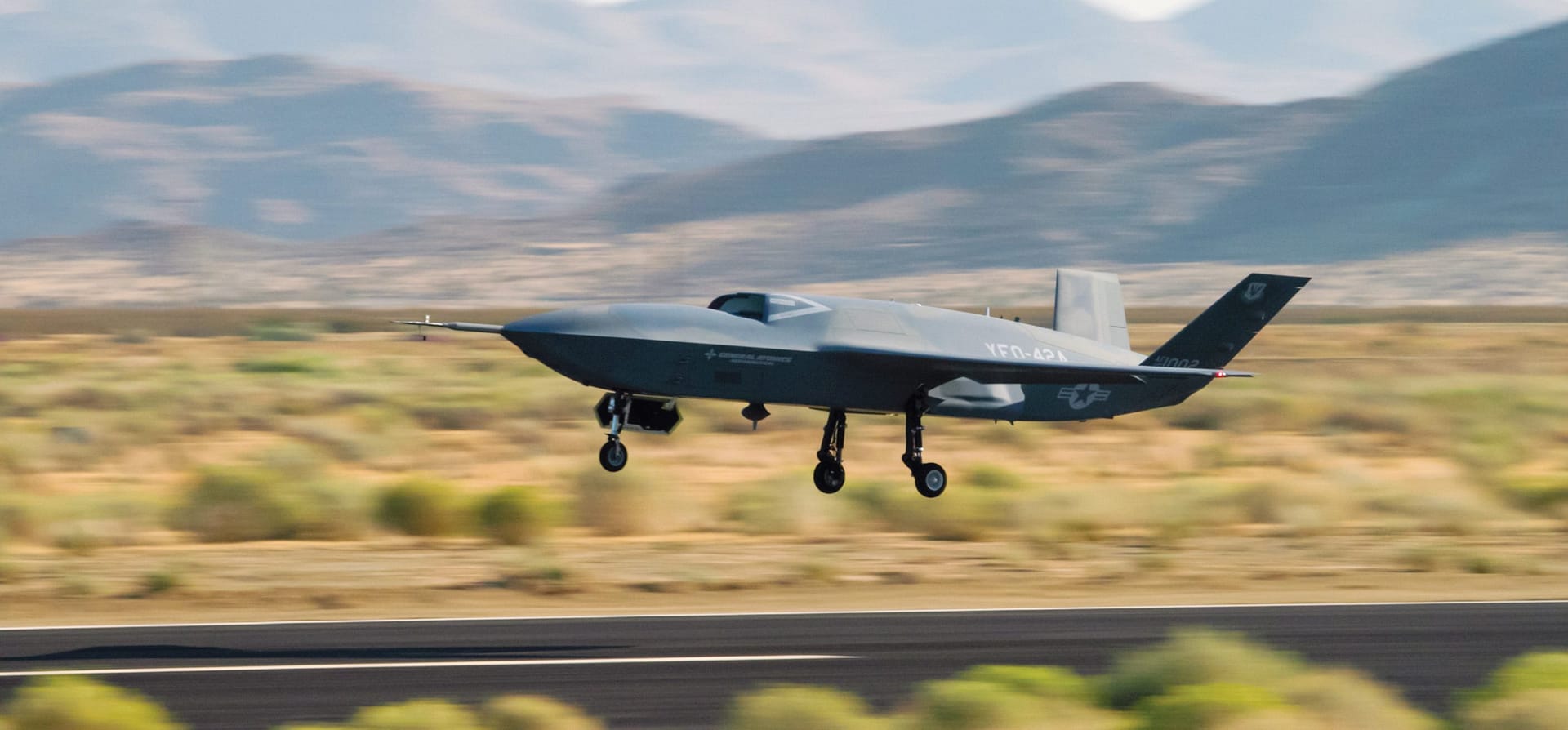
There is something quietly momentous about a small nation on the North Sea becoming the first foreign partner in what may prove to be the most consequential transformation in air power since the jet age. On 23 April 2026, the United States Air Force and the Netherlands Ministry of Defence signed a landmark partnership: The Royal Netherlands Air Force will fund two Collaborative Combat Aircraft — semi-autonomous drone wingmen designed to fly alongside crewed fighters — making the Netherlands the first ally anywhere in the world to invest directly in America’s robot wingman programme.
• The Netherlands signed a CCA partnership with the USAF on 23 April 2026, becoming the first foreign nation to fund prototype Collaborative Combat Aircraft
• The Dutch will acquire two aircraft — either the General Atomics YFQ-42A, the Anduril Industries YFQ-44A, or one of each
• Dutch airmen will train alongside Americans at the Experimental Operations Unit at Nellis AFB, Nevada
• The USAF is pursuing a total CCA fleet of 1,000 drones to fly alongside crewed fighters including the F-35, F-22, and F-47
What Exactly Is a Collaborative Combat Aircraft?
The CCA programme represents Washington’s most serious attempt yet to answer a question that has haunted Western defence planners for two decades: how do you generate mass in the air at a cost the treasury can sustain? The answer is the semi-autonomous unmanned aircraft — an intelligent drone designed not to replace the fighter pilot, but to fly beside him, extending his reach and multiplying his options.
Two aircraft are currently competing: General Atomics offers the YFQ-42A, and Anduril Industries the YFQ-44A. The YFQ-42A completed its first flight tests in August 2025 — from programme launch to first flight in under two years.
The Dutch Decision: More Than a Procurement
With 40 F-35As in service and a final objective of 52 aircraft, the Dutch have made their strategic bet on fifth-generation air power. The CCA partnership is the logical next move — an investment not merely in hardware, but in the operational concepts that will govern how those F-35s fight in the 2030s and beyond.

“The future fight will be fought with allies and partners. By aligning our approaches early, we ensure interoperability and shared advantage in the era of human-machine teaming.”
Nellis Air Force Base: The Classroom for Tomorrow’s Air War
Under the terms of the agreement, the two Dutch-funded CCAs will be delivered to the Experimental Operations Unit at Nellis Air Force Base in Nevada. Dutch airmen, embedded within this unit, will participate in developing tactics, techniques, and procedures for human-machine teaming from its earliest stages. They will not merely receive a finished product — they will help shape how it is operated.
A European First, and What It Signals
By becoming the first European nation to invest in CCA, The Hague signals something Brussels and Berlin would do well to note: the future of air power will be shaped not merely by those who design the technology, but by those who help develop the doctrine. Influence, in defence affairs, accrues to those who show up early.
Other European F-35 operators — Italy, Norway, Denmark, Belgium, Poland — will be watching. The Dutch have already taken their seat at the table.
The Machines: YFQ-42A and YFQ-44A
General Atomics brings decades of unmanned systems experience — the company built the Predator and Reaper. Anduril Industries represents Silicon Valley’s disruption of the defence industrial base. The Dutch-funded aircraft could be either type, or one of each — a useful hedge allowing the Royal Netherlands Air Force to develop experience across both platforms.
A New Chapter in Atlantic Alliance
The Dutch decision to invest directly in the future of American air power is an act of strategic confidence. It is a bet that the alliance works, that interoperability is worth pursuing, and that the best guarantee of European security remains a tight, technically integrated partnership with Washington. At Nellis, in the Nevada desert, Dutch and American aviators will soon learn together how to command machines that think.
Sources: Air & Space Forces Magazine | The Defense Post | DVIDS
• Experience a Fighter Jet Flight with MiGFlug


 English
0 Comments