

The Florida evening smelled of pine resin and rocket smoke. On a cracked, disused runway deep in the Eglin reservation — Wagner Field, the same strip where Doolittle’s raiders once practised short takeoffs — a four-engine Hercules sat bristling with thirty rocket motors, like a cargo plane that had wandered into a missile depot and come out wearing half of it. The crews who climbed aboard her that autumn of 1980 were all veterans of Desert One. Every one of them had volunteered to go back to Tehran.
Their mission, hidden under the deliberately bland name Operation Credible Sport, was perhaps the most audacious flying job ever asked of a C-130: land a 70-ton transport inside the Amjadieh soccer stadium across the street from the U.S. Embassy in Tehran, hold it to roughly 100 metres of ground roll, load Delta Force and 52 freed American hostages, and blast back out over the bleachers on a wall of rocket fire.
It came astonishingly close to working.
Quick Facts
- Program: Operation Credible Sport, July–November 1980 (part of project Honey Badger)
- Aircraft: Three modified C-130H Hercules (XFC-130H / YMC-130H), fitted with 30 rocket motors
- Goal: Land inside Tehran’s Amjadieh stadium, extract the 52 US embassy hostages
- Rockets: 8 forward-firing ASROC motors to stop, 8 downward Shrikes to cushion, 8 rearward for takeoff, plus stabilising motors on wings and tail
- The crash: 29 October 1980 at Wagner Field, Eglin AFB — braking rockets fired early, right wing torn off, entire crew walked away
- Outcome: Program cancelled after the November 1980 election; hostages freed by diplomacy in January 1981
Five Months After Desert One
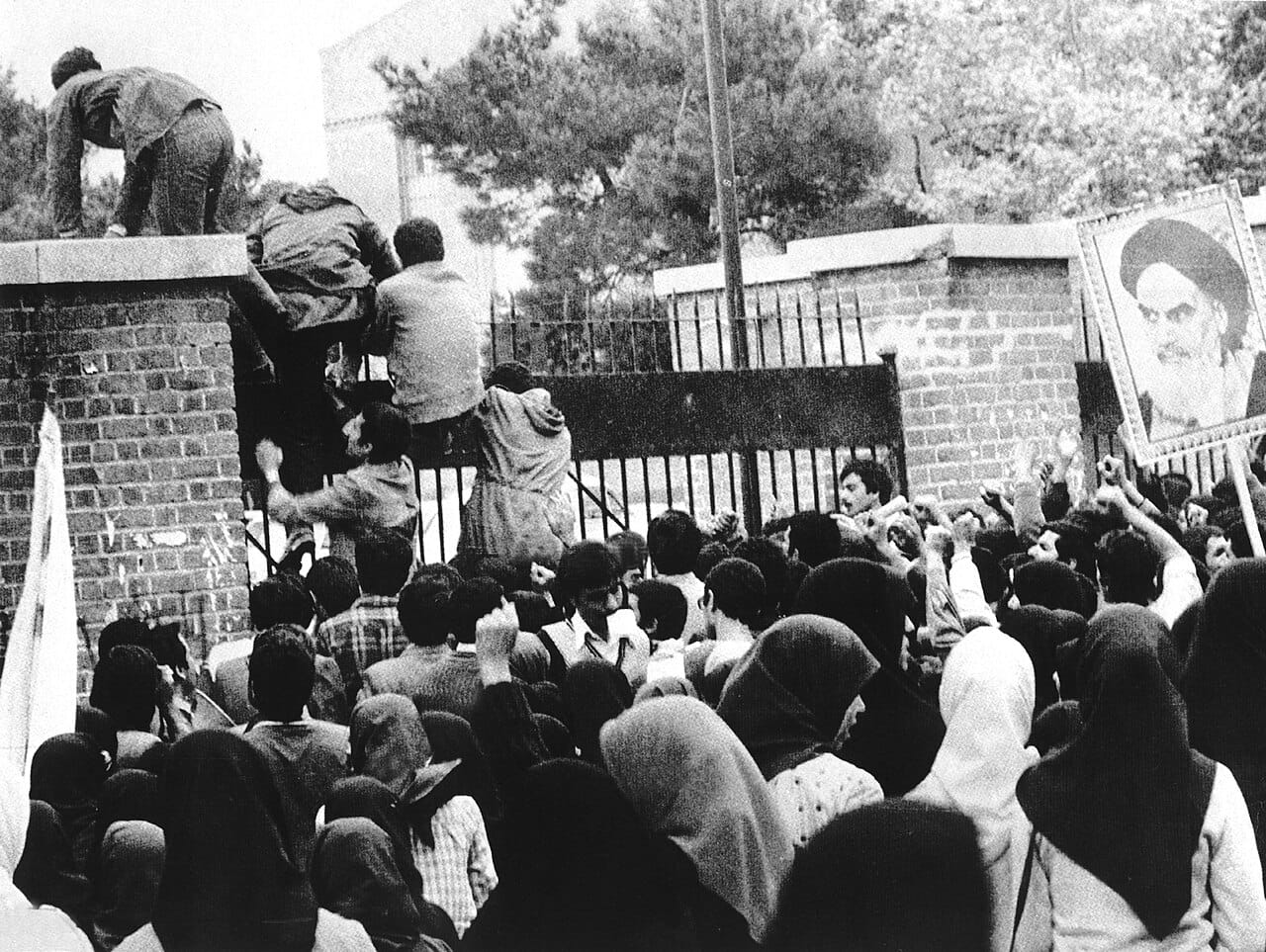
The wound was still raw. In April 1980, Operation Eagle Claw had ended in flames at a desert refuelling point in eastern Iran when an RH-53D helicopter drifted into a parked C-130. Eight men died. The helicopters — minesweepers pressed into a job they were never built for — had been the weak link, and everyone in the planning cells knew it.
Within two weeks the Pentagon was planning a second attempt. The new joint task force, working under the codename Honey Badger, kept arriving at the same brutal arithmetic: helicopters could not be trusted to carry 52 hostages and their rescuers out of the centre of a hostile capital. What they needed was a fixed-wing aircraft that could land where no fixed-wing aircraft had any business landing.
The answer sat across the street from the embassy itself: the Amjadieh soccer stadium. If a C-130 could somehow be made to stop within the pitch and clear the 90-foot bleachers on the way out, the helicopters could be cut out of the equation entirely.
Thirty Rockets on a Hercules
Lockheed’s first study, in July 1980, was sobering: a conventional JATO approach would need 58 bottles and still would not stop the aircraft in time. So the Navy’s rocket scientists at China Lake were brought in, and the solution grew wilder. Eight forward-pointing ASROC anti-submarine rocket motors were blistered onto the forward fuselage to kill the aircraft’s forward speed. Eight downward-firing Shrike motors above the wheel wells would cushion the final drop. Eight more rockets on the rear fuselage would hurl the aircraft back off the ground, while smaller motors on the wings and under the tail kept the beast pointed the right way up.
Add double-slotted flaps, extended ailerons, a tailhook for an emergency carrier landing, terrain-following radar and new fins, and the XFC-130H was less a transport than a piloted missile battery. Around 20 Navy personnel, 50 Air Force personnel and more than 1,000 civilians worked on the project — and the first fully modified aircraft was delivered in roughly 90 days from a standing start.
The performance was unlike anything a Hercules had ever produced. In retired Colonel Jerry Thigpen’s official history of the Combat Talon program, the takeoff tests read like science fiction:
The crews assigned to fly the mission were drawn from the 463rd Tactical Airlift Wing — and all three crews were Operation Eagle Claw veterans. They had seen Desert One burn. They strapped into an aircraft carrying thirty live rocket motors anyway.
29 October 1980: Twenty Feet Too High
Through late October the test program at Wagner Field went almost flawlessly. The double-slotted flaps let the Hercules crawl down an eight-degree glideslope at 85 knots. On 29 October, aircraft 74-1683 flew the first full-profile demonstration. The takeoff phase set short-takeoff records. Then came the landing.
The Lockheed test crew, wary of the still-uncalibrated rocket-firing computer, elected to trigger the motors manually. The upper pair of braking rockets fired in the air, as designed — and wrapped the cockpit in glare and smoke. Blinded, the flight engineer believed the aircraft was already on the runway and fired the lower braking rockets early, at about 20 feet. The descent-cushioning rockets never fired at all. Forward speed went to nearly zero, and 70 tons of Hercules dropped straight down.
The right wing broke between the third and fourth engines. Fire trailed the sliding wreck down the runway — and then something remarkable happened: a hovering medevac helicopter blew the flames away from the fuselage, crash crews smothered the fire within seconds of the aircraft stopping, and the entire crew climbed out and walked away.
The footage of that landing — long classified, the wreck itself dismantled and buried on-site for secrecy — has since become one of aviation’s most replayed test films:
The Election That Ended It
Even after the crash, the program had believers. The second fully modified aircraft, 74-1686, was nearly ready. Major General James Vaught, the task force commander who had led the first rescue attempt, argued in a November memo that the fleet of modified Talons was worth having regardless: “Attainment of the rocket-assisted capability is a much needed but secondary consideration,” he wrote — the priority was simply more refuelable special-operations Hercules.
But history was moving faster than the engineers. On 2 November 1980, Iran’s parliament accepted an Algerian-brokered framework for releasing the hostages. Two days later, Ronald Reagan won the presidential election. The rescue mission — and with it Credible Sport — was dead. The 52 hostages came home on 20 January 1981, minutes after Reagan was sworn in. No rockets required.
For the people who built the aircraft, the pride never quite faded. Joe Lozano, a Texas Instruments engineer who installed the terrain-following radar at Dobbins, put it simply decades later:
The Stadium Jumper’s Legacy
The surviving rocket-plane, 74-1686, kept flying — stripped of its motors, it became the YMC-130H prototype for the MC-130H Combat Talon II, the special-operations Hercules that served for four decades. Today the airframe stands at the Empire State Aerosciences Museum in New York, its rocket fairings still scarring the fuselage.

And the deeper lesson of Credible Sport outlived the airframes. The Pentagon concluded that what it really needed was an aircraft that could take off and land like a helicopter but fly like a turboprop — a requirement that led, in time, to the V-22 Osprey. The program’s full story, told by its participants, is preserved in this documentary:
Three crews of Desert One veterans volunteered to fly a rocket-studded transport into a stadium in the middle of an enemy capital, at night, with 52 lives in the cargo bay. The mission never launched. The nerve it took to be ready for it deserves to be remembered.
Sources: Jerry L. Thigpen, “The Praetorian STARShip” (Air University Press, 2001); War Is Boring / Joseph Trevithick (declassified USAF documents via FOIA); Carl Posey, Air & Space Magazine; crediblesport.blogspot.com (program participants); Wikipedia.
 English
0 Comments