
It was a clear winter morning over the Costa del Sol, the kind where the Mediterranean glitters like hammered tin. At 10:30 on 17 January 1966, the villagers of Palomares — tomato farmers, mostly, in a corner of Almería so dry the fields had to be coaxed into life — heard a sound like the sky tearing open. Six miles above them, a B-52 bomber loaded with four hydrogen bombs had just flown into its tanker.
The fireball consumed 40,000 gallons of jet fuel. Burning wreckage rained across the village for minutes — an engine here, a wing spar in a tomato field there. Seven of the eleven airmen aboard the two aircraft were dead. And somewhere in the debris falling toward Spain were four B28 thermonuclear bombs, each carrying many times the destructive power of Hiroshima.
What followed was one of the strangest episodes of the Cold War: plutonium in the tomato fields, the largest deep-sea search in history, a Spanish fisherman who out-calculated the US Navy, and an American ambassador swimming for the cameras.
Quick Facts
- Date: 17 January 1966, ~10:30 local time, 31,000 ft over Palomares, Spain
- Aircraft: B-52G of Strategic Air Command and KC-135A tanker from Morón Air Base
- Casualties: 7 airmen killed (all 4 tanker crew, 3 of 7 bomber crew); 4 survived by parachute
- Payload: Four B28FI thermonuclear bombs (1.45 megatons each)
- On land: Two bombs’ conventional explosives detonated, scattering plutonium; one landed intact in a riverbed
- At sea: One bomb lost in the Mediterranean for 80 days — found with the help of fisherman Francisco Simó Orts and the submersible Alvin, raised 7 April 1966 from 869 m
A Routine Called Chrome Dome
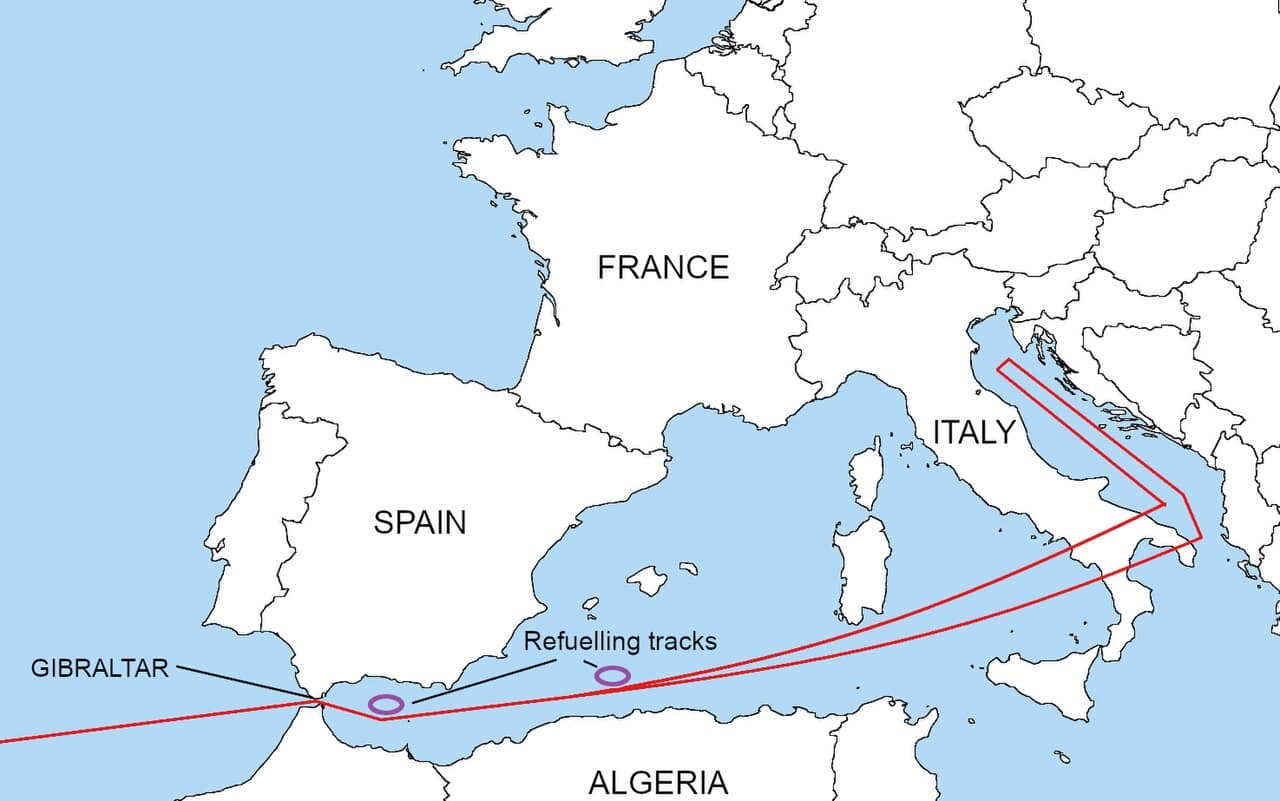
The B-52, callsign Tea 16, was flying Operation Chrome Dome — the Strategic Air Command program that kept nuclear-armed bombers airborne around the clock, circling toward the Soviet border so that no surprise attack could catch America’s deterrent on the ground. The southern route ran across the Atlantic, around the boot of Italy, and home again, with two aerial refuellings over Spain.
The second refuelling, on the way home, is where it went wrong. The bomber closed on the KC-135’s boom carrying just a little too much speed.
The boom nozzle struck the top of the bomber’s fuselage and snapped its structure; the B-52 broke apart and the tanker exploded with everyone aboard. Four of the bomber’s seven crew got out, drifting down under parachutes into the sea and the hills — Messinger among them, wounded, paddling a life raft 45 minutes offshore.
Three Bombs Down, One Missing
Within 24 hours, search teams found three of the four bombs on land. One had floated down on its parachute and was recovered nearly intact from a riverbed. The other two had hit hard: their conventional high explosives detonated on impact — without triggering a nuclear blast, as designed — but the detonations blew plutonium dust across roughly two square kilometres of village and farmland.
Some 1,400 tonnes of contaminated soil and vegetation were eventually scraped up, sealed in steel barrels, and shipped to South Carolina for burial. American airmen in fatigues worked the tomato fields for weeks; the village’s crops were bought up and destroyed. Decades later, patches of contaminated land near Palomares remain fenced off, and Madrid and Washington are still negotiating the final cleanup.
But the fourth bomb was simply gone. A local fisherman, Francisco Simó Orts, had watched from his boat as the wreckage fell — and told anyone who would listen that he had seen a “half man” hit the water: something falling under a parachute too small for the load beneath it. He marked the spot in his head the way fishermen do, by shore bearings his family had used for generations.
The Navy was sceptical. Then its mathematicians ran the currents, the winds, and Simó’s bearings through a Bayesian search model — and his patch of sea came out on top. The locals were already calling him Paco el de la bomba: Paco of the bomb. Spanish courts later agreed he deserved salvage compensation for pointing the world’s most powerful navy at its own missing hydrogen bomb.
Eighty Days Under the Mediterranean
The search that followed was the largest undersea operation ever mounted: more than 30 ships, thousands of men, and two tiny deep-diving submersibles, Alvin and Aluminaut, crawling along a seabed canyon in darkness. On 15 March 1966 — nearly two months after the crash — Alvin’s crew finally saw it: a bomb-shaped object wrapped in its grey parachute, perched on a 70-degree slope 777 metres down, exactly where Simó’s bearings pointed.

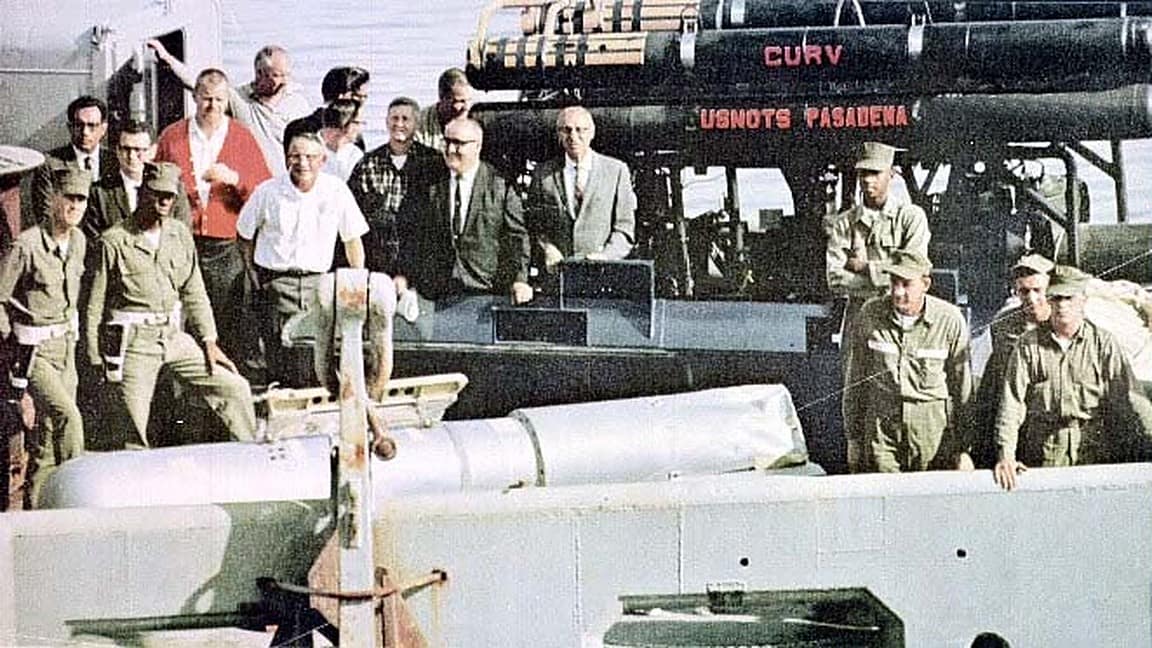
Getting it back proved harder than finding it. The first lifting attempt snapped its lines, and the bomb slithered deeper down the canyon — lost again for another nine days. On 7 April, an unmanned recovery vehicle called CURV fouled itself in the bomb’s parachute, and the Navy decided to haul the whole tangle up together. After 80 days on the seabed, the B28 broke the surface, intact.
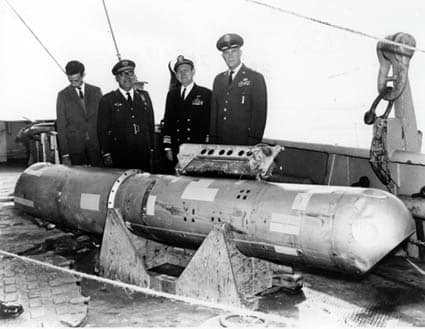
The next morning, reporters were brought aboard the submarine rescue ship USS Petrel to photograph it — the first time the United States had ever displayed a nuclear weapon to the public. The picture went around the world.
The Ambassador Goes Swimming
While the Navy hunted the bomb, Washington fought a parallel battle for Spanish public opinion. Tourism was the lifeblood of Franco’s coastal economy, and headlines about radioactive beaches threatened to empty the hotels of the Costa del Sol. So on 8 March 1966, US Ambassador Angier Biddle Duke staged one of the most famous photo opportunities of the Cold War: he went swimming at a Palomares-area beach, in front of the world’s cameras, with Spain’s information minister splashing alongside.
The swim made for marvellous newsreel. The reality was messier: the plutonium was never in the water but in the soil, and the long-term health monitoring of Palomares residents continues to this day. Spain banned US flights with nuclear weapons over its territory, and within two years — after another armed B-52 crashed at Thule, Greenland — Chrome Dome itself was shut down for good.
The story of the crash and the hunt for the lost bomb is told in this documentary:
What Palomares Changed
Palomares was the worst “Broken Arrow” — nuclear weapons accident — in history to that point, and it rewired how the superpowers handled their arsenals. Airborne alert with live weapons ended. Weapon safety design was overhauled so that no impact, fire or short circuit could detonate the conventional explosives the way two of the Palomares bombs had. And the Navy’s Bayesian search techniques, vindicated by a Spanish fisherman’s shore bearings, went on to find the USS Scorpion and, decades later, Air France 447.
For a shorter period-style retelling of the day itself, this on-this-day capsule covers the collision and its aftermath:
The village, for its part, never asked to be a Cold War landmark. Seven airmen died over its fields; its farmers lost their crops and, some of them, their peace of mind. And one fisherman, Paco of the bomb, proved that local knowledge can outperform a fleet.
Sources: US Navy historical records; Brookings Institution; Time; ABC News; History.com; Wikipedia (1966 Palomares accident).

 English
0 Comments