
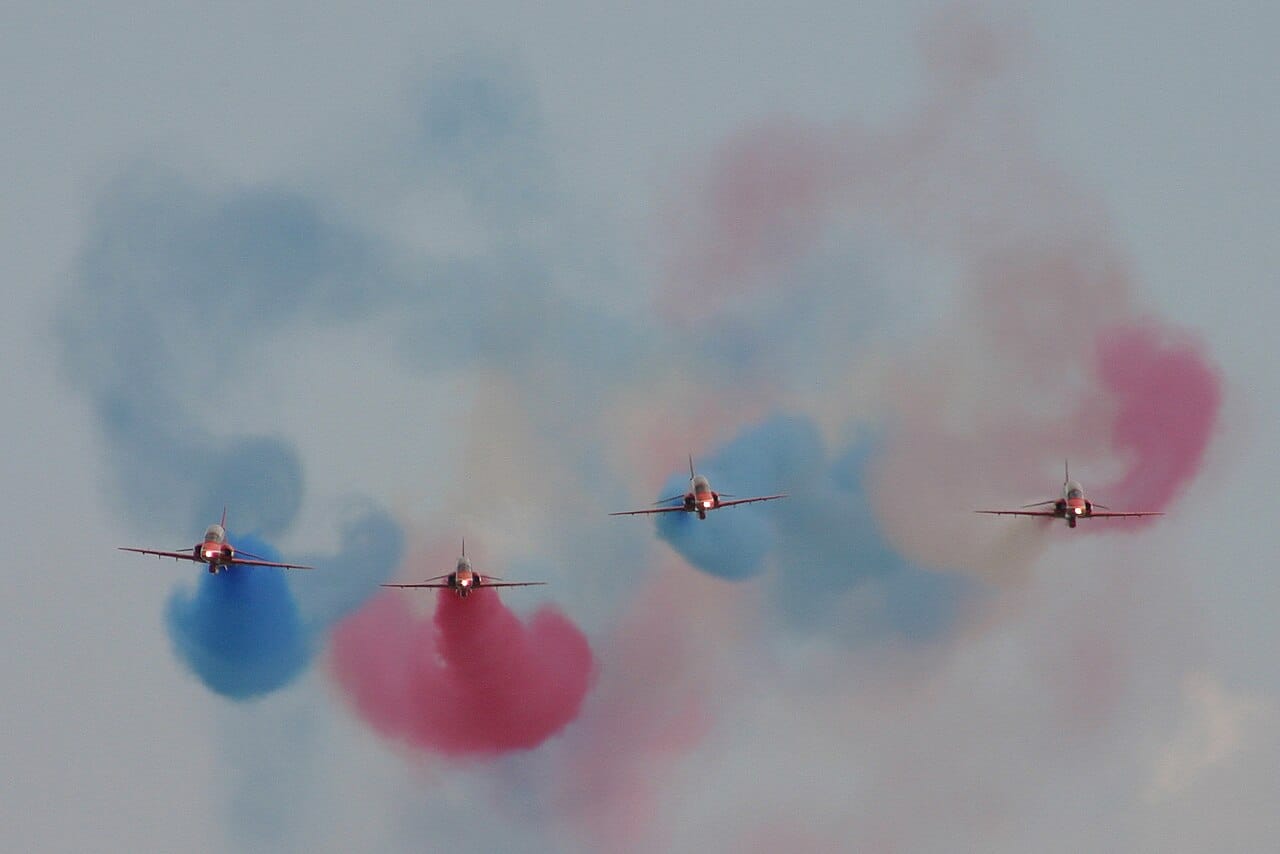
The Diamond Nine is to the British what the Blue Angels’ Delta is to the Americans: a closing formation so tight and so visually unforgettable that for almost sixty years it has been the single most iconic shape in the sky over Britain. Nine red BAE Hawk T1s in a precision diamond, smoke trails painting the colour of the Union flag on the air behind them. From the Queen’s Silver Jubilee in 1977 to the Olympic opening ceremony of 2012, the Red Arrows in nine-ship were what Britain looked like from the air.
From the 2026 display season onwards, you will mostly not see it. The Royal Air Force Aerobatic Team — RAFAT, the Red Arrows — has announced that the vast majority of its public displays will now be flown by seven aircraft, not nine. The Diamond Nine will appear only twice in 2026, for the King’s Birthday Flypast in June and for the United States’ 250th anniversary on 4 July. The reason is mundane and unsentimental: the Hawk T1’s engines are out of production and the team can no longer afford to wear out spares in routine displays.
Quick Facts
| Team | Royal Air Force Aerobatic Team — the Red Arrows |
| Aircraft | BAE Systems Hawk T1, Rolls-Royce Adour Mk 151 turbofans |
| Standard display formation | 9 aircraft (1968–2025) → 7 aircraft (2026 onwards) |
| Hawk T1 first flight | 21 August 1974 |
| Hawk T1 RAF entry | 1976 |
| Hawk T1 fleet retirement | 2030 (after the 2029 display season) |
| Replacement | BAE Hawk T2 (already in RAF training service) or possible Aeralis trainer |
| Diamond Nine in 2026 | Twice only — King’s Birthday Flypast (June), US 250th Independence Day (4 July) |
An aircraft older than its pilots
The Hawk T1 the Red Arrows fly today is approaching fifty years old, with the oldest airframes in the fleet dating back to 1976. The youngest pilot on the 2026 display team was born in the early 1990s. The Rolls-Royce Adour Mk 151 turbofan that powers the Hawk T1 went out of production decades ago. The RAF maintains a strategic stockpile of spare engines — but every engine the Red Arrows use for a display is one fewer available for the rest of the RAF Hawk T1 training fleet, including the Hawk T1A used at RAF Valley to teach future fast-jet pilots.
The Red Arrows fly approximately 75 to 80 public displays per season, plus countless practice flights at RAF Waddington, the team’s home since leaving RAF Scampton. Each nine-ship display imposes wear on nine engines simultaneously. A seven-ship display, by reducing the number of airframes airborne, cuts the engine wear by 22%. Multiplied across an entire season, that is the difference between the Hawk T1 fleet reaching its planned 2030 retirement and the fleet running out of usable engines earlier.
A team built around a number
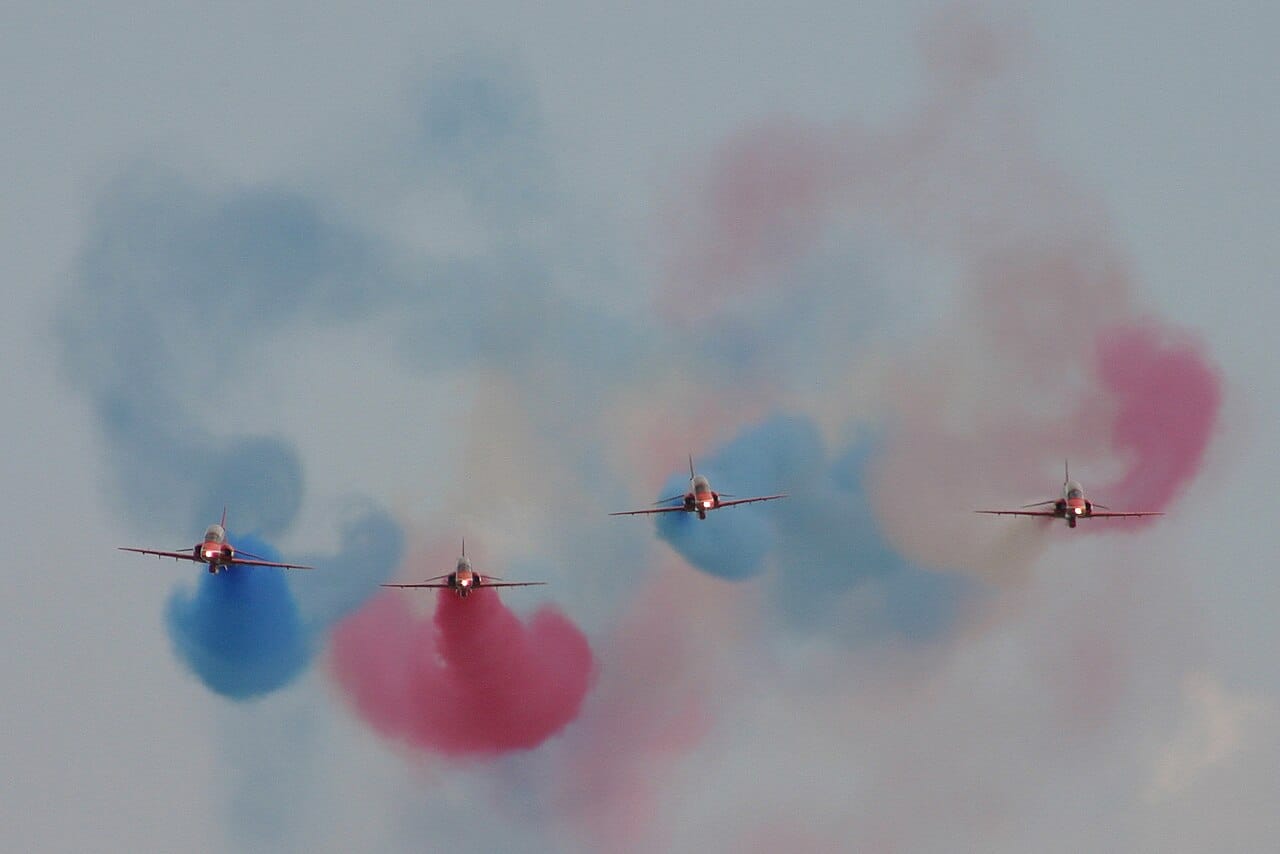
The number nine is not arbitrary. The Red Arrows’ displays — the Apollo Roll, the Diamond Loop, the Vixen Break — were choreographed around a specific aerodynamic geometry that only nine aircraft can produce. Reducing to seven required a complete redesign of the routine. The 2026 display, revealed in early May, drops the Apollo and modifies the Vixen. A new manoeuvre called the Tornado, flown by all seven aircraft passing simultaneously through a central point, has been introduced to give the spectators a new piece of visual choreography.
The team’s leadership has been at pains to insist that this is a temporary measure — that the Diamond Nine will return when the Hawk T1 is replaced, that the team retains its full nine-pilot establishment, that no pilots have been removed from the team. All true. None of it changes the underlying engineering arithmetic: the engines that fly the Diamond Nine are out of production, will not be remanufactured, and have to last another four display seasons.
The successor that hasn’t been chosen
The thornier question is what replaces the Hawk T1 in 2030. The RAF has no firm answer. The obvious candidate — the Hawk T2 already in service at RAF Valley — is structurally similar but has a more modern engine (Rolls-Royce Adour 951) that the team would have to learn from scratch. The British start-up Aeralis is developing a modular jet trainer specifically pitched at the Red Arrows replacement role, but its first flight is still years away. A foreign acquisition (the Leonardo M-346, the KAI T-50, even a second-hand Boeing T-7A) has been discussed in defence circles but not, so far as is publicly known, formally tendered.
What is certain is that 2030 is the cliff edge. The Hawk T1 cannot stretch beyond it; the spares simply do not exist. The Red Arrows must either have a successor aircraft on strength in 2030 or stop displaying. Given the visibility and political importance of the team — the Red Arrows are arguably the single most-watched element of the entire Royal Air Force in any given year — neither outcome is acceptable. The decision will be made well before 2030. It has just not been made yet.
For now, if you see a Red Arrows display in 2026, take a photograph. There will be seven jets, not nine, and the choreography will be subtly different from the one you remember. The Diamond Nine, when it does appear, will be a state event — the Royal Family’s birthday, the United States’ 250th, perhaps one or two others. The everyday Diamond Nine is, for the next four years, gone.
A full Red Arrows nine-ship display from the 2025 season — captured at the RAF Cosford Air Show. The choreography that 2026 audiences will mostly no longer see in its complete form.
Sources: The Aviationist; Royal Air Force; Air Data News; uknip.co.uk; The Daily Sceptic; GB News; AOL.

 English
Thank you for this interesting and comprehensive article explaining in detail the context of the change from nine to seven aircraft — and for including the YouTube video of the 2025 full performance display at RAF Cosford, by the wonderful Red Arrows.