They came in the dark, descending from helicopters onto a deck slick with sea spray.
In the early hours of Sunday, June 14, Royal Marine commandos from 42 Commando fast-roped from RAF Chinook and Merlin helicopters onto the 244-metre oil tanker MV Smyrtos as it transited the English Channel. Alongside them came officers from the National Crime Agency. Six hours later, the vessel — loaded with 101,400 tonnes of Russian crude oil — was under British control and heading for anchorage off Portland. The captain, a 38-year-old Indian national, was in handcuffs.
It was the first time the United Kingdom had seized a Russian shadow fleet vessel. And it was choreographed to land the morning before the G7 summit opened in France.
Flag: Cameroon (revoked earlier in June — effectively stateless)
Owner: Zhao Yao Shipping Ltd (Hong Kong)
Cargo: 101,400 tonnes Urals crude from Ust-Luga, Russia
Destination: Port Said, Egypt
Boarding force: 42 Commando Royal Marines, NCA
Air support: RAF Chinook, Merlin HC4, Wildcat, P-8 Poseidon
Naval escort: HMS Sutherland, HMS Ledbury
Crew: 25 (Georgian and Indian nationals); captain arrested
The Boarding
The operation was textbook maritime interdiction. An RAF P-8 Poseidon maritime patrol aircraft tracked the Smyrtos as she entered the western approaches of the English Channel. HMS Sutherland, a Type 23 frigate, and HMS Ledbury, a mine countermeasures vessel, closed in. Then the helicopters launched.
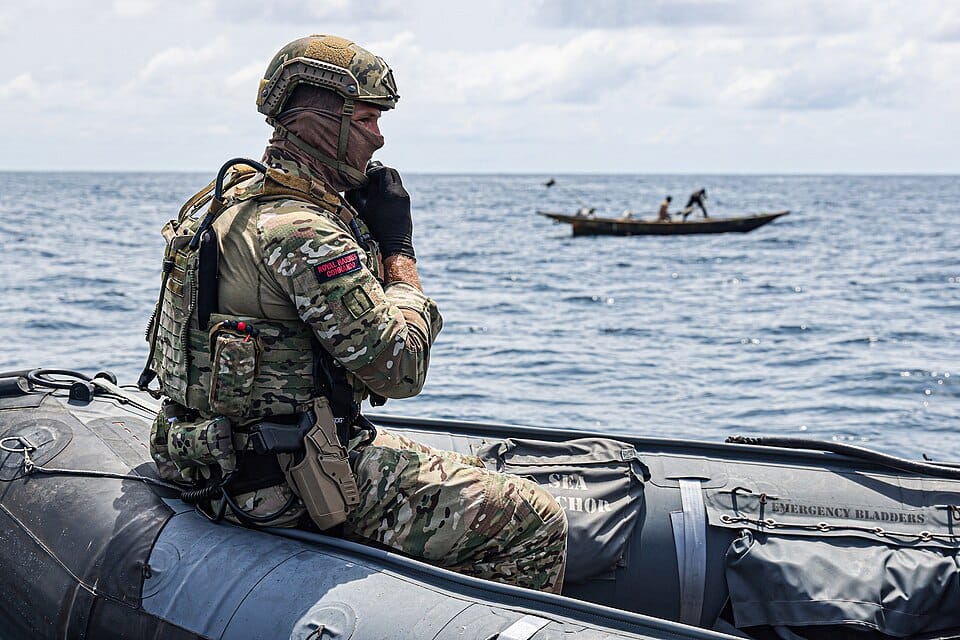
Royal Marines from 42 Commando — part of the newly renamed UK Commando Force, validated earlier this year as the Special Operations Maritime Task Group — fast-roped onto the tanker’s deck. NCA officers followed. The boarding was unopposed. The 25-member crew, a mix of Georgian and Indian nationals, offered no resistance. Within hours, investigators had the ship’s documents and the captain was under arrest on suspicion of sanctions offences.
The legal basis was simple but devastating: Cameroon had stripped the Smyrtos from its registry earlier in June, making the vessel effectively stateless. Under UNCLOS Article 110, any warship can board a stateless vessel in international waters. Once aboard, British law enforcement applied domestic sanctions regulations.
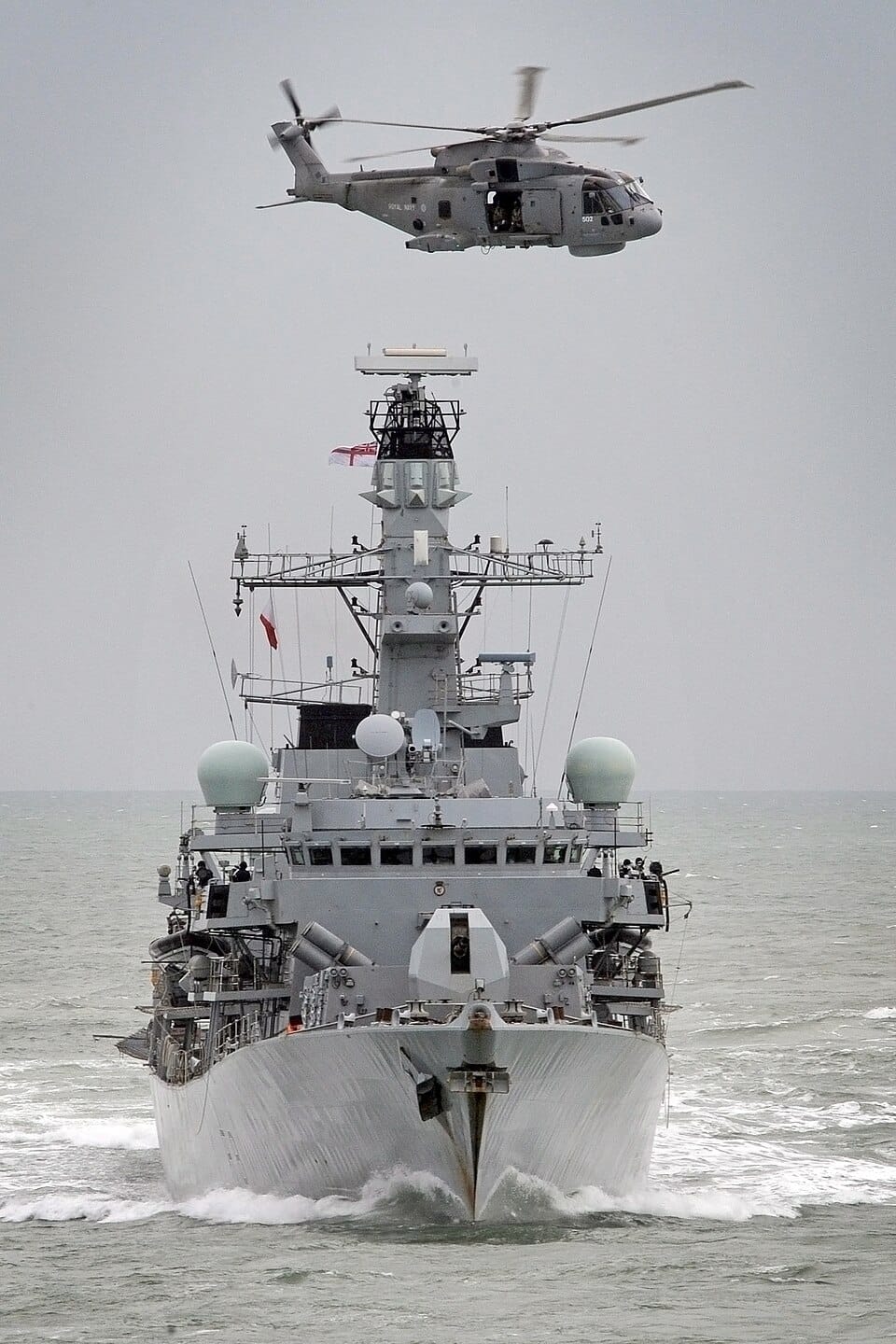
HMS Sutherland Stands Watch
HMS Sutherland (F81) with a Royal Navy Merlin helicopter overhead. Crown Copyright / Wikimedia Commons
By Sunday afternoon, the Smyrtos sat at anchor off Portland, watched by HMS Sutherland and NCA enforcement vessels Sentinel and Invictus. Navy Lookout captured photographs of the tanker riding low in the water — heavy with more than 100,000 tonnes of crude that would now go nowhere near Egypt.
For Defence Secretary Dan Jarvis, this was an introduction to the job measured in days. Jarvis — a former Parachute Regiment officer — had replaced John Healey just three days earlier after Healey resigned over defence spending. His first major operation as Defence Secretary could not have been more cinematic.
“Operations like this require skill, professionalism and courage,” Jarvis said. “Russia relies on its shadow fleet to fund their conflict in Ukraine and our interdiction delivers a blow to Putin’s illegal war.”
Starmer’s Message to Moscow
Prime Minister Keir Starmer framed the seizure in personal terms. “I directed our Armed Forces to intercept a shadow fleet oil tanker attempting to pass through the English Channel,” he said. “This successful operation delivers yet another blow to Russia and reminds those fueling Putin’s war in Ukraine that we will not let them hide.”
The timing was no accident. Starmer had authorised the military and law enforcement to intercept shadow fleet vessels in UK waters back in March 2026, ahead of the Joint Expeditionary Force summit in Helsinki. Three months passed before the first boarding. That it came the day before the G7 summit in Evian-les-Bains gave Starmer a concrete result to carry into the room.
Ukrainian President Volodymyr Zelensky responded within hours. “Oil must be stopped so that Russia’s war comes to a halt,” he wrote on social media. “Thank you, Britain.” He called the seizure “an important step” and urged Europe to pass legislation enabling not just detention but confiscation of shadow fleet cargoes.
The Shadow Fleet Problem
Russia’s shadow fleet is estimated at more than 700 vessels — an armada of aging, poorly insured tankers that carries roughly 75 percent of Russia’s sanctioned oil exports. Over 72 percent of these ships are more than 15 years old, and more than 50 safety incidents have been documented. The UK has sanctioned almost 600 of them.
But sanctioning a ship and stopping one are different things. Before the Smyrtos, the Western response to the shadow fleet had been largely administrative — designations on paper, port bans, insurance restrictions. The Channel boarding marks a shift from paperwork to physical interdiction.
Whether it becomes a pattern or stays a one-off spectacle for the G7 cameras depends on whether London, Paris, and their allies are willing to dedicate warships to a sustained campaign of maritime enforcement. The shadow fleet isn’t short of tankers. It’s short of consequences.
Sources: UK Ministry of Defence, Navy Lookout, UK Defence Journal, The Aviationist, Al Jazeera, CNN, PBS, Lloyd’s List
The U.S. Army and allies signed a joint statement at Eurosatory 2026 to pool drone and counter-drone marketplaces — a coordinated push against the swarm.



 English
0 Comments