
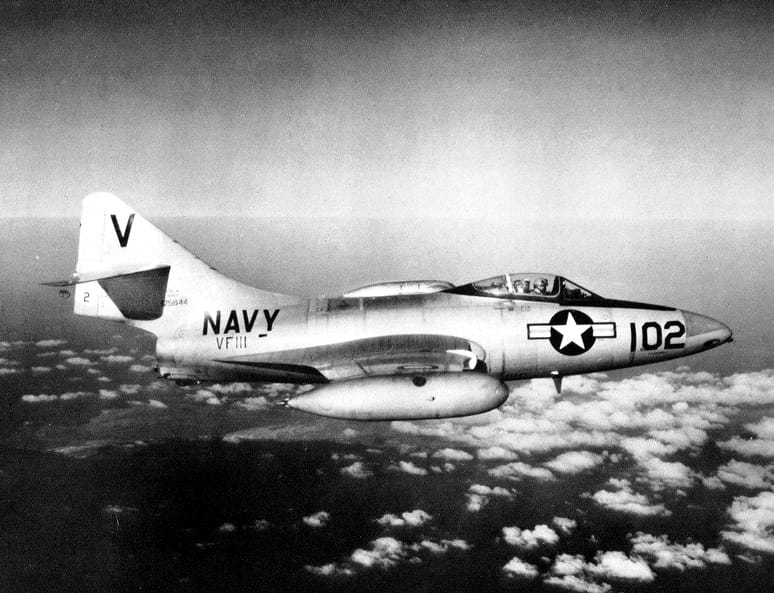
The blizzard came in off the Sea of Japan in sheets, and the flight deck of the USS Oriskany pitched in the grey November swell. It was 18 November 1952, and Lieutenant Royce Williams climbed into the cockpit of his Grumman F9F-5 Panther for his second mission of the day. He had no idea he was about to fly into the longest dogfight in U.S. Navy history — or that, when it was over, he would be sworn to a silence that lasted half a century.
Within the hour, Williams would be alone over the freezing ocean against seven Soviet MiG-15s. He would shoot down four of them, limp back to his carrier with a jet riddled by cannon fire, and then be ordered never to speak of it. Not to the press. Not to his fellow pilots. Not even to his wife.
For decades the most extraordinary single air battle of the Korean War simply did not exist. This is the story of the man who fought it, and the fifty years it took for the truth to come home.
Quick Facts
- Date: 18 November 1952, during the Korean War
- Pilot: Lt. (later Capt.) E. Royce Williams, VF-781
- Aircraft: Grumman F9F-5 Panther, flown from USS Oriskany (Task Force 77)
- The fight: One Panther vs. seven Soviet MiG-15s, roughly 35 minutes
- Result: Williams credited with downing four MiGs; his Panther took 263 holes
- Secrecy: Classified for ~50 years; records declassified in 2002
- Recognition: Silver Star (1953) → Navy Cross (2022/23) → Medal of Honor (24 Feb 2026)
A Scramble Into a Blizzard
Williams was no novice. By late 1952 he had already flown dozens of combat missions over Korea with Fighter Squadron 781, hammering bridges, trains and supply lines in the Panther — a sturdy straight-wing jet built more for hauling bombs than for turning with enemy fighters. On that second sortie of the day, his division of four launched into appalling weather.

The contacts were not the North Korean aircraft the Americans had expected. They were MiG-15s — and the men flying them were Soviet. Listeners aboard the task force, monitoring enemy radio traffic, heard Russian commanders order their pilots to engage. This was the Cold War turning briefly, terrifyingly hot.
As Williams’ flight bored up toward the seven MiGs, fate began thinning his odds. The division leader and his wingman were forced to turn back toward the carrier with a fuel-pump malfunction. Williams pressed on.
Alone Against Seven
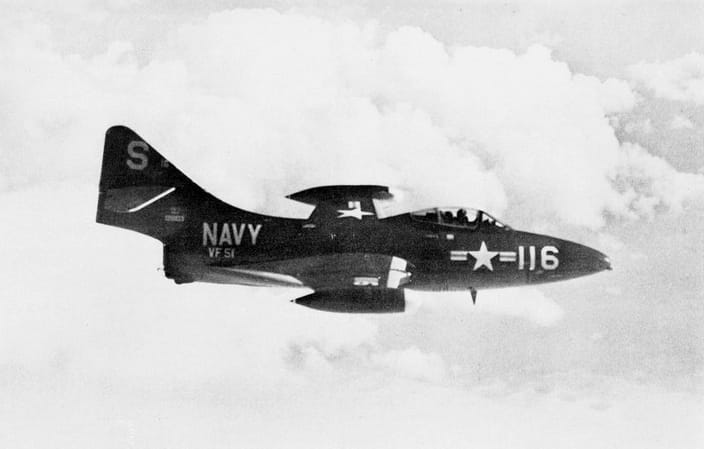
The first pass settled the matter. Williams hauled his Panther into a tight turn, slid onto the tail of a trailing MiG and fired. The Soviet jet went down. And then, as he later recalled, the last of his cover peeled away.
What followed was, by the reckoning of the U.S. Navy, the longest dogfight it has ever recorded: roughly 35 minutes of one man against many. The MiG-15 was faster, climbed harder and turned tighter than the Panther. By every measure on paper, Williams should have died in the first few minutes.
Instead he fought. The Soviet pilots stopped attacking in formation and began rolling in one at a time, taking turns — and that, paradoxically, gave Williams his chance. Each time a MiG committed to a firing pass, he met it head-on or twisted away and snapped back, his four 20mm cannon hammering whenever a target crossed his nose.
Seventy-four years later, the U.S. Navy itself would mark the moment publicly — recognition that, in 1952, was unthinkable:
Williams said he felt no terror, only an eerie composure as the fight stretched on and his fuel and ammunition drained away.
263 Holes and a Landing on the Edge
The MiGs did not leave him untouched. A 37mm cannon shell tore into the Panther, savaging its hydraulics and control response. When Williams finally counted the cost, his ground crew tallied 263 holes in the airframe. He thought about ejecting — and then thought about the freezing winter sea below, where a parachute would have meant a slow death by hypothermia. He decided to ride the wreck home.
Nursing a barely controllable jet, he circled the Oriskany for some ten minutes while the deck was cleared, then lined up far faster than any safe approach allowed. The landing signal officer’s warning carried over the wind: “He’s coming in hot.” He caught a wire. The aircraft was so badly mauled that, by some accounts, it never flew again and was pushed over the side.
The animation studio Yarnhub reconstructed the entire engagement — a useful way to grasp just how lopsided the geometry of this fight was:
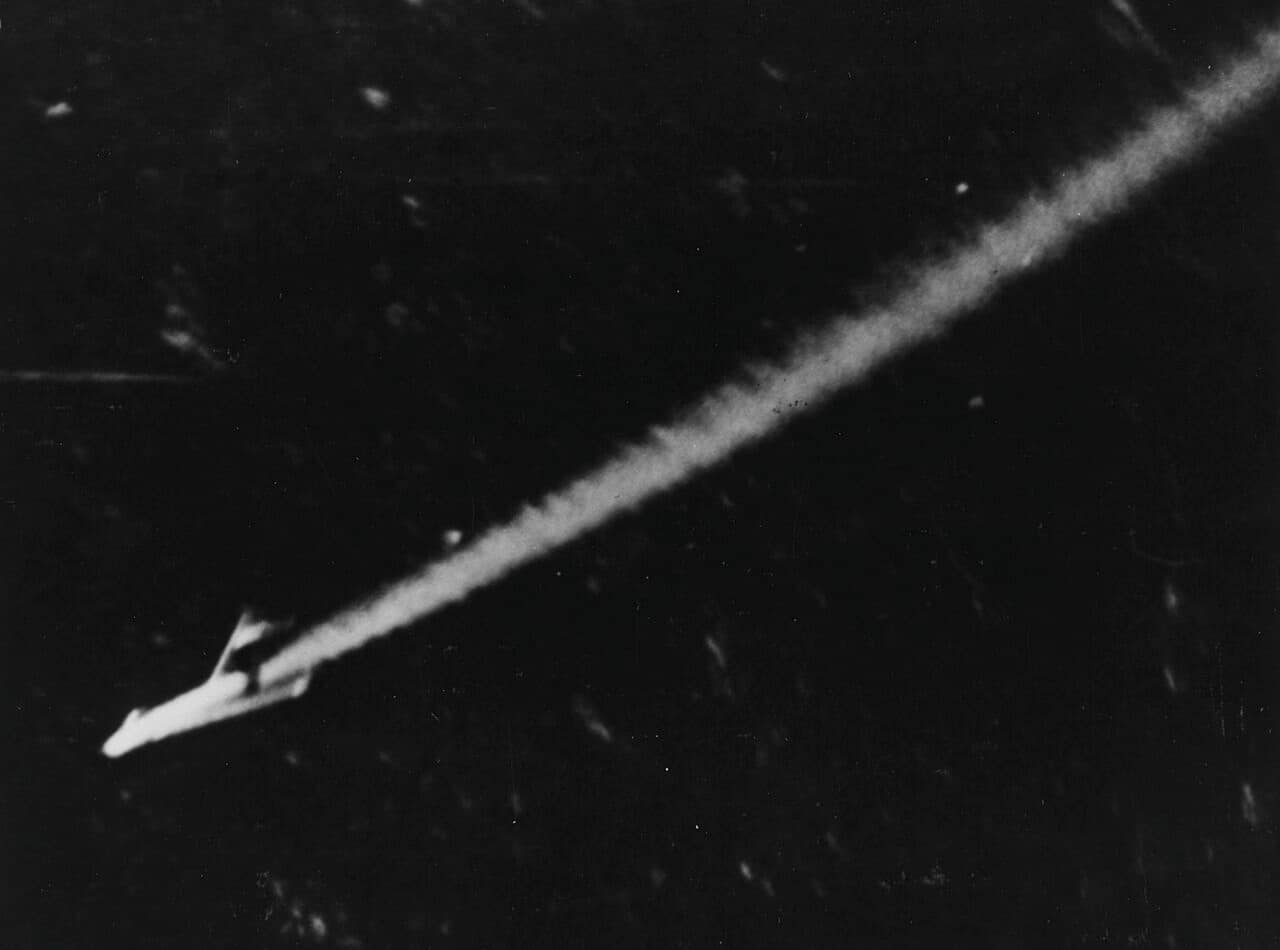
A MiG-15 streaming smoke as it falls — the fate Williams dealt four times that morning — was an almost mythical sight for U.S. Navy pilots in 1952, when official records insisted the Navy had downed nothing at all:
The Order of Silence
Back aboard, Williams expected a debrief. He got an interrogation. Admirals questioned him. So did the Secretary of Defense. Weeks later, the newly inaugurated President Dwight Eisenhower wanted to hear it firsthand. Their conclusion was stark: this could not become public.
The reason was the calendar of the Cold War. The Soviet Union was not officially a combatant in Korea. An air battle in which an American shot down four Soviet pilots — and in which U.S. forces had been reading Soviet communications — risked dragging Moscow openly into the war, or worse. The engagement was scrubbed from Navy and National Security Agency records. Williams’ own citation credited him with a single kill against an unnamed enemy.
He kept the vow completely. He told no one — not his pilot brother, not his wife — for the better part of fifty years. The story survived only in two places: the memory of one man, and the archives of his enemy.
The Truth Comes Home
After the Soviet Union collapsed in 1991, Russian records began to surface. A Russian account eventually named the Soviet Naval Aviation pilots involved and confirmed the staggering arithmetic: of the MiGs sent up that day, only one returned. In 2002, U.S. Korean War records were declassified, and Williams’ secret slowly became sayable.
Even then, he assumed the world had moved on.
His friends disagreed. A small group of retired officers spent years pressing the Navy to recognise what he had done. The historian Thomas McKelvey Cleaver, in his account of Task Force 77’s air war, did not hedge: he wrote that on that day Williams “became the top-scoring carrier-based naval aviator… of the ‘forgotten war,’” having “accomplished what no other American fighter pilot would ever accomplish: shoot down four MiG-15s in one fight.”
Among those who lobbied and celebrated were fellow naval aviators, including Senator Mark Kelly, himself a former Navy combat pilot:
The Navy upgraded his Silver Star to the Navy Cross in late 2022, presented in San Diego in January 2023. But his champions were not finished.
For the wider arc of the battle and its decades of secrecy, The History Guy tells it well:
A Medal, Seventy-Four Years Late
On 24 February 2026, in front of a joint session of Congress at the State of the Union address, the silence ended for good. First Lady Melania Trump fastened the Medal of Honor — the nation’s highest decoration — around the neck of a 100-year-old retired captain. With it, Williams became the last living Korean War recipient of the medal.
It is worth being precise about the numbers, because Williams’ own story always has been. At the time, U.S. records credited him with just one kill. Today the Navy and his Medal of Honor narrative credit him with multiple MiGs destroyed in the engagement; the widely cited figure — supported by the Soviet records showing only one of the attacking MiGs returned — is four. Whatever the exact tally, the essential fact is unchallenged: one man, one Panther, against a flight of Soviet jets, and he came home.
For half a century, the U.S. Navy’s greatest solo air battle was a ghost — unrecorded, unrewarded, unspoken. Royce Williams carried it alone, the way he flew it. The remarkable thing is not only that he survived 18 November 1952. It is that he kept his word about it for fifty years, and lived long enough to finally hear his country say it out loud.
Sources: Wikipedia (“Royce Williams”); CalMatters (Deborah Brennan, March 2026); CNN (Brad Lendon, Jan 2023); Task & Purpose (Max Hauptman, 2022); U.S. Navy press release (Dec 2022); Thomas McKelvey Cleaver, Holding the Line: The Naval Air Campaign in Korea.

 English
0 Comments