

On a September morning in 1962, the air traffic controllers at Van Nuys Airport made a phone call. They told the local police and fire departments to stand by. Out on the ramp sat the most absurd aeroplane anyone there had ever seen — a Boeing airliner whose entire upper body had been blown up like a balloon, a swollen silver sausage on spindly landing gear. Nobody seriously believed it would fly. Then it did.
That grotesque machine was the Aero Spacelines Pregnant Guppy, and within a decade its even bigger descendants would be hauling the rockets that took Americans to the Moon. The Guppies looked like a joke. They turned out to be one of the most important pieces of equipment in the entire Apollo programme — and one of them, against all odds, is still flying for NASA today.
This is the story of the flying whales: how a barnstorming pilot mortgaged his house to build an impossible aeroplane, why NASA could not have won the Space Race without it, and how a 1960s oddity quietly fathered the Airbus Beluga and the Boeing Dreamlifter.
Quick Facts — The Aero Spacelines Guppies
- Builder: Aero Spacelines, Inc. (founded by John M. “Jack” Conroy, 1961)
- Based on: surplus Boeing 377 Stratocruiser / C-97 Stratofreighter airframes
- Pregnant Guppy: first flight 19 September 1962; 4 × Pratt & Whitney R-4360 Wasp Major radial pistons
- Super Guppy: first flight 1965; 4 × Pratt & Whitney T34 turboprops
- Super Guppy Turbine (SGT): 4 × Allison 501-D22C turboprops (civil version of the T56)
- Cargo bay (Super Guppy): roughly 25 ft (7.6 m) in diameter — loaded through a hinged nose that swings open 110°
- Famous payloads: Saturn S-IV and S-IVB stages, instrument units, Apollo and Skylab hardware
- Still flying: NASA Super Guppy Turbine N941NA, based at El Paso, Texas
A Rocket Too Big for Any Road
By 1960, NASA had a logistics nightmare. The rocket stages that would carry astronauts toward the Moon were being built on the West Coast, but they had to reach the launch sites in Florida. These stages were enormous — far too wide for any railway tunnel, road bridge or low power line. The only option was to float them by barge through the Panama Canal or around the Gulf of Mexico, a journey that swallowed weeks.
Weeks were exactly what NASA did not have. President Kennedy had promised a Moon landing before the end of the decade, and every delay in moving hardware threatened to push a launch date. The agency needed to fly the stages — but no aircraft on Earth had a fuselage wide enough to swallow one.
Enter Jack Conroy. A former World War II bomber pilot who had survived a German prisoner-of-war camp and later set flight records in the Air National Guard, Conroy heard about NASA’s problem and had a wild idea. His friend, aircraft broker Lee Mansdorf, was sitting on a stockpile of surplus Boeing 377 Stratocruisers — obsolete piston airliners that the jet age had made worthless. What if you cut one open and grafted on a vast, ballooned cargo hull?

When Conroy showed his sketches to NASA, an official remarked that the bloated thing looked like a pregnant guppy. The name stuck. The agency was lukewarm at first, so Conroy did something faintly insane: he mortgaged his own house to fund the conversion and founded Aero Spacelines to build it.
The Pregnant Guppy Takes Flight
The Pregnant Guppy first flew on 19 September 1962, with Conroy in the left seat and test pilot Clay Lacy alongside him. Powered by four Pratt & Whitney R-4360 Wasp Major radial engines — the largest-displacement piston aero-engine ever mass-produced in America — the converted Stratocruiser lumbered into the sky and, to everyone’s astonishment, handled cleanly.
A year later it began flying NASA cargo for real. The payoff was staggering. A rocket stage that had taken roughly 18 to 25 days to crawl across the water by barge could now reach Cape Canaveral in well under a day. NASA had bought back weeks of schedule on the most time-critical programme in its history.
The man who ran the rocket programme noticed. The Pregnant Guppy was demonstrated to Wernher von Braun at the Marshall Space Flight Center, and his verdict was unequivocal.
Bigger, Bulbous-er: The Super Guppy
One Guppy was not enough. As Apollo scaled up, NASA needed to move the much larger S-IVB stage — the upper stage used on both the Saturn IB and the mighty Saturn V. So Aero Spacelines went bigger still. The Super Guppy, which first flew in 1965, had a wider fuselage, a taller tail and more powerful Pratt & Whitney T34 turboprops in place of the thirsty radials.
Its cargo bay was a cathedral of empty air: around 25 feet across. To load it, engineers did something gloriously theatrical — instead of a rear door, the entire nose of the aircraft, cockpit and all, swings open on a hinge to a yawning 110 degrees. Drive the rocket stage straight in through the front, swing the nose shut, and fly.
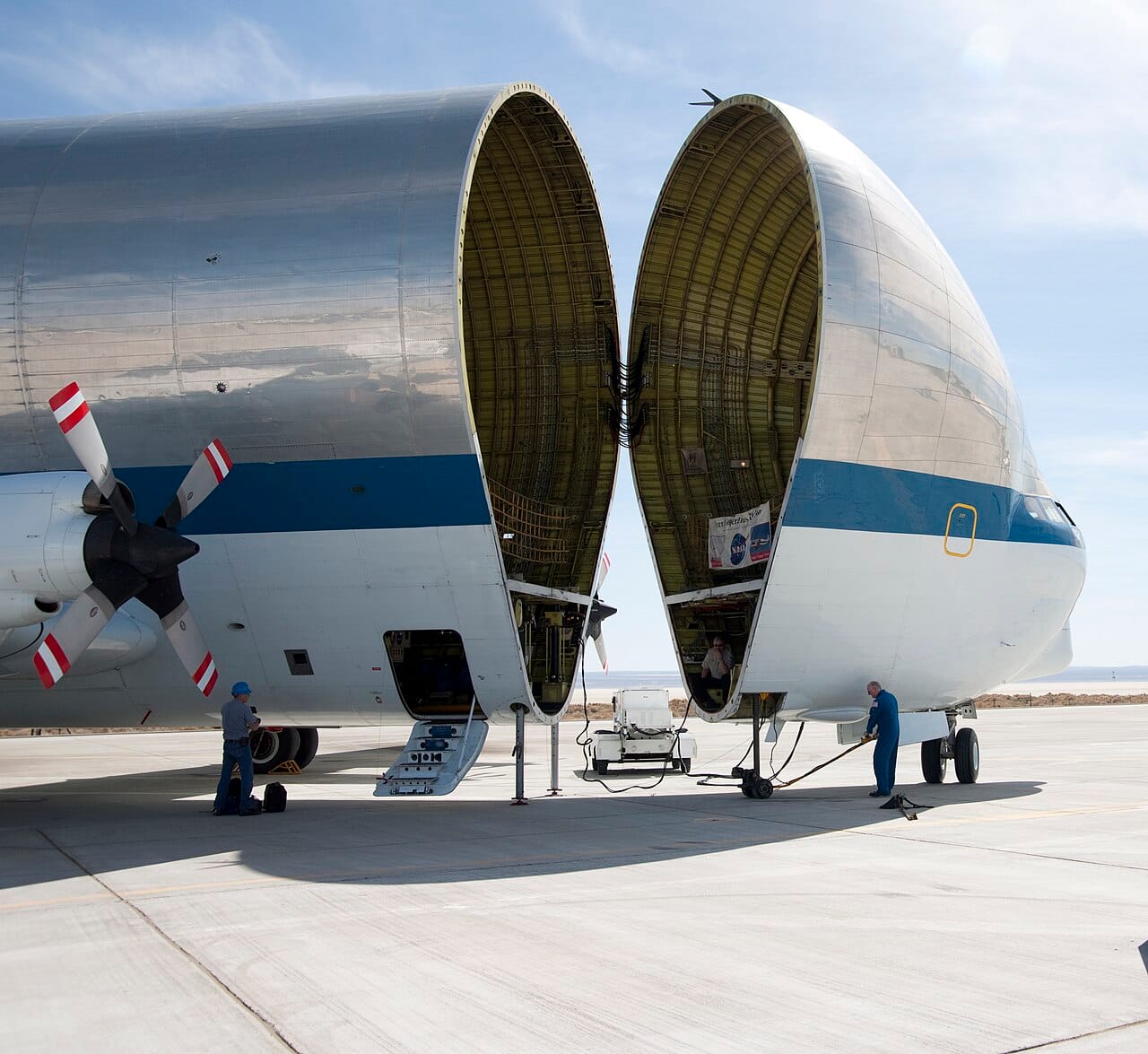
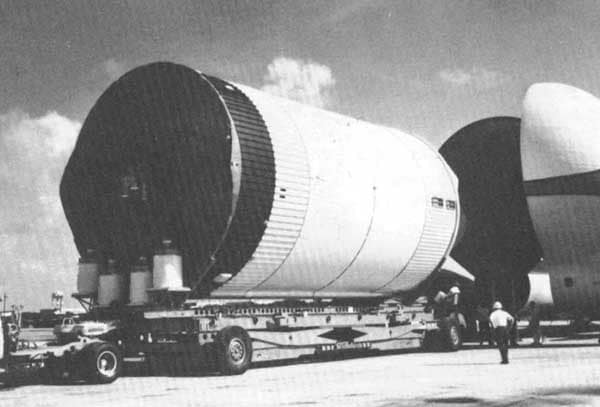
The Super Guppy became the only aircraft ever to carry a complete S-IVB stage, doing so repeatedly through the busiest years of Apollo. During the closely packed Saturn IB and Saturn V launch schedule of 1966–67, it shuttled stages and their instrument units around the country, keeping the assembly lines fed. Move the hardware by air, and a launch that might otherwise have slipped could stay on the calendar.
The scale only really lands when you see one in person. This walkaround captures just how vast — and how strange — the aircraft is up close.
It Looked Impossible. It Worked Anyway.
To the people of Goleta, California — where Aero Spacelines later built its hangars — the Guppies were a beloved local spectacle. Residents recall watching the swollen aircraft heave themselves into the air and willing them upward, certain that something that shape simply could not stay aloft. It always did.
That is the central paradox of the Guppy. Aerodynamically it should have been a disaster: a fragile, bulging hull bolted onto a 1940s airframe. Yet the family worked well enough to underpin the most demanding aerospace effort in history. Conroy went on to build a stretched Super Guppy Turbine line; the final SGT variant swapped to Allison 501-D22C turboprops — the civil version of the C-130’s T56 — for reliability and parts commonality.
Even now, decades later, the sight of a Guppy on final approach still stops people in their tracks — including the airports that host it.
The Whale That Refused to Die
Aero Spacelines is long gone, and most of the Guppies are in museums. But the breed is not extinct. Airbus acquired the manufacturing rights and built Super Guppy Turbines to ferry airliner fuselage sections around Europe through the 1970s, 80s and 90s. When Airbus retired its fleet, NASA acquired one — SGT number four, registration N941NA — under a barter arrangement tied to the International Space Station.
That aircraft is still on the books. Based at El Paso, Texas, NASA’s Super Guppy Turbine remains the agency’s go-to for cargo nothing else can swallow — in recent years carrying Orion spacecraft components and Space Launch System hardware for the Artemis Moon programme, the spiritual heir to the very Apollo missions it was born to serve.
NASA’s own look inside the aircraft shows how the modern Guppy still earns its keep moving space hardware around the country.
And when it flies, it is still an event. A rare landing of the last airworthy Super Guppy draws crowds the way few cargo aircraft ever could.
From Pregnant Guppy to Beluga and Dreamlifter
The Guppy did more than haul rockets — it proved a concept. Before Conroy, the idea of an aircraft built specifically to swallow outsize but lightweight cargo through a balloon-shaped fuselage was untested. Afterward, it was obvious.

The jet-powered Airbus Beluga and the Boeing 747 Dreamlifter both owe their basic shape and purpose to the Guppy. Each carries enormous aircraft sections between far-flung factories, and each wears the same grinning, bulbous profile that once made air traffic controllers reach for the phone. The joke aeroplane became an entire genre.
Not bad for a 1940s airliner that a former POW blew up like a balloon on a mortgaged house and a hunch. The Guppies looked impossible. They built the road to the Moon — and one of them is still flying it.
Sources: NASA Aircraft Operations (Johnson Space Center); Aero Spacelines Super Guppy and Pregnant Guppy entries, Wikipedia; John M. Conroy biography, Wikipedia; Smithsonian National Air and Space Museum; Goleta History (Tom Modugno); CNN Travel; Digital Trends.
Related Questions
What was the Aero Spacelines Guppy?
The Aero Spacelines Guppy was a series of enormous, balloon-bodied cargo aircraft built in the 1960s to carry oversized loads. Created by Aero Spacelines, founded by pilot Jack Conroy in 1961, they were converted from surplus Boeing 377 Stratocruiser and C-97 airframes with hugely swollen fuselages.
What were the Guppy planes used for?
The Guppies were built to transport outsized cargo that would not fit in normal aircraft — most famously the giant rocket stages of NASA's Apollo Moon programme. Their ballooned fuselages could swallow components that otherwise had to travel slowly by sea or road.
How did the Guppy help the Apollo program?
The Guppies flew Apollo rocket stages and other bulky components between contractors and NASA sites in hours instead of the weeks a sea voyage took. This air bridge helped keep the Moon programme on schedule, making the odd-looking aircraft one of Apollo's most important tools.
Is the Super Guppy still flying?
Yes. One Super Guppy Turbine remains in service with NASA today, still hauling outsized space hardware. It is the last airworthy survivor of the Guppy family that began with the Pregnant Guppy in 1962.
When did the first Guppy fly?
The original Pregnant Guppy made its first flight on 19 September 1962, powered by four Pratt & Whitney R-4360 Wasp Major radial engines. Many doubted the bloated machine could fly at all — but it did, and bigger turboprop-powered versions followed.
How big is the Super Guppy's cargo hold?
The Super Guppy's cargo bay is roughly 25 feet (7.6 m) in diameter, loaded through a hinged nose that swings open so outsized items can be slid straight in. That cavernous interior is what let it carry rocket stages and other giant components.
Who built the Guppy aircraft?
They were built by Aero Spacelines, a company founded in 1961 by former barnstormer and pilot John "Jack" Conroy. He converted surplus Boeing 377 Stratocruiser and C-97 airframes into the swollen Guppies, betting that NASA would need a way to fly outsized cargo.


0 Comments