
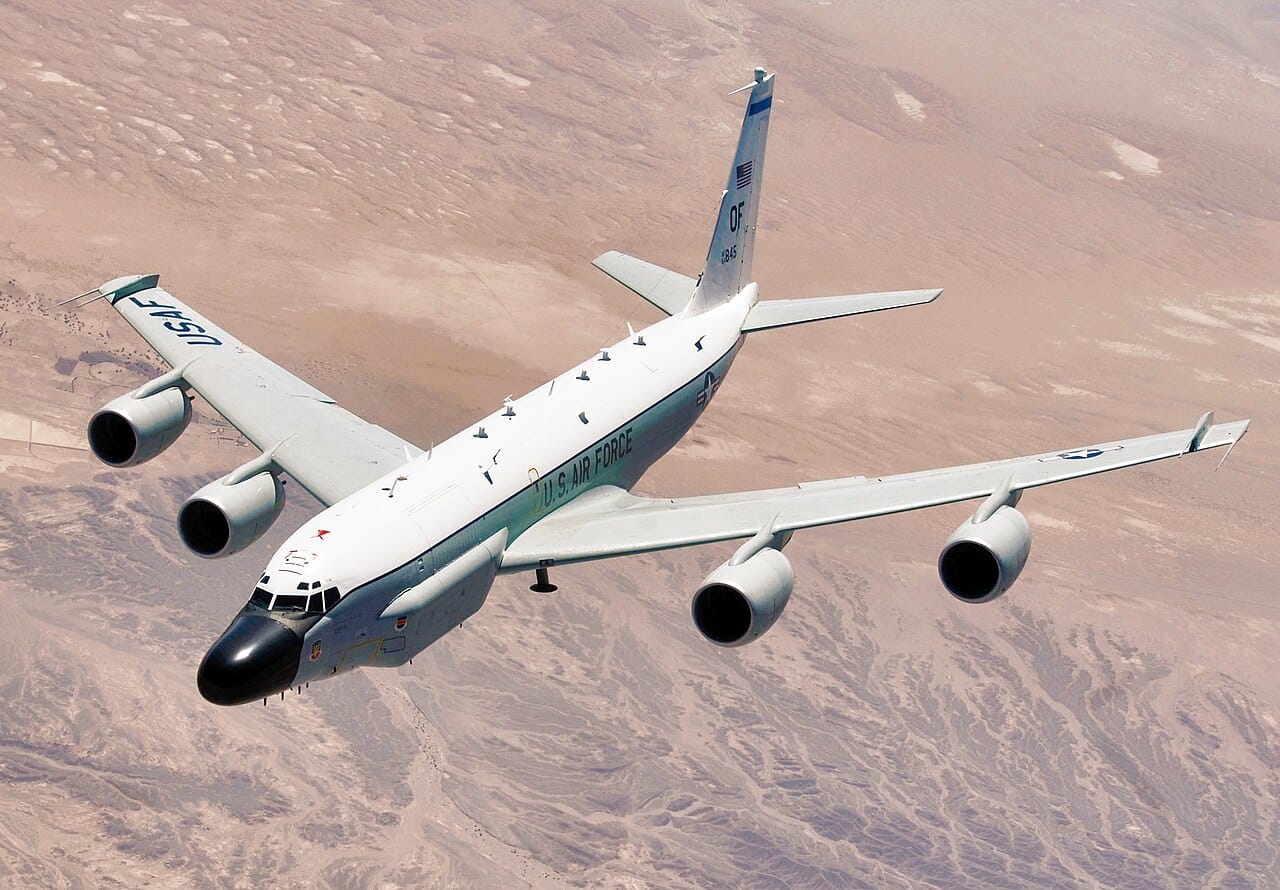
The Su-35 came so close that the autopilot gave up. Six metres from the nose of a Royal Air Force Rivet Joint cruising over the Black Sea in international airspace, the British jet’s emergency alerts started screaming and the autopilot cut itself out. The crew of 51 Squadron took the controls manually and finished the mission.
On 20 May 2026, the UK Ministry of Defence finally went public with what its surveillance crews had endured in April. Multiple intercepts. Su-27 Flankers. Su-35 Flanker-Es. One pass after another, well inside the “professional” envelope NATO expects of nuclear-armed neighbours. UK Defence Secretary John Healey called it “dangerous and unacceptable” — and the MoD described it as the most dangerous Russian intercept of a British aircraft since 2022.
Quick Facts
Aircraft intercepted: RAF RC-135W Rivet Joint, 51 Squadron, RAF Waddington
Russian aircraft: Su-35 Flanker-E (RF-81718) and Su-27 Flanker
Closest pass: Six metres from the RC-135 nose
Effect: Triggered emergency alerts, disabled autopilot
Number of passes: Su-27 made six passes between 6 and 15 metres
When: April 2026, made public 20 May 2026
Su-35 payload: Air-to-air missiles plus a single Kh-31 (AS-17 Krypton) anti-ship missile
Last comparable incident: September 2022 — Russian Su-27 fired two air-to-air missiles at RAF Rivet Joint (both missed)
A six-metre gap and a triggered autopilot
The numbers are what give it away. A modern fighter intercept is an established choreography: the interceptor closes to perhaps 30-50 metres, flies parallel for a moment, then peels off. It is the visual equivalent of a polite warning. Six metres is something else entirely. At cruise speed — roughly 800 km/h — six metres is the difference between a controlled intercept and a mid-air collision that would kill the roughly 30 RAF personnel aboard and turn a SIGINT sortie into the first NATO-Russia loss-of-life incident in three decades.

The Su-35 in question is one British and American crews have met before. Tail number RF-81718 was part of the formation that escorted two Tu-95 Bear bombers into the Alaskan Air Defence Identification Zone in February 2025, where Eielson-based USAF F-35As intercepted it. Same airframe, same pilot pool, same theatrics — now transplanted to the Black Sea with a Kh-31 anti-ship missile slung underneath as an unsubtle reminder of what the jet can do.
The 2022 incident that almost started a war
To understand why six metres matters, you have to remember September 2022. Over almost exactly the same patch of sea, a Russian Su-27 pilot fired two air-to-air missiles at a Royal Air Force Rivet Joint. Neither hit. The first missile, the UK government initially claimed, was a “technical malfunction.” Then leaked Russian radio chatter revealed the real story: a confused Russian pilot believed he had been cleared to engage. His wingman screamed at him. He fired anyway. The second missile he ditched into the sea.
That incident very nearly became NATO’s first combat loss to Russia in the post-Soviet era. The British government chose not to escalate publicly at the time — and Russian pilots seem to have read that restraint as licence. Since 2022, RAF Rivet Joints over the Black Sea have flown with Typhoon escort, sometimes joined by French Rafales. The intercepts have continued anyway.

Why the RC-135 is over the Black Sea in the first place
The RC-135W Rivet Joint is not a weapon. It carries no armament. What it does carry is a fuselage stuffed with antennas, signals processing equipment, and Russian-speaking operators who can pull radar emissions, voice communications, and electronic order-of-battle data out of the air over thousands of kilometres. From cruise altitude over the Black Sea, an RC-135 can listen deep into both Russia and Ukraine simultaneously — and the intelligence it generates feeds NATO targeting cells, Ukrainian air defence batteries, and Whitehall ministerial briefings.
The RAF operates three Rivet Joints, all based at 51 Squadron in RAF Waddington. They entered service in 2014 as a like-for-like replacement for the Nimrod R1, retired in 2011 after nearly four decades of service. The fleet is so closely integrated with the US Air Force’s larger RC-135 force that the British jets receive upgrades in Greenville, Texas, on the same production line as their American counterparts.

The Kh-31 detail nobody missed
Aviation watchers latched onto one specific feature of the Su-35 photographs released by the UK MoD: under the Russian fighter’s wing sat a single Kh-31 missile. The Kh-31 — NATO codename AS-17 “Krypton” — is a Mach 3.5 anti-ship missile originally designed to punch through the Aegis air defence systems of US Navy carrier groups. Carrying one on a Black Sea air-defence patrol is unusual. Carrying it during a close intercept of a NATO ISR aircraft is a message.
The message reads: this jet can engage surface targets, this jet is configured for offensive action, and this jet is choosing to fly six metres from your nose while loaded. Whether that signal was authorised at Kremlin level or improvised at squadron level remains unclear. Either reading is concerning.
What happens next
The UK has formally protested through the Russian embassy in London — the same diplomatic channel used after the 2022 incident, with similarly little visible effect. RAF Rivet Joint sorties will continue. So will the Typhoon escorts. France will likely keep contributing Rafales on a rotating basis. The US Air Force’s MQ-9 Reaper drones — one of which was already brought down by a Russian Su-27 over the same patch of sea in March 2023 — will keep flying their parallel orbits.
What is missing is any apparent Russian intent to de-escalate. The intercepts are getting closer, not further apart. The next six-metre pass may be the one that puts a Russian fighter wingtip into an RAF Rivet Joint fuselage. After that, nobody knows what comes next — and that is precisely the problem.
Watch: archival footage of a Russian Su-27 / RAF Rivet Joint intercept over the Black Sea, showing how close these encounters routinely get.
Sources: UK Ministry of Defence; The Aviationist; UK Defence Journal; The War Zone; Crown Copyright imagery 2026.

 English
Do you honestly expect anyone to believe that a Su-27 fired two air-to-air missiles at a KC-135 in September and missed with both of them? That a slow, fat target like the KC-135 could be missed not once, but twice, requires more than a suspension of disbelief. It requires an absence of critical reasoning altogether. Save the BS for bed-time stories with your children.