
For three consecutive days last week, two of America’s most secretive flying laboratories circled over the Gulf of Mexico in tight formation — and the aviation intelligence community is buzzing about what they were testing.
Northrop Grumman’s heavily modified CRJ-700, registered as N806X and flying under the callsign SCAN 06, arrived at Eglin Air Force Base on March 23. It was joined by Raytheon’s equally mysterious Boeing 727, registration N289MT, known by its radio callsign VOODOO 1. For the next three days, the two aircraft flew coordinated missions inside restricted airspace over the Gulf.
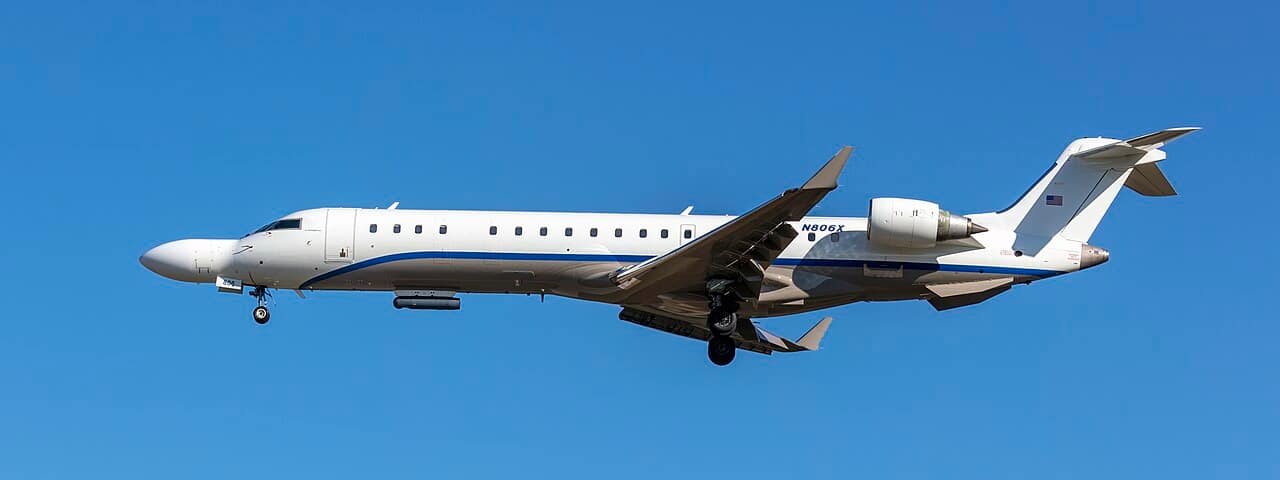
Two Airborne Labs, One Mission
SCAN 06 is one of three CRJ-700s that Northrop Grumman operates out of Baltimore-Washington International Airport. All three have been extensively modified to carry advanced sensors and communications systems — testing them in the air before they’re integrated into frontline combat jets. The aircraft are covered in unusual antennas and fairings that hint at electronic warfare and radar capabilities far beyond anything a regional jet was designed to carry.
VOODOO 1 is even more intriguing. Raytheon’s 727 testbed sports a radome shaped like the nose of an F-15 Eagle — purpose-built for flight-testing advanced fighter radars at scale. The aircraft has been a key player in the development of next-generation air-to-air radar technology for years, and its presence at Eglin alongside the Northrop Grumman platform suggests a rare joint test involving sensors from both defence giants.
Flower Patterns Over the Gulf
Flight tracking data revealed a fascinating picture. SCAN 06 operated at around 27,000 feet inside the W-151 restricted area, flying a distinctive flower-shaped pattern often associated with sensor calibration runs. VOODOO 1 held slightly higher at roughly 27,850 feet. The synchronised orbits over three days point to a methodical integration exercise — the kind of testing you do when you’re trying to make two different sensor systems talk to each other.
Eglin is the natural home for this kind of work. The base hosts the Air Force’s premier weapons testing range, and its restricted airspace over the Gulf of Mexico offers vast, sensor-instrumented corridors where classified programmes can operate away from prying eyes — though not, it turns out, from flight-tracking enthusiasts.
What Were They Testing?
Neither Northrop Grumman nor Raytheon has commented on the flights. But the combination of a next-generation radar testbed and an advanced sensor platform flying calibration patterns together narrows the possibilities. The most likely candidates include integration testing for the AIM-260 Joint Advanced Tactical Missile’s seeker, next-generation electronic warfare suites, or advanced sensor fusion technology destined for sixth-generation fighter programmes.
Whatever the payload, watching two of America’s most secretive test aircraft operate in concert is a rare glimpse behind the curtain of the military-industrial machine — and a reminder that the weapons shaping the next air war are being born right now, over the warm waters of the Gulf.
Sources: The Aviationist; Air & Space Forces Magazine
 English